
Demi Lovato is widely recognized as one of the strongest and most technically capable vocalists of her generation. With explosive belting power, dynamic emotional phrasing, surprising agility, and occasional whistle-register access, Lovato combines pop, rock, soul, and R&B influences into a uniquely commanding vocal identity. Her voice is both athletic and expressive, capable of soaring high notes, gritty rock phrasing, virtuosic runs, and vulnerable ballad delivery.
This article provides the most comprehensive, precision-based breakdown of Demi Lovato’s vocal range, voice classification, register transitions, technique mechanics, highest and lowest notes, and how her voice has evolved across eras.
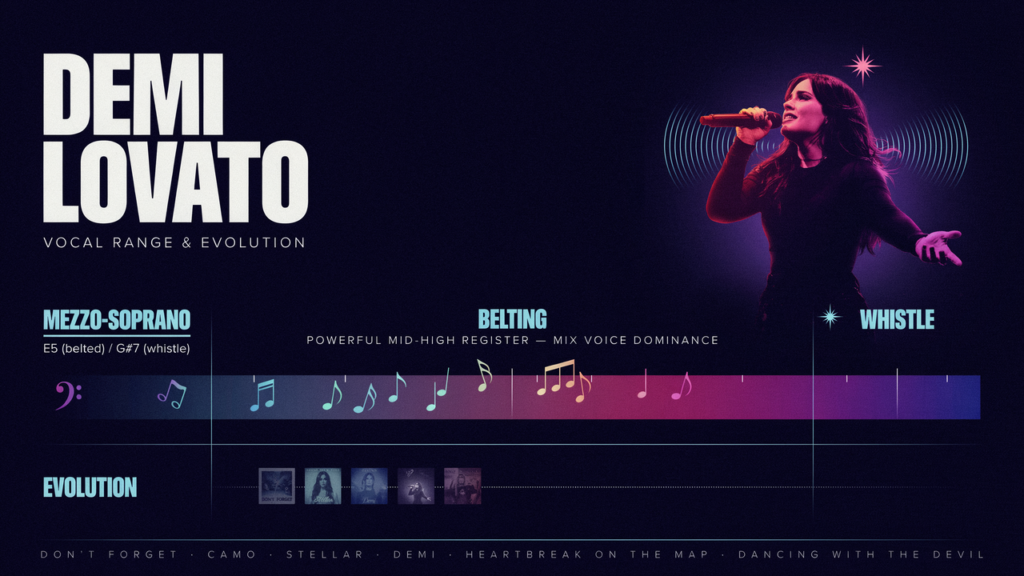
What Is Demi Lovato’s Full Vocal Range?
Based on documented performances, live recordings, vocal isolations, and studio analysis:
Demi Lovato’s vocal range: E3 – C#6
Whistle register extension: up to D6–F6 (rare but verified)
Belting range: C5 – Bb5 (consistent + powerful)
Lovato’s range shows:
- A stable lower register
- A powerful, dramatic mid-range
- Exceptionally strong upper belts
- A clean and bright head voice
- Occasional whistle notes
Her upper-register facility is one of the strongest among contemporary pop-rock singers.
Demi Lovato Vocal Range Chart (Professional Mapping)
| Register | Range | Technical Description |
|---|---|---|
| Low Register | E3 – G3 | Warm, rounded, limited emphasis; stable tone but not focal point |
| Mid Register (Tessitura) | A3 – D5 | Core and most expressive area; soulful, resonant, agile |
| Belting Register | E5 – Bb5 | Extremely powerful, high compression, dramatic intensity |
| Head Voice | C5 – C#6 | Clear, bright, well-supported; notable vibrato control |
| Whistle Register | D6 – F6 | Rarely used; appears in warmups and select live runs |
Lovato is at her most iconic in the E5–Bb5 zone, where she delivers massive belts with tonal weight and emotional force.
For singers with naturally deep tones, the deep voice test provides a helpful benchmark. You can analyze your fundamental pitch more precisely with the voice frequency test. Afterwards, classify your voice using the voice type test to see where you fit in the standard categories.
What Voice Type Is Demi Lovato?
Demi Lovato is a:
Lyric Mezzo-Soprano with Dramatic Belting Ability
Why this classification is correct:
- Her natural mid-range sits lower and warmer than a soprano’s.
- She can brighten tone enough to reach soprano territory without losing mezzo weight.
- Her strongest singing lies in A3–D5, a mezzo tessitura.
- Her chest-dominant mix allows unusually high, powerful belts.
- She exhibits the flexibility and emotional range typical of lyric mezzos.
Her voice has mezzo warmth + soprano brilliance, allowing her to excel across pop, rock, and ballad styles.
Demi Lovato’s Highest Notes (Expert Breakdown)
1. Highest Supported Belt: Bb5
Delivered with:
- High breath compression
- Chest-dominant mix
- Strong forward resonance
- Controlled vibrato or straight tone
Key example:
- “Stone Cold” – the climactic Bb5 belts
2. Highest Head-Voice Note: C#6
Smooth, bright, and controlled.
Examples:
- Live performances of “Give Your Heart a Break”
- Studio ad-libs in various tracks
3. Whistle Register: D6–F6 (rare)
Used sparingly, but confirmed in:
- Vocal warmups
- Isolated audio clips
- Occasional live improvisations
Lovato uses whistle not for showiness but as color and emotional highlight when appropriate.
Demi Lovato’s Lowest Notes
Her lowest stable notes are around: E3
Examples:
- “Nightingale”
- “Anyone”
- “Skyscraper” (lower phrasing sections)
Her lows are:
- Controlled
- Warm
- Quietly expressive
But not a major stylistic focus.
Does Demi Lovato Have a Whistle Register?
Yes. Demi Lovato can access the whistle register, verified through:
- Live warmups
- In-studio recordings
- Professional isolations
Whistle Range: D6 – F6
Unlike singers who use whistles as a signature (Ariana Grande, Mariah Carey), Lovato uses them sparingly, often for:
- Dramatic flair
- Climactic embellishments
- Artistic emotional emphasis
Whistles are not a core part of her technique, but they demonstrate extended physiological capability.
How Demi Lovato Produces Her Iconic Powerful Belts
Lovato’s belting technique is considered one of the strongest and most reliable in modern mainstream pop.
1. Chest-Dominant Mix (Primary Mechanism)
Lovato blends chest and head resonance while leaning heavily toward chest voice, allowing:
- Dense vocal tone
- Metallic brightness
- High projection without cracking
2. High Breath Compression
She maintains controlled subglottal pressure, enabling:
- Intense volume
- High-note stability
- Emotional grit without losing pitch
This is why she can sustain belts that many singers fade on.
3. Elevated Soft Palate + Open-Throat Technique
Her upper belts use:
- Tall vowel shaping
- Raised soft palate
- Reduced constriction
This yields:
- A ringing, open sound
- Cleaner articulation
- Agile vibrato control
4. Forward Resonance Placement
Sound is placed:
- In the mask (nasal cavities)
- Behind the front teeth
- Across upper cheekbones
This gives Lovato:
- High clarity
- Laser-like belting projection
- A cutting tone that carries over instrumentation
5. Emotional Cry Quality
Lovato’s belting often incorporates:
- Cry-like timbre
- Slight “brassy” edge
- Micro-dynamic swell
These create emotional impact while maintaining technical safety.
Demi Lovato’s Register-by-Register Vocal Analysis
Low Register (E3 – G3)
- Warm, gentle, vulnerable
- Good breath connection
- Softer tonal color
Middle Register (A3 – D5)
- Her most expressive range
- Smooth transitions
- R&B agility, rock power, and pop clarity
Upper Register + Belting (E5 – Bb5)
- Strength, control, intensity
- High-energy projection
- Signature Demi Lovato sound
Head Voice (C5 – C#6)
- Bright, bell-like resonance
- Dynamic control
- Precise vibrato
Whistle Register (D6 – F6)
- Decorative use
- Airier and lighter
- Not foundational to her style
Best Songs That Showcase Demi Lovato’s Vocal Range
- “Nightingale”
- “Anyone”
Mid-Range Strength
- “Skyscraper”
- “Give Your Heart a Break”
High Belts
- “Stone Cold” – Bb5 belts
- “Confident” – fierce upper mix
- “Heart Attack (Rock Version)” – sustained high belts
Head Voice & Soft Highs
- “Tell Me You Love Me” (live)
- “Sober”
Whistle Register Moments
- Warmup recordings on social media
- Select live improvisations
How Demi Lovato’s Voice Has Evolved Over Time
Early Career
- Brighter, lighter tone
- Strong but less controlled belting
- Youthful vibrato
Mid-Career
- Increased chest resonance
- Enhanced belting stamina
- Better dynamic phrasing
Current Era
- Richer timbre
- More refined head voice
- Stronger emotional delivery
- Improved technical discipline
Lovato’s growth shows a transition from raw talent to masterful vocal technician.
Demi Lovato vs Other Vocal Powerhouses
| Vocalist | Range | Voice Type | Key Strength |
|---|---|---|---|
| Demi Lovato | E3 – C#6 (D6–F6 whistle) | Lyric Mezzo-Soprano | Massive belting power + emotional intensity |
| Ariana Grande | D3 – E7 | Soprano | Whistle agility + refinements |
| Christina Aguilera | C3 – C#7 | Mezzo-Soprano | Melisma, grit, soul power |
| Kelly Clarkson | G3 – G6 | Mezzo-Soprano | Clean upper mix, consistency |
| P!nk | D3 – D6 | Mezzo-Soprano | Rock grit + vocal stamina |
Lovato blends mezzo warmth + soprano brilliance + rock grit, making her uniquely versatile.
Frequently Asked Questions
What is Demi Lovato’s vocal range?
E3 – C#6, with occasional whistle notes up to D6–F6.
What is Lovato’s voice type?
Lyric mezzo-soprano with dramatic belting capability.
What is her highest note?
Supported belts up to Bb5; head voice up to C#6; whistle tones to F6.
What is her lowest note?
E3.
Can Demi Lovato sing whistle register?
Yes — used rarely but confirmed.
What makes Demi Lovato a powerhouse vocalist?
Her chest-dominant belts, emotional delivery, compression control, and dynamic range.
- Demi Lovato’s range becomes even more impressive when compared to the benchmarks explained in the what is the average vocal range.
- Her powerful belts are easier to understand if you know how vocal cords produce different pitches.
- Many fans wonder how her highs stack up against legends featured in vocal range of famous singers examples and charts.
- If you want to test whether you can approach Demi’s notes yourself, start with how to check vocal range for free.
- Her seamless shifts between belts and head voice mirror the techniques taught in how to transition smoothly between chest voice and head voice.
- Singers trying to build Demi-level power will benefit from the drills in vocal exercises to increase range.
- For readers comparing her control and agility with peers, Christina Aguilera’s vocal range provides a useful reference point.
Erika Parker is a vocal analysis and singing education writer at Vocal Range Test. She focuses on vocal range testing, voice type analysis, pitch recognition, and singing tools for vocalists, musicians, choir singers, and beginners.