
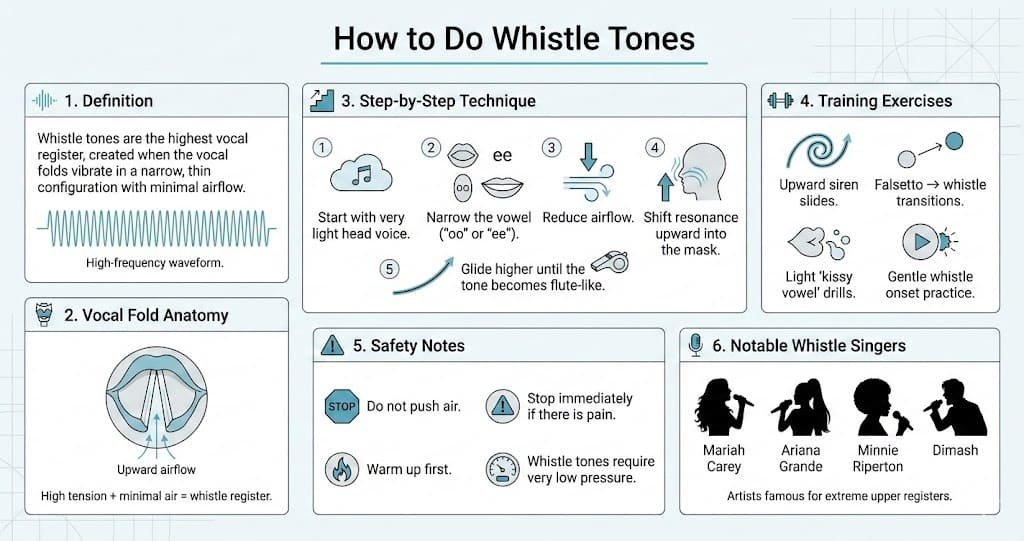
Learning how to do whistle tones (also called whistle register) is a goal for many singers who admire high-range artists like Mariah Carey, Ariana Grande, Dimash, and Minnie Riperton.
Although the whistle register is the highest part of the human voice, it is not rare—most singers can learn it with correct technique and safe training.
This guide provides a complete, structured method for accessing whistle tones safely and developing long-term control.
What Are Whistle Tones? (Accurate Vocal Science)
Whistle tones are extremely high-frequency pitches produced when the front edges of the vocal folds come together and vibrate in a very small contact area.
This coordination creates a bright, whistle-like sound that sits above head voice and falsetto.
Characteristics
- Pitch range typically C6–G7+
- Bright, pure, flute-like quality
- Very small airflow requirement
- Minimal vibration or chest sensation
- Naturally soft volume
Who Can Produce Whistle Tones?
Most singers can develop whistle tones regardless of:
- Gender
- Vocal type
- Experience
The determining factor is technique, not genetics.
Safety Checklist Before Practicing Whistle Register
- Warm up for 3–5 minutes
- Hydrate your voice
- Use gentle airflow
- Do not force volume
- Stop immediately if you feel tightness or sharp pain
Whistle tones require precision, not power.
How to Do Whistle Tones: Step-by-Step Method
Step 1: Start in Your Lightest Head Voice
Use a soft “hoo” or “hee” to slide to the highest comfortable note.
You should feel:
- No throat tension
- A light, airy sound
- Resonance above the soft palate or in the top of the head
This prepares the folds for whistle onset.
Step 2: Create a Narrow Vocal Tract Shape
Whistle tones require a small resonating space.
Try:
- “Ooh” shape — rounded lips, small opening
- “Ee” shape — narrow, high tongue
- Pursed lips — gently blowing on warm soup
This narrowing helps create the acoustic tube necessary for whistle resonance.
Step 3: Use Minimal Airflow
This is the most important step.
Too much air will cause cracking, squeaking, or no sound.
Use extremely gentle airflow, similar to:
- Fogging a mirror
- Lightly blowing on glass
- Whispering softly
Controlled airflow is essential.
Step 4: Slide Up Until You Hear a “Click”
Perform a smooth siren on “hoo” or “hee.”
At a certain point, your voice may flip into a tiny, bright pitch.
This flip indicates the whistle register has activated.
Step 5: Use the Puppy-Whimper Technique
Produce a very soft, high-pitched:
“ee-ee-ee” or “peep-peep-peep.”
This method:
- Thins the vocal folds
- Encourages correct airflow
- Helps beginners find whistle placement quickly
It is one of the simplest ways to trigger whistle tones.
Step 6: Stabilize the Whistle Tone
Once the whistle onset appears:
- Keep airflow soft
- Maintain a narrow lip shape
- Keep the tongue high and forward
- Hold the note for half a second to one second
Sustaining comes with practice.
Strengthening breath control becomes easier by following the Breathing Techniques for Singing guide and combining it with routines like the Daily Vocal Warm-Up. You can also enhance high-note stability using tips from the High Notes Singing guide and track your vocal progress with the Vocal Range Test.
Top Whistle Tone Exercises
1. Light Sirens
Slide from head voice into whistle register smoothly.
2. Squeaky Door Exercise
Create a tiny “eeeek” sound to encourage epiglottic narrowing.
3. Straw Phonation Slides
Perform high slides through a straw to reduce tension and regulate airflow.
4. Staccato Whistle Pops
Short “peep-peep-peep” notes to build agility and onset control.
5. Octave Leaps
Jump from a high head voice note into a whistle tone to train placement.
Whistle Register Anatomy Explained
Whistle register occurs because:
- The vocal folds close at a very small anterior point
- The epilarynx narrows, increasing air pressure efficiency
- Only a tiny portion of the folds vibrate
- Resonance occurs in a very small acoustic chamber
This produces frequencies far above normal singing range.
Common Problems and How to Fix Them
Too Much Air
Reduce airflow. Whistle tones require very small amounts.
Throat Tension
Stop immediately and reset your posture and vowel shape.
Wrong Vowel Shape
Switch to “ee” or “oo” to narrow the vocal tract.
Lack of Warm-Up
Always warm up lightly before attempting high-frequency phonation.
Expecting Loud Notes
Whistle notes are naturally soft at first. Power develops later.
Is the Whistle Register Safe?
Yes, when done correctly.
Unsafe whistle attempts typically involve:
- Forcing volume
- Excessive airflow
- Constricting the throat
- Singing when fatigued
Using proper technique prevents strain and irritation.
Advanced Whistle Techniques (For Experienced Singers)
Controlled Whistle Onsets
Trigger whistle tones without sliding into them.
Whistle Runs
Perform riffs and melismas in whistle register.
Belt-to-Whistle Transition
Move rapidly between mixed/belt voice and whistle register.
Whistle Sustain Development
Improve airflow efficiency to hold whistle notes longer.
Resonance Tuning
Use subtle tongue and soft palate adjustments for clarity.
Frequently Asked Questions
Can everyone learn whistle tones?
Most singers can, with correct technique and consistent practice.
Are whistle tones easier for females?
They may feel more accessible due to habitual high resonance use, but all genders can produce them.
How long does it take to learn?
Anywhere from a few days to several months depending on coordination and training frequency.
Do whistle notes damage the voice?
Not when executed correctly. Incorrect technique can irritate the folds.
Why does my voice crack when trying to whistle-sing?
This is usually from excess airflow or tension.
What range does the whistle register cover?
Typically C6 and above, extending to G7 or higher in advanced singers.
Conclusion
Whistle tones are not reserved for elite singers.
With the right combination of:
- Light head-voice setup
- Narrow vowel shaping
- Minimal airflow
- Targeted exercises
- Vocal awareness
…most singers can activate and master the whistle register safely.
Just tell me.