
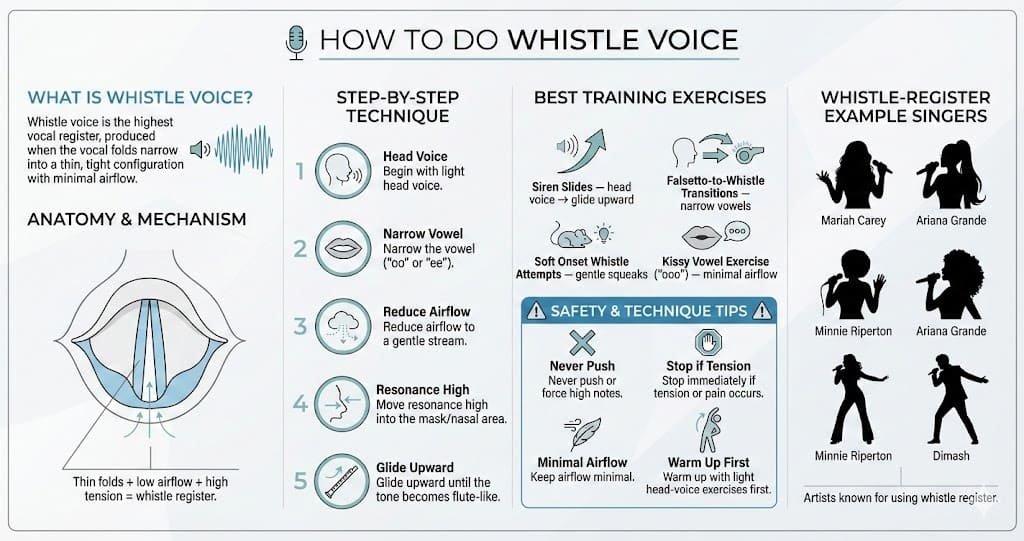
The whistle voice—also called the whistle register—is the highest vocal register a human can produce. It creates extremely high, flute-like pitches similar to those used by Mariah Carey, Ariana Grande, Dimash, and Minnie Riperton.
Although whistle voice can seem difficult or “genetic,” most people can learn it with the right technique, proper airflow, and progressive exercises. This guide provides a fully optimized, expert-level, science-backed tutorial to help you develop whistle voice safely and effectively.
What Is Whistle Voice?
Whistle voice is a specialized vocal register produced when only the front edges of the vocal folds make contact, allowing a very small portion of the folds to vibrate. This coordination creates a high-frequency, whistle-like sound that sits above both head voice and falsetto.
Key Characteristics
- Pitches typically start at C6 and can extend above G7
- Extremely bright, pure, and flute-like tone
- Minimal airflow required
- Very little physical vibration felt in the throat or chest
- Naturally soft at first, strengthened over time
Who Can Learn It?
Anybody with healthy vocal folds can learn whistle voice, regardless of:
- Gender
- Vocal type
- Age
- Experience
Technique—not genetics—is the deciding factor.
For singers working to refine tone clarity, breath control is essential, making the breathing techniques for singing guide a critical resource. Once your airflow is stable, try exercises from high notes singing to strengthen your upper register. You can then test resonance and clarity using the AI voice analysis tool and confirm improvements with the vocal range test.
How to Do Whistle Voice: Step-by-Step Method
This is the most effective and widely validated method for safely accessing whistle register.
Step 1: Begin in Your Lightest Head Voice
Start with a gentle “hoo” or “hee” in head voice and move upward to your highest comfortable pitch.
You should feel:
- A light, floating tone
- No tension
- Minimal volume
- Resonance high in the head
This prepares the folds by thinning them out before entering whistle register.
Step 2: Shape a Narrow Resonating Space
Whistle voice requires a small acoustic chamber.
Use one of the following shapes:
- A rounded “ooh”
- A narrow “ee”
- Slightly forward, pursed lips
The narrowing helps focus the vibration into the high-frequency whistle range.
Step 3: Use Minimal Airflow
This is the most important whistle technique.
Correct airflow feels like:
- Lightly fogging a mirror
- Very soft exhalation
- Controlled, steady airflow
Too much airflow will cause:
- Cracking
- Air-only sound
- Throat tightness
- Failure to reach whistle tone
Step 4: Slide Up Until the Whistle “Flip” Occurs
Perform slow sirens on “hoo,” “hee,” or “mm.”
At a certain pitch, your voice may suddenly flip into a bright, tiny, whistle-like note.
This flip indicates:
- Correct fold closure
- Narrowed vocal tract
- Whistle onset
The first flip is your access point to whistle register.
Step 5: Use the Puppy-Whimper Exercise (High Success Rate)
Make a soft, squeaky: “ee-ee-ee” or “peep-peep-peep”
This exercise works because it:
- Activates edge-only vibration
- Naturally narrows the vocal tract
- Eliminates excess airflow
- Helps beginners find whistle placement quickly
It is one of the fastest methods to trigger whistle voice.
Step 6: Stabilize the Note
Once you hit a whistle note:
- Maintain minimal airflow
- Avoid increasing volume
- Keep the lips narrow
- Hold for half a second to one second
With training, you’ll gain strength, clarity, and sustain.
Best Exercises to Train Whistle Voice
1. Light Sirens (Head → Whistle Transition)
Promotes smooth coordination and helps you locate the whistle flip.
2. Squeaky Door Technique
Produces a tiny “eeeek” sound, encouraging epilaryngeal narrowing.
3. Straw Phonation
Perform high slides through a thin straw to reduce tension and regulate airflow.
4. Staccato Whistle Pops
Short “peep” sounds that develop agility, accuracy, and onset control.
5. Octave Leaps into Whistle
Jump from a high head-note directly into whistle register to build placement memory.
Understanding the Anatomy Behind Whistle Voice
Whistle register occurs due to a unique combination of anatomical settings:
1. Minimal Vocal Fold Contact
Only the front edges touch, allowing high-frequency vibration.
2. Epilaryngeal Tube Narrowing
The area above the vocal folds tightens slightly, increasing air pressure and resonance focus.
3. Small Resonance Chamber
Sound is channeled through a compact acoustic space, forming the whistle quality.
4. Low Airflow Requirement
Very little air is needed—excess air disrupts vibration.
Understanding these mechanisms significantly improves technique, safety, and control.
Common Mistakes and How to Fix Them
Mistake: Only air comes out
Cause: Too much airflow
Fix: Lower breath pressure and switch to “ee” vowel.
Mistake: Voice cracks when sliding up
Cause: Misaligned fold tension
Fix: Use slower sirens and straw-phonation warm-ups.
Mistake: Throat feels tight
Cause: Laryngeal constriction
Fix: Relax jaw, avoid forcing, use narrow vowels.
Mistake: Whistle tones happen inconsistently
Cause: Poor placement memory
Fix: Repeat puppy-whimper and staccato drills daily.
Is Whistle Voice Safe?
Whistle voice is safe when:
- Airflow is minimal
- Tension is avoided
- Warm-ups are performed
- Volume is not forced
It becomes unsafe when:
- Singers push for loudness
- Air pressure is excessive
- The throat squeezes
Practiced gently, whistle register does not damage the voice.
Advanced Whistle Voice Techniques
Controlled Whistle Onsets
Trigger whistle voice without sliding for precise note attacks.
Whistle Runs (Melismas)
Develop small interval agility inside whistle register.
Belt-to-Whistle Transitions
Used in pop, R&B, and dramatic vocal styling.
Whistle Sustain Development
Strengthen airflow control to hold whistle notes longer.
Resonance Tuning
Refine tone quality by adjusting tongue position, lip shape, and soft palate.
Frequently Asked Questions
Can everyone learn whistle voice?
Most healthy voices can learn whistle with proper technique.
Do men also have whistle register?
Yes. Men can access whistle register just like women.
How long does it take to learn?
Anywhere from a few days to several months depending on vocal coordination.
Why does my throat hurt when I try whistle voice?
This indicates tension or too much air pressure.
What notes belong to whistle register?
Typically C6 and above, though advanced singers may reach G7–C8.
Is whistle voice the same as flageolet?
They are closely related; flageolet is a subtype of extremely high-frequency phonation.