
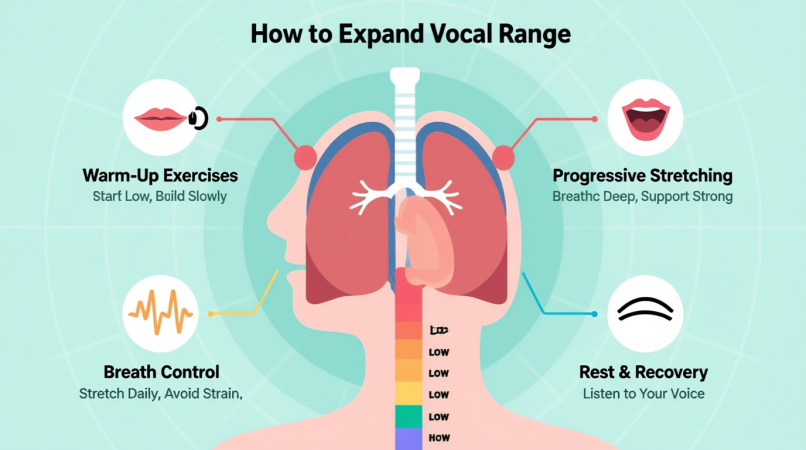
You can expand your vocal range by combining proper warm-ups, breath support, and targeted exercises for both higher and lower notes. Progress takes consistent practice, but most singers can add several notes to their range safely over time.
Why Expanding Your Vocal Range Matters
A wider range opens up more possibilities:
- You can sing songs comfortably across styles.
- High and low notes feel less strained.
- You gain control, flexibility, and confidence.
While some singers dream of hitting extreme highs or earth-shaking lows, the goal isn’t only about adding octaves. It’s about building a voice that feels strong, expressive, and sustainable.
Use this singing range tool to see how your voice compares to others.
The Foundations of Range Expansion
Before adding new notes, strengthen the basics:
- Breath support: Use diaphragmatic breathing to control airflow.
- Posture: Keep your body aligned so your lungs and vocal cords can work freely.
- Warm-ups: Gentle humming, lip trills, and sirens prepare your voice for safe stretching.
Think of these as your “gym warm-up” before lifting heavier weights.
Step-by-Step Guide to Expanding Vocal Range
1. Start with Warm-Ups
Always warm up before testing limits. Try:
- Humming scales
- Lip trills (blowing air through relaxed lips)
- Sirens (gliding smoothly up and down your voice)
2. Build High Notes Gradually
- Use light sounds like “ng” or “ee” vowels.
- Work into your head voice and mixed voice.
- Add one semitone at a time instead of jumping too high.
3. Strengthen Low Notes
- Relax and use more chest resonance.
- Try gentle humming downward into your lowest note.
- Speak low phrases before singing them.
4. Explore Your Tessitura
Your tessitura is the sweet spot where your voice sounds best. Expanding your range is exciting, but singing comfortably in your tessitura is what makes your voice shine.
5. Track Your Progress
Write down your lowest and highest notes each week. Tools like an online vocal range calculator can help you visualize improvement.
Example of a 7-Day Training Plan
| Day | Focus | Exercise Example |
|---|---|---|
| 1 | Warm-up + posture | Lip trills, sirens |
| 2 | High notes | “ng” slides upward |
| 3 | Low notes | Humming scales downward |
| 4 | Rest or light hum | Gentle hums only |
| 5 | High + mixed | Octave jumps |
| 6 | Low strengthening | “mum” slides down |
| 7 | Review | Record and measure range |
Vocal Health Tips
- Hydrate: Drink water before and after singing.
- Don’t force: If it hurts, stop immediately.
- Rest: Just like athletes, singers need recovery days.
- Coach check: If possible, get feedback from a vocal teacher to avoid strain.
FAQs
How long does it take to expand vocal range?
With consistent training, many singers notice improvements within weeks, though full results take months.
Can anyone develop a 4-octave range?
Not realistically. Genetics play a role, but almost everyone can expand beyond their starting range.
Does age affect vocal range?
Yes. Younger singers often have more flexibility, while older singers may notice a drop in upper notes.
Should I count falsetto or whistle notes?
Yes, but treat them as part of your extended range, separate from your main singing voice.
What’s more important, range or tessitura?
Tessitura—where your voice feels natural and expressive—matters more for real-world singing.