
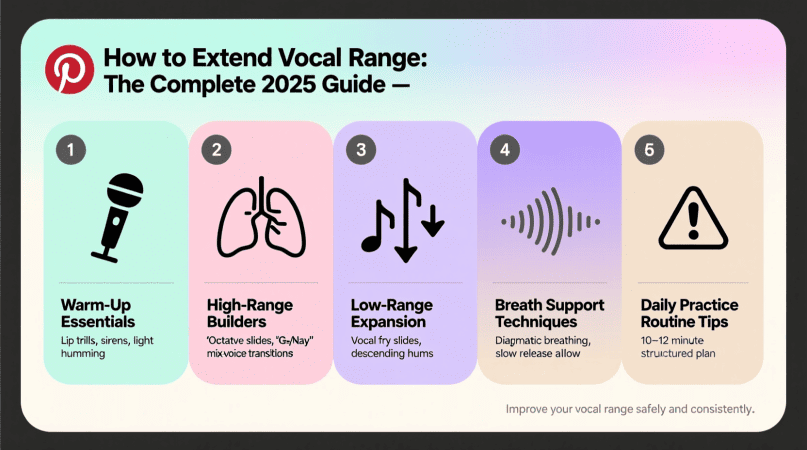
Extending your vocal range is one of the most transformative skills for singers. Whether your goal is to sing higher notes, strengthen your low register, or gain more power and control, range expansion comes from precision training, not force.
This guide provides a comprehensive, evidence-based approach to expanding your range safely and effectively, with techniques used by professional vocal coaches and supported by vocal science.
Understanding Vocal Range and Why It Expands
Your vocal range is determined by the highest and lowest pitches you can produce with controlled, healthy phonation.
Range is influenced by:
- Vocal fold length, mass, and elasticity
- Laryngeal tilt and muscular coordination
- Breath management and subglottal pressure
- Shape and tuning of the vocal tract (resonance)
- Register transitions (chest, mix, head, falsetto)
Although anatomy sets your foundational potential, training enhances flexibility, efficiency, and coordination, allowing you to access pitches previously unavailable.
Range expands through:
- Reduced tension
- Improved resonance strategies
- Stronger engagement of pitch-controlling muscles (CT/TA)
- Balanced airflow and breath support
If you’re curious about how well the platform works, you can read genuine feedback on the testimonials page while exploring tools like the Vocal Range Test and the Deep Voice Test. Many singers also mention how the Vocal Range Improvement Plan helped them progress, giving you a realistic idea of what to expect.
What Usually Limits Your Vocal Range
Common limitations include:
- Excess throat and neck tension
- Overdominance of chest voice at high pitches
- Weak head voice development
- Poor breath control
- Tight jaw or tongue position
- Inconsistent warm-up routines
- Fear or hesitation at high notes (psychological barrier)
Most singers plateau because they rely on brute force instead of proper coordination.
How to Extend Your Vocal Range Safely
Vocal range extends when efficiency increases. That means less effort, more resonance, and better coordination.
1. Warm Up With Flexibility-Based Exercises
The vocal folds must be warmed before stretching. Focus on gentle, tension-free activation.
Effective Warm-Up Routines:
- Lip trills
- Light humming (closed-mouth resonance)
- Gentle five-note scales
- Sliding “ng” resonance patterns
These wake up the vocal folds, prepare the respiratory system, and establish stable airflow.
2. Strengthen Your Head Voice to Access Higher Notes
Head voice development is essential for upward range extension. High notes become accessible when the cricothyroid muscle can lengthen the folds without resistance.
Essential Head Voice Exercises:
- Soft “woo” glides into upper range
- Falsetto → head voice blending drills
- Light sirens using “oo” or “ee”
- “Nay-nay-nay” bright forward resonance drills (for mix activation)
Why this works:
Head voice balances vocal fold tension and prevents the “pushed chest voice” that causes cracking or strain.
3. Strengthen Your Chest Voice to Extend Low Notes
Low-range development requires stability, depth, and gentle thickening of vocal folds.
Effective Chest Voice Exercises:
- Descending “gee” patterns
- Low “uh” slides
- Controlled vocal fry → tone transitions
- Speaking-range strengthening with supported airflow
Why this works:
These exercises increase the TA (thyroarytenoid) muscle’s control, creating a richer and more stable low end.
4. Develop Mixed Voice for Smooth Register Transitions
A strong mixed voice eliminates the “break” between chest and head voice—crucial for a wider range.
Mixed Voice Training:
- “Mum-mum-mum” in a speech-like tone
- Scales passing through the passaggio
- Resonance-forward “ng → vowel” transitions
- Octave leaps focusing on mid-register stability
Why this works:
Mix voice blends register qualities, allowing you to rise higher without strain and descend lower without losing clarity.
5. Use Flexibility and Stretching Exercises to Expand Total Range
Dynamic sliding exercises help stretch the voice safely.
Recommended Range-Stretching Exercises:
- Full sirens (low → high → low)
- Octave leaps on open vowels
- Yawn-sighs to release laryngeal tension
- SOVT (semi-occluded vocal tract) exercises such as:
- Straw phonation
- Lip bubbles
- Voiced fricatives (“vvv,” “zzz”)
Why this works:
SOVT exercises reduce collision force on the vocal folds, improving efficiency and expanding range without strain.
Daily Practice Routine to Extend Vocal Range
A consistent routine produces measurable improvement.
Step-by-step daily plan:
- Warm-Up (5 minutes)
Lip trills, hums, “ng” slides - Head Voice + Mix Training (10 minutes)
Sirens, bright “nay,” octave leaps - Chest Voice Conditioning (5 minutes)
Descending “gee,” fry-to-tone - Range Expansion Exercises (5 minutes)
SOVT drills, full sirens - Cool Down (2 minutes)
Gentle hum, soft airflow exercises
Total time: 27–30 minutes
Consistency > duration.
How Long It Takes to Extend Vocal Range
Expected progress timeline:
- 2–3 weeks: smoother transitions, fewer cracks
- 4–8 weeks: increased comfort in new pitches
- 3–6 months: noticeable range expansion
- 6–12 months: stable, long-term extension
Rate of progress varies based on technique, genetics, vocal health, and practice frequency.
Mistakes That Prevent Range Growth
Avoid:
- Forcing chest voice too high
- Singing with raised shoulders or tense posture
- Tightening the tongue or jaw
- Overblowing air on high notes
- Skipping warm-ups
- Practicing high notes when fatigued
- Belting without mix support
Efficiency—not volume—is what extends range.
Measure Your Current Range Before Training
Understanding your starting point helps you:
- Choose appropriate exercises
- Track progress over time
- Identify weak registers
- Determine your voice type
Use the Vocal Range Test to measure:
- Lowest controlled note
- Highest controlled note
- Register balance
- Resonance tendencies
This creates a personalized roadmap for range growth.
Frequently Asked Questions
Can anyone extend their vocal range?
Most people can increase their usable range with correct technique and consistent training.
Do I need head voice to sing higher notes?
Yes. High notes rely on head voice or mixed voice—not chest voice.
How often should I practice?
Daily or near-daily practice produces the most consistent progress.
Why do I crack between registers?
Weak mix voice and incorrect breath support cause instability at the passaggio.
Is vocal fry helpful for extending low range?
When used correctly, it improves vocal fold closure and enhances low resonance.
Can overtraining damage my voice?
Yes. Always avoid strain and rest when fatigued.
Conclusion
Extending your vocal range is a process of increasing efficiency—not applying force. By improving breath support, strengthening head and chest voice, developing a balanced mix, and using scientifically supported exercises, you can expand both your high and low range safely and sustainably.
- Serious singers usually start with our vocal exercises to increase range to safely push their high and low notes.
- For a structured foundation, the beginner singing lessons hub walks you through proper technique from day one.
- Understanding how the vocal cords work makes it easier to avoid strain while expanding your range.
- Many singers use these proven adult singing lessons to continue improving well beyond the basics.
- Studying elite voices like Dimash’s vocal range shows what is physically possible with the right training.
- High-note mastery often starts with learning how to do whistle voice the correct way.
- For a broader learning path, the free singing course provides step-by-step guidance you can follow immediately.