
Few voices in American music are as instantly recognizable as Johnny Cash’s. His deep, resonant tone helped shape country, folk, gospel, and rock for more than five decades. But what made his voice so distinctive? What was his exact vocal range? And how did his voice evolve across his career?
This in-depth guide provides the most accurate, modern analysis of Johnny Cash’s vocal range (F1–A3), his voice classification, his lowest recorded notes, and the science behind his uniquely powerful sound. Whether you’re a singer, music historian, or simply a curious fan, this article gives you the complete picture.
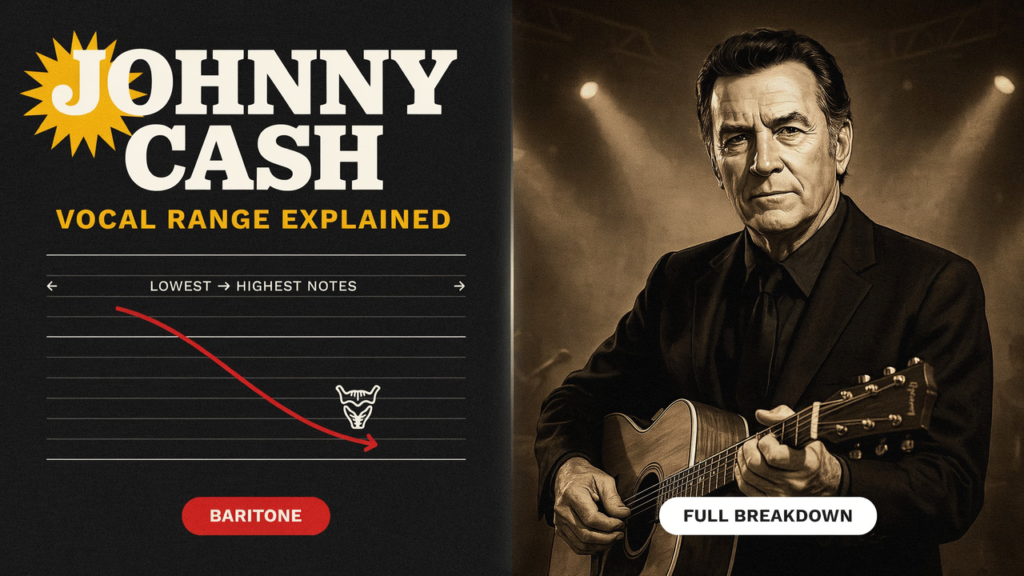
Johnny Cash Vocal Range
Johnny Cash’s vocal range is widely measured as: F1 – A3 (approximately 2 octaves)
- Lowest sustained note: F1
- Highest comfortable note: E3–F3
- Occasional upper notes: G3–A3, primarily early career
- Voice type: Bass-Baritone
- Primary register: Chest voice
- Key tonal trait: Deep, dark, storytelling resonance
Cash’s range was not exceptionally wide, but his timbre, resonance, and emotional delivery made him a once-in-a-century vocalist.
What Voice Type Was Johnny Cash? (Bass-Baritone Explained)
Johnny Cash is best described as a bass-baritone, a classification that sits between a full operatic bass and a traditional baritone. Bass-baritones tend to have:
- A naturally deep speaking voice
- Powerful low-mid frequencies
- Less reliance on head voice
- Strong chest resonance
- A dark, warm timbre
Cash embodied all of these traits. Even when singing relatively high for his range, his tone remained weighty and rich—a hallmark of bass-baritone vocal production.
Why Not a True Bass?
While Cash could dip into bass territory, he did not consistently access sub-bass notes (C1–E1) that classical basses utilize. His upper range was also more flexible than a pure bass.
Why Not a Baritone?
His lower register was significantly stronger and more resonant than typical baritones, who often base their singing between A2–A4.
Thus, bass-baritone is the most accurate classification.
Johnny Cash Vocal Range Chart (Notes and Frequency Mapping)
| Vocal Component | Notes | Approx. Hz | Description |
|---|---|---|---|
| Lowest Note | F1 | ~43 Hz | Achieved in later-life recordings; extremely rare in commercial voices |
| Highest Note | A3 | ~220 Hz | Found in early-material phrasing or emphatic peaks |
| Comfort Range | F2–E3 | 87–165 Hz | Where Cash performed most consistently |
| Total Range | ~2 octaves | — | Narrow but tonally powerful |
This compact range created the warm, grounded vocal style that became Cash’s trademark.
How Johnny Cash’s Voice Evolved Through His Career
One of the most fascinating aspects of Johnny Cash’s voice is how dramatically it changed over time. His vocal journey can be divided into three eras.
1. Early Career (1955–1969): Bright Baritone with Deep Undertones
In his Sun Records and early Columbia years, Cash’s voice was:
- Clearer
- Slightly higher
- Less raspy
- More flexible in E3–A3 range
Songs like “Folsom Prison Blues,” “I Walk the Line,” and “Ring of Fire” illustrate a youthful tone with pronounced mid-range energy.
Though still deep, his voice had a brightness and freshness that faded in later decades.
2. Middle Career (1970–1989): The Classic ‘Man in Black’ Tone Emerges
As Cash aged, his voice matured into the sound we most associate with him:
- Weightier resonance
- Darker timbre
- Greater chest-dominance
- More spoken-singing delivery
- Reduced upper register
His vocal comfort zone shifted downward toward F2–D3.
Songs like “Man in Black” and “Sunday Morning Coming Down” reveal a deeper, more authoritative sound.
3. Late Career (1990–2003): Deep, Weathered, Iconic Bass-Baritone
The American Recordings era is celebrated for a raw, emotionally devastating vocal style:
- Rich, aged character
- Pronounced rasp
- Lower lows (often touching F1)
- Vulnerable high range
- Intimate, narrative phrasing
Tracks such as “Hurt,” “The Man Comes Around,” and “God’s Gonna Cut You Down” showcase some of the deepest, most resonant notes he ever produced.
Many listeners consider this era the most expressive of Cash’s career—not because of range, but because of emotional depth.
What Songs Best Show Johnny Cash’s Vocal Range?
Deepest Notes
- “Hurt” (American IV) – dark lows approaching F1
- “God’s Gonna Cut You Down” – gritty low-end resonance
- “Why Me Lord” (Live) – notably deep spoken sections
Strong Mid-Range Examples
- “Folsom Prison Blues”
- “Man in Black”
- “Big River”
Rare Higher Notes
- “I Still Miss Someone”
- “Ballad of a Teenage Queen”
Cash seldom exploited his upper register; his power came from stability, phrasing, and tone.
Why Was Johnny Cash’s Voice So Deep?
The depth of Cash’s voice resulted from a combination of anatomy, technique, and lifestyle.
1. Naturally Thick Vocal Folds
Deeper voices come from longer, thicker folds that vibrate at lower frequencies.
2. Chest-Dominant Technique
Cash used almost exclusively chest voice, avoiding head or falsetto.
3. Subglottal Pressure and Resonance
His breath support produced a solid, grounded tone that amplified lower frequencies.
4. Aging Effects on the Larynx
As men age, the vocal folds relax and thicken, deepening the voice—especially evident from the 1990s onward.
5. Environmental and Lifestyle Factors
Smoking, stress, long tours, and illness contributed to raspy overtones that added emotional rawness.
How Johnny Cash’s Vocal Range Compares to the Average Male
Most adult male singers perform comfortably in A2–A4.
Johnny Cash’s typical singing range was F1–E3.
This places him:
- About one full octave lower than average
- In the lowest 1–2% of recorded commercial male voices
- Comparable to dark baritones and light basses in classical music
He didn’t rely on extreme range but on a deep, unmistakable sound.
Compare Your Vocal Range to Johnny Cash
Want to see how your voice matches Johnny Cash’s?
Use our Free Vocal Range Test to discover:
- Your lowest and highest notes
- Your voice classification (bass, baritone, tenor, etc.)
- Whether you can hit notes as low as Cash
- A visual comparison chart against famous singers
Start your vocal range test now.
Frequently Asked Questions
Did Johnny Cash have a wide vocal range?
No. His range was relatively narrow, but extremely expressive.
How low could Johnny Cash sing?
He could reach F1 in late career performances.
Was Johnny Cash a bass or baritone?
He was a bass-baritone.
Did his voice deepen because of age?
Yes. Age, health, and lifestyle significantly darkened his tone.
What made his voice unique?
His emotional delivery, deep resonance, and narrative phrasing.
- Explore bass-vocal-range to understand where Johnny Cash’s deep lows fit.
- Learn how-to-find-your-vocal-range to see how your voice compares to his full range.
- Check out tips-to-extend-your-lower-vocal-range for techniques to reach rich low notes like Cash’s.
- Try daily-vocal-warm-up exercises to maintain control over both high and low registers.
- Understand breathing-techniques-for-singing to support long, resonant phrases.
- Explore how-to-do-whistle-voice to understand upper register techniques, even for low-range singers.
- Compare Cash’s range using the singercomparisontool to see how his baritone-bass voice ranks among other legends.
Erika Parker is a vocal analysis and singing education writer at Vocal Range Test. She focuses on vocal range testing, voice type analysis, pitch recognition, and singing tools for vocalists, musicians, choir singers, and beginners.