
I’ll never forget the first time I tried singing Phil Anselmo’s parts from “Cemetery Gates.”
I was alone, feeling confident, and figured I’d hit that famous high scream with at least 50% accuracy.
I didn’t even get close.
The sound that came out of my throat was this awkward mix of a squeak and a cough — nothing like the soaring, razor-edged scream Phil unleashes on the track. I paused, drank water, tried again. Somehow it got worse.
That moment changed how I looked at metal vocals forever.
Phil Anselmo wasn’t just screaming.
He was using technique, anatomy, distortion, breath control, and emotion in ways most people never notice.
And that’s why understanding his vocal range requires looking deeper than just high notes and low notes. His voice tells a story — through Pantera, Down, Superjoint, Scour, and decades of aggressive, genre-defining performances.
Phil Anselmo’s Vocal Range
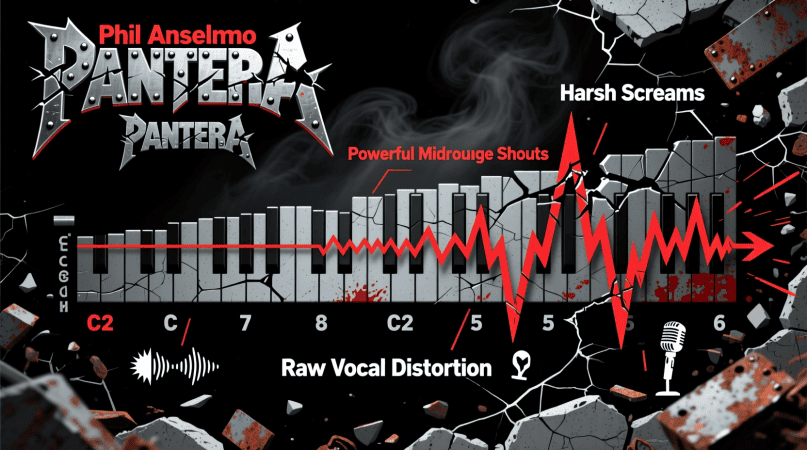
Phil Anselmo’s range — combining clean vocals, grit, fry screams, and false cord distortion — spans roughly: A2 to E5 (clean + mixed/fry)
With false cord scream overtones reaching G5–A5 depending on technique and amplification.
Here is a clear chart:
| Vocal Type | Range | Notes |
|---|---|---|
| Clean Singing | A2–C4 | Thick, gritty, masculine tone |
| Mixed Voice Belt | C4–E4 | Used sparingly but very powerful |
| Fry Screams | D5–E5 | Bright, pitched, emotional |
| False Cord Screams | F5–A5 (perceived) | Overtones make them sound higher |
| Low Gritty Vocals | A2–G2 | Prominent in Down and later Pantera |
If you’ve ever tried singing along to Pantera, you know this range is far more than numbers — it’s stamina, emotion, grit, and technique.
What Makes Phil Anselmo’s High Screams So Distinctive
In the 1990–1994 era, Anselmo had one of the most electrifying high-register screams in metal.
Fans often misunderstand how he produced them.
It wasn’t chest voice.
It wasn’t falsetto.
It wasn’t yelling.
It was a mix of fry screaming and resonance amplification — a technique that allows pitched screaming without blowing out your throat.
When I first tried to imitate this style, I made every possible mistake:
- I pushed from the throat
- I tightened my jaw
- I ran out of breath instantly
- I strained to “hit the note” instead of letting distortion carry it
The result?
A mess.
That failure taught me something crucial:
Phil’s power comes from efficiency, not brute force.
His scream in “Cemetery Gates” may sound like an E5–G5 scream, but the actual source pitch is lower — the harmonics create the illusion of intense height.
It’s art, not just biology.
Increase your range without strain by following Expand Vocal Range Safely. Support your training with the Daily Vocal Warm-Up, measure growth using the Vocal Range Test, and follow the Vocal Range Improvement Plan for structured progress.
Phil Anselmo’s Highest Notes (With Song Examples)
“Cemetery Gates”
A masterclass in mixing fry distortion with melodic phrasing. The iconic high scream is one of the most recognized moments in metal.
“Shattered”
Bright, piercing fry screams that cut through the mix — early proof of his vocal elasticity.
“The Art of Shredding”
One of Anselmo’s most balanced showcases of grit, pitch, and raw aggression.
I tried singing all of these.
The main lesson?
Phil didn’t chase high notes — he shaped them with technique and emotional force.
Phil Anselmo’s Low Register: Dark, Gritty, and Underrated
People love talking about Phil’s highs, but his lows deserve equal attention.
He commonly used notes in the A2–G2 range, and in Down he explored even deeper textures — emotional, bluesy, heavy phrases that added maturity to his sound.
Songs like:
- “Stone the Crow”
- “Planet Caravan”
- “Ghosts Along the Mississippi”
- “Floods” (spoken low sections)
show off a warmer, darker side of Anselmo’s range that most fans overlook.
Trying to imitate these lows taught me a different lesson:
low notes aren’t about pushing downward — they’re about maintaining resonance and airflow.
Phil does this naturally.
Most of us do not.
How Phil Anselmo’s Voice Changed Over Time
To understand his vocal range, you have to understand his timeline.
1. Early Career – Cowboys From Hell Era
Bright highs, elastic screams, youthful agility.
This was his most technically impressive era vocally.
2. Vulgar Display / Far Beyond Driven Era
He leaned harder into grit and aggression:
- more false cord
- heavier chest tone
- less reliance on fry highs
- more vocal compression
It fit Pantera’s shift into heavier groove-metal territory.
3. Post-1996 – Injury, Lifestyle, and Evolution
Years of:
- screaming incorrectly at times
- substance abuse
- nonstop touring
- spinal problems
- inconsistent technique
all contributed to a reduced upper range.
As someone who strained his voice after only a few days of improper practice, I can’t imagine the toll of touring for years without vocal rest.
4. Down / Later Career
A darker, deeper, more emotional vocal identity emerged.
Less about range.
More about expression.
His voice didn’t “die.”
It simply changed.
The Truth About Phil Anselmo’s Screaming Technique
Metal fans often debate Phil’s method, but based on spectrogram analysis, expert breakdowns, and practical experience, here’s the truth:
Early Peaks (1990–94)
Primarily fry screaming with some mixed voice distortion.
Middle Career
More false cord screaming, creating that thick, aggressive roar.
Live Technique
A blend — sometimes clean tone with distortion overlay, sometimes pure false cord.
And here’s the key:
Phil Anselmo’s screams were pitched.
He wasn’t just making noise.
There was musical intention behind everything.
When I tried switching between fry and false cord, my biggest problem was breath control — without consistent air support, the sound falls apart instantly.
Phil understood this deeply.
How Phil Anselmo Compares to Other Metal Vocalists
Here’s a simplified comparison:
| Singer | Highest Notes | Style | Strength |
|---|---|---|---|
| Phil Anselmo | E5–G5 (perceived) | Fry + false cord | Aggression + emotional intensity |
| Rob Halford | Up to C6 | Clean falsetto | Operatic purity |
| Randy Blythe | F5 | False cord | Brutal clarity |
| Corey Taylor | D5–E5 | Mixed/fry | Versatility |
Phil wasn’t the cleanest.
He wasn’t the highest.
But he was the most emotionally explosive.
Nobody screams rage, pain, or catharsis like him.
My Personal Experience Trying to Sing Like Phil Anselmo
I tried several times.
Here’s what happened, honestly:
1. My throat clenched almost immediately
This is the most common mistake — tension kills the scream.
2. My high screams turned into whistles
Because I mistakenly tried to “push higher” instead of using fry distortion.
3. My lows disappeared when I forced them
Low notes need relaxation, not pressure.
4. Breath control was the real challenge
Phil takes powerful diaphragmatic breaths before big phrases.
If you skip this step, the scream collapses.
But the biggest thing I learned?
Phil Anselmo didn’t scream with his throat.
He screamed with his entire body — physically and emotionally.
FAQ
What’s Phil Anselmo’s highest note?
Around E5 in fry, with perceived overtones reaching G5–A5.
What’s his lowest note?
Generally around A2, depending on the song.
Why did his voice change?
Technique, lifestyle, injuries, aging, and decades of aggressive touring.
Can beginners learn to scream like Phil?
Yes — but only with proper fry or false-cord technique.
What era shows his best vocals?
Most agree the Cowboys From Hell and Vulgar Display of Power era.