
The soprano vocal range is the highest female voice type in classical music and one of the most recognizable in modern genres. Known for its bright, ringing tone and ability to soar above choirs and orchestras, the soprano voice often carries the melody in opera, musical theater, and choral works.
If you’ve wondered whether you might be a soprano or want to strengthen your upper range, this guide covers everything: range details, types of sopranos, famous singers, songs, training tips, and daily exercises.
Start by finding your current vocal range using our Vocal Range checker to see where your voice fits.
What Is the Soprano Vocal Range?
Most sopranos sing comfortably between C4 (middle C) and C6, with some professionals extending even higher into the “soprano high C” and whistle register.
| Voice Type | Typical Range (Notes) | Approx. Frequency Range (Hz) |
|---|---|---|
| Contralto | F3–F5 | 175–698 Hz |
| Mezzo-Soprano | A3–A5 | 220–880 Hz |
| Soprano | C4–C6 | 261–1046 Hz |
The soprano voice is lighter, brighter, and more agile than other female voice types, making it ideal for melody-driven roles in classical and contemporary music.
Key Characteristics of the Soprano Voice
- Tone Quality: Bright, resonant, and ringing
- Tessitura (Comfort Zone): Upper register with sustained high notes
- Projection: Designed to carry over orchestras and choirs
- Versatility: Found in opera, musical theater, pop, gospel, and jazz
If you’re new to singing, the soprano voice often feels “on top of the harmony,” leading main melodies while lower voices provide richness and depth.
Types of Soprano Voices
Classical singing divides sopranos into several categories based on vocal weight, agility, and tessitura:
- Coloratura Soprano
- Extremely agile, capable of singing rapid, ornamented passages
- Examples: The Queen of the Night aria in Mozart’s The Magic Flute
- Lyric Soprano
- Warm, light tone with lyrical quality
- Suitable for romantic and melodic roles
- Dramatic Soprano
- Powerful, darker tone for intense operatic roles
- Examples: Wagnerian soprano roles in large-scale operas
- Spinto Soprano
- Blend of lyric warmth and dramatic power
- Ideal for passionate, emotional roles
- Light Soprano
- Bright, youthful tone with ease in higher registers
- Common in musical theater and choral music
Famous Soprano Singers
Across classical and contemporary music, some iconic sopranos include:
- Maria Callas – Legendary dramatic soprano with emotional depth
- Renée Fleming – Renowned lyric soprano in opera and jazz crossover
- Sarah Brightman – Musical theater soprano with global acclaim
- Whitney Houston – Pop and gospel soprano with soaring high notes
- Celine Dion – Pop soprano known for range and control
Listening to these singers helps you understand different soprano styles and techniques.
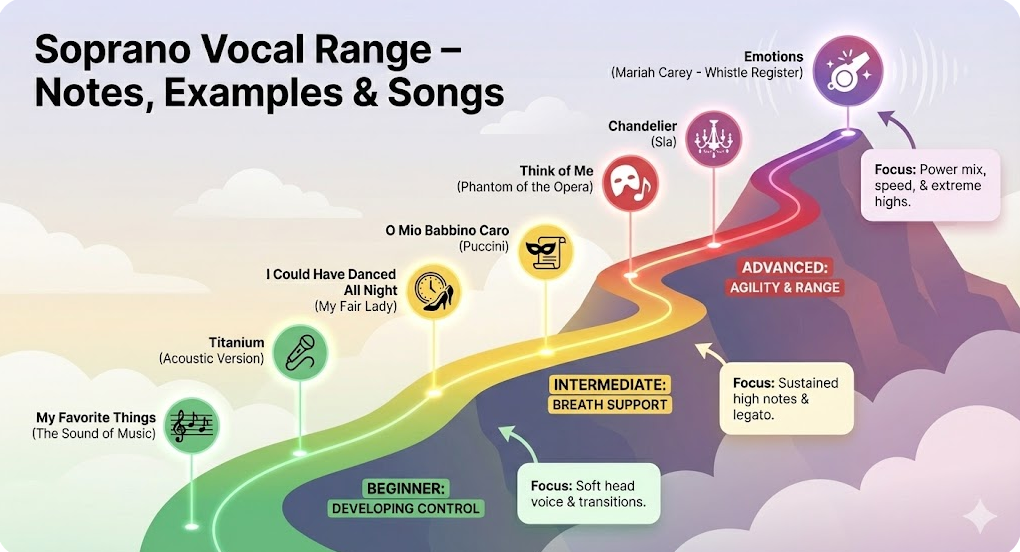
Songs for Soprano Voices
Choosing the right repertoire keeps your voice comfortable while showcasing range and tone.
Beginner-Friendly Songs:
- Think of Me – Phantom of the Opera (Andrew Lloyd Webber)
- Somewhere Over the Rainbow – The Wizard of Oz
- Pie Jesu – Andrew Lloyd Webber
Intermediate & Advanced Songs:
- The Queen of the Night Aria – Mozart
- O Mio Babbino Caro – Puccini
- Defying Gravity – Wicked (Stephen Schwartz)
Before singing, warm up using Daily Vocal Warm-Up Exercises to protect your voice.
Main Interactive Tools:
- Vocal Range – find your exact highest and lowest notes online in seconds.
- Vocal Range Calculator – measure and record your range accurately using your microphone.
- Singer Comparison Tool – compare your vocal range with famous singers and see where you align.
- AI Voice Analysis – get instant feedback on your tone, pitch stability, and clarity through advanced AI.
- Song Key Finder – discover songs that naturally fit your vocal range and tessitura.
- Ear Training Game – improve pitch accuracy and interval recognition through fun listening challenges.
- Microphone Tester – check your mic setup before testing your range or recording vocals.
Soprano vs Mezzo-Soprano vs Contralto
| Feature | Soprano | Mezzo-Soprano | Contralto |
|---|---|---|---|
| Range | C4–C6 | A3–A5 | F3–F5 |
| Tone | Bright, agile | Warm, rich | Deep, dark |
| Opera Roles | Heroines, leading roles | Supporting, character roles | Mature, dramatic roles |
If you’re unsure of your classification, use the Vocal Range Calculator for accuracy.
Training Tips for Sopranos
1. Strengthen Breath Support
High notes require airflow control. Learn Breathing Techniques for Singing to build stamina.
2. Master High Note Techniques
Check our High Notes Singing Training guide for safe exercises to reach top notes without strain.
3. Develop Agility with Scales
Coloratura and lyric sopranos benefit from fast scales and arpeggios for flexibility.
4. Blend Chest and Head Voice
Smooth transitions between registers prevent breaks and maintain tone quality. Read Chest Voice vs Head Voice for blending tips.
Daily 15-Minute Routine for Sopranos
| Exercise | Duration | Focus |
|---|---|---|
| Diaphragmatic Breathing | 2 min | Breath support & stamina |
| Lip Trills & Humming | 3 min | Warm-up & relaxation |
| 5-Note Scales on “ah” | 3 min | Pitch accuracy & resonance |
| Siren Glides Low → High → Low | 3 min | Range flexibility & blending |
| Song Practice | 4 min | Apply technique to repertoire |
Common Mistakes to Avoid:
- Skipping warm-ups before singing high notes
- Pushing chest voice too high without switching registers
- Ignoring posture and breath control
- Singing at full volume before tone stability is developed
How to Know If You’re a Soprano
You might be a soprano if:
- Your lowest note is around C4
- Your highest comfortable note reaches C6 or above
- The upper range feels natural and resonant
Confirm with the Vocal Range Calculator for precision.
FAQs About Soprano Vocal Range
Q1: What is the typical soprano range?
Most sopranos sing between C4 and C6, with some extending higher.
Q2: Can sopranos sing low notes?
Yes, but sopranos specialize in the upper range; mezzos and contraltos handle lower tessituras more naturally.
Q3: What songs fit sopranos best?
Classical arias, Broadway solos, and pop ballads often highlight soprano voices.
Q4: Can I increase my soprano range?
Yes, with safe range expansion exercises and consistent training.
Q5: Are sopranos rare?
Sopranos are common in choirs but professional-level sopranos with extended range and agility are less common.