
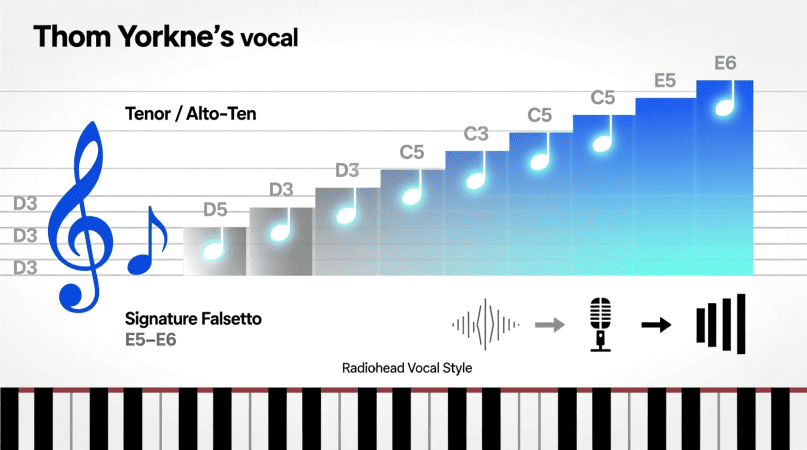
Thom Yorke is one of those singers you don’t fully appreciate until you try—really try—to sing like him. The first time I attempted “Nude,” I thought,
“Okay, it’s soft, it’s gentle, it’s floaty… how hard can this be?”
Turns out: unbelievably hard.
My voice cracked, drifted sharp, drifted flat, ran out of breath, and at one point sounded like an emotional tea kettle. That’s when it hit me:
Thom Yorke’s voice is not powerful in the traditional sense.
It’s powerful because of how he controls fragility.
It’s high, yes—but it’s the precision, the breath flow, and the emotional shading that make his vocal style so haunting.
What looks delicate is actually engineered with incredible finesse.
Let’s break down Thom Yorke’s vocal range, voice type, registers, techniques, evolution, and why his singing is deceptively difficult—mixed with the real struggles I personally went through while trying to replicate his sound.
Thom Yorke’s Vocal Range
Most credible analyses place Thom Yorke’s vocal range around: F2 – C6 (approximately three octaves)
Depending on the era and whether live performances are counted, some charts place it slightly higher or lower—but C6 falsetto peaks and F2 lows are commonly accepted.
But here’s the truth:
A vocal range number doesn’t tell you anything about why Thom Yorke sounds like Thom Yorke.
His genius is not the range itself—it’s how he uses every inch of it with intention.
What Voice Type Is Thom Yorke?
Thom Yorke is most often labeled as a high tenor, but there’s nuance here:
1. He sings heavily in falsetto and head voice.
Unlike belting tenors, he lifts into head resonance early, giving him that floating, otherworldly tone.
2. He has the agility of a countertenor, but not the operatic technique.
This is why casual listeners call him a “countertenor” even though technically he is a tenor with an exceptionally strong, expressive falsetto.
3. His timbre is breath-rich but pitch-stable.
This combination is incredibly hard to imitate.
When I tried singing softly like he does, my pitch evaporated instantly.
4. His emotional delivery shapes his tone.
Yorke’s phrasing often sounds like he’s exhaling sadness.
You cannot sing his songs with neutral emotion—you have to lean into the vulnerability.
Thom Yorke is proof that voice type is not just about classification…
It’s about expression.
Breaking Down His Vocal Registers
1. Low Register (F2–A2): Underrated Depth
Yorke doesn’t go low often, but when he does, it’s soft, warm, almost whispered.
For example:
- “Pyramid Song”
- “Give Up the Ghost” (lower stacked harmonies)
When I tried matching his lows, I discovered a problem:
They’re too gentle.
Low notes usually feel anchored and heavy. Yorke sings them airy and intimate, which makes pitch control harder. My voice wobbled like a sad cello.
2. Midrange (A2–G4): The Emotional Center of His Sound
This is where Yorke delivers the heart of Radiohead’s catalog:
- “High and Dry”
- “Karma Police”
- “Airbag”
- “Reckoner”
- “True Love Waits”
His midrange is expressive, flexible, and fluid. He slides between notes with intentional imprecision—something that’s easy to mock but extremely hard to replicate artistically.
When I first recorded myself singing “High and Dry,” the notes were correct…
but the feeling was completely wrong.
Yorke doesn’t just hit notes—he shapes them like brushstrokes.
You need micro-breath adjustments, slight vocal fry on onsets, and emotional shading. Without that, it sounds empty.
3. Upper Register (G4–B4): Light Mix and Early Head Shift
Yorke’s upper midrange is where most singers start to push.
Yorke? He gently lets go.
He transitions into a head-dominant mix early, which removes strain and gives his upper notes a glassy, lightweight texture.
Songs that show this:
- “How to Disappear Completely”
- “There, There”
- “Weird Fishes / Arpeggi”
When I attempted this, I made one of the most common mistakes:
I kept too much chest voice.
The result? Tension.
Yorke avoids tension by choosing lightness over force.
It’s counterintuitive—but genius.
4. Falsetto & Head Voice (C5–C6): Thom Yorke’s Signature Color
This is where he becomes unmistakable.
Yorke’s falsetto is:
- Ethereal
- Pillowy
- Breath-suffused
- Emotionally loaded
- Incredibly controlled
Listen to:
- “Nude”
- “Everything in Its Right Place”
- “Identikit”
- “Daydreaming”
Here’s the mistake I made for YEARS:
I assumed falsetto = breathy and unsupported.
But Yorke’s falsetto isn’t “soft because he’s being quiet”—it’s soft because he’s controlling airflow with precision.
The moment I learned to support falsetto like real singing, everything changed.
I could finally sing parts of “Nude” without cracking like a broken whistle.
Following a structured approach like the Vocal Range Improvement Plan helps you grow steadily while using daily support from the Daily Vocal Warm-Up. You can measure your growth with the Vocal Range Test and strengthen airflow control using the Breathing Techniques for Singing.
Why Thom Yorke’s Voice Is Harder to Sing Than It Sounds
Here’s the secret singers discover the moment they attempt Yorke:
It’s not the range that’s hard.
It’s the control.
1. Softness requires strength.
Singing quietly without losing pitch is extremely difficult.
2. He uses breath as an emotional tool.
Yorke modulates airflow mid-phrase—a subtle technique few singers master.
3. He slides BETWEEN notes with intention.
Most singers slide because of inaccuracy.
Yorke slides because of choice.
4. His phrasing is deeply psychological.
Yorke sings like he’s trying not to cry.
Replicating that without sounding melodramatic is delicate work.
5. His head voice coordination is elite.
He blends falsetto and head voice seamlessly, which takes years of practice.
When I first practiced his songs, I realized something humbling:
Thom Yorke doesn’t just sing.
He paints with airflow.
How Thom Yorke’s Voice Evolved Over Time
Early Radiohead (Pablo Honey → The Bends)
Bright, youthful tone
More chest voice
Clearer phrasing
OK Computer → Kid A Era
Shift to falsetto-heavy singing
More ambient vocal layering
Experimental delivery
Hail to the Thief → In Rainbows
Balanced mix of chest, head, and falsetto
Warmer, richer timbre
Refined emotional expression
A Moon Shaped Pool → The Smile
Mature, breathier, silky tone
More control, less force
A master of emotional minimalism
Yorke’s voice has aged like a fine watercolor—not losing vibrancy, just gaining depth.
Thom Yorke Vocal Range Chart
| Register | Notes | Characteristics |
|---|---|---|
| Low | F2–A2 | Soft, warm, restrained |
| Midrange | A2–G4 | Expressive, fluid, emotional |
| Upper Register | G4–B4 | Light mix, airy resonance |
| Falsetto / Head Voice | C5–C6 | Ethereal, haunting, controlled |
Can You Sing Like Thom Yorke?
Yes—but you can’t brute-force it.
Yorke isn’t impressive because he belts.
He’s impressive because he balances softness with stability.
Here’s what helped me most:
1. Practicing breathy onsets with pitch accuracy
Not too airy, not too tight.
2. Doing slow slides between notes
Yorke-style glides must feel intentional, not sloppy.
3. Strengthening supported falsetto
Airflow + cord closure = Yorke tone.
4. Recording myself obsessively
Painful, but it exposed every pitch drift.
5. Letting go of ego and embracing fragility
Yorke doesn’t try to sound powerful.
He tries to sound human.
When I stopped “trying to sing well” and started “trying to feel,” the Yorke sound clicked.