
If you’ve ever wondered what it feels like to sing like Tina Turner, let me tell you: the first time I tried “Proud Mary,” I thought I was ready. I’d warmed up, hydrated, stretched — all the responsible singer stuff.
But the moment the song kicked into that iconic explosive “ROLLIN’,” my voice basically wrote a resignation letter. My throat felt raw, my breath tanked in under 20 seconds, and my confidence evaporated faster than my vocal cords could scream “ABORT MISSION.”
That’s when I truly understood something important: Tina Turner didn’t just have a vocal range. She had a vocal engine — powerful, gritty, fearless, and fueled by technique most people underestimate.
Let’s break down Tina Turner’s vocal range, voice type, technique, power, grit, and stamina, all woven together with my real personal experience and tiny mistakes I made along the way.
Tina Turner’s Vocal Range
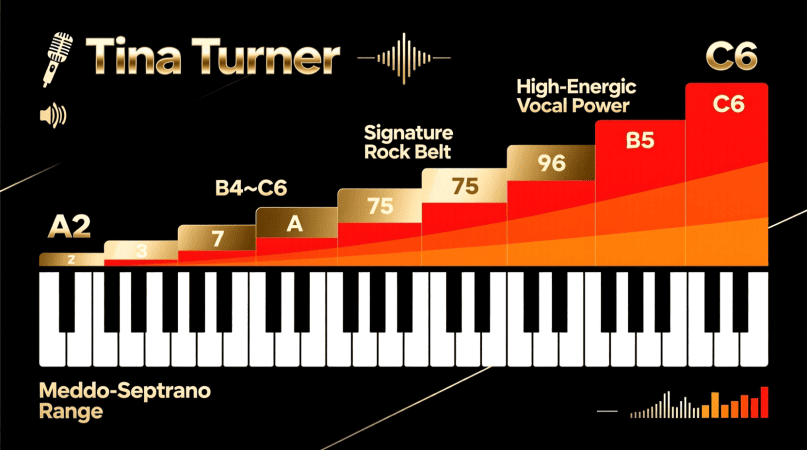
Most credible sources place Tina Turner’s vocal range around: F2 – C♯6
(approximately 3–4 octaves, depending on the recording and era)
But her magic wasn’t how high she could sing.
Her magic was the intensity, the attack, the attitude, and the electricity she carried into every note — even the simple ones.
Tina didn’t just sing pitch.
She sang presence.
Taking care of your voice is essential for long-term progress, which is why the Vocal Health Tips for Singers guide is helpful to follow alongside your regular Daily Vocal Warm-Up. You can practice safe expanding techniques from the Expand Vocal Range Safely page and evaluate your performance using the Vocal Range Test.
What Voice Type Was Tina Turner?
Tina Turner is best described as a mezzo-soprano, but she carried a deep, rich contralto texture in her lower register.
Here’s what that really means:
1. Mezzo Power Up Top
This is where her belts lived — bright, brassy, rock-driven chest voice notes that sliced through a full band like a blade.
2. Contralto Warmth Down Low
When she dipped into her low notes, you felt depth, grit, and attitude.
3. Signature Rasp
Not an accident. Not strain.
It was part of her natural timbre and trained stamina.
I learned this the hard way:
I once tried adding rasp on “The Best” by “just pushing harder.”
Spoiler — that’s how you lose your voice by lunchtime.
Tina’s rasp was layered over support, not strain.
That’s the difference between legendary singers and the rest of us mortals.
Her High Notes: Where Tina Becomes a Vocal Bulldozer
Tina Turner was one of the queens of rock belting, especially in the E5–B♭5 area — a zone most singers avoid because it’s where chest voice becomes risky.
But Tina?
She lived there.
She thrived there.
Songs like:
- “Proud Mary”
- “The Best”
- “River Deep – Mountain High”
- “It’s Only Love”
…showcase her laser-focused, chest-dominant belts.
When I tried singing along with “The Best,” two things happened:
1. I underestimated how much breath she uses.
Her belts aren’t just loud — they’re supported by massive airflow.
2. I overestimated how much my throat could handle.
I tried to match her intensity without matching her technique.
Big mistake.
What Tina mastered:
- Strong diaphragm engagement
- Forward resonance placement
- Controlled grit layered on a clean belt
- Endless stamina
Trying to copy her without understanding this is like trying to run a marathon without shoes.
Her Low Notes: Deep, Warm, and Criminally Underrated
Although her high-power belts steal the spotlight, Tina’s lower range is surprisingly strong and expressive.
She could dip into F2–A2, giving songs a smoky, soulful tone.
You hear this beautifully in:
- “Private Dancer”
- “What’s Love Got to Do with It”
- “I Don’t Wanna Lose You”
When I tried these low lines, I expected them to be the easy parts.
Yet I struggled more with keeping the tone steady than with hitting the pitch.
Tina’s low notes are gentle — but supported.
That’s the secret: she keeps enough vocal cord closure to avoid sounding muddy or breathy.
Let’s Talk About the Rasp — The Most Misunderstood Part of Her Voice
If you search how to sing like Tina Turner, most people think:
“Oh, just add rasp!”
Let me save your vocal cords:
Do not add rasp without support.
Do not grind your throat.
Do not force air until your voice cracks.
I made this mistake exactly once.
I tried real grit on “Nutbush City Limits,” and instantly regretted every life choice that led me there.
Tina’s rasp is:
- partly natural timbre
- partly controlled breath pressure
- partly vocal fold compression
- partly decades of conditioning
It’s like controlled distortion on an electric guitar — the effect only works if the foundation is strong.
How Tina Turner Kept Her Voice SO Strong for SO Long
Tina Turner sang with immense energy into her 60s and 70s, which is almost unheard of for a rock vocalist.
How did she do it?
1. Exceptional breath support
Her whole body sang — not just her throat.
2. Chest voice dominance with proper technique
She belted high, but she belted smart.
3. Stamina from performance movement
Dancing actually improved her vocal power.
4. Decades of conditioning
This kind of endurance doesn’t come overnight — it’s trained.
When I tried doing just one song with Tina-like energy (singing + moving), I was winded in 90 seconds. Tina did two-hour shows.
Her voice wasn’t just big.
It was athletic.
Tina Turner Vocal Range Breakdown
| Vocal Area | Approx. Notes | Characteristic Sound |
|---|---|---|
| Lower register | F2 – A2 | Warm, husky, soulful |
| Middle range | A3 – E4 | Rich, gritty, expressive |
| Upper belts | E5 – B♭5 | Explosive, bright, high chest voice |
| Highest studio peaks | Up to C♯6 (sometimes higher claims) | Intense, powerful, ringing |
Her range wasn’t just wide — it was consistent and fearless.
Can You Sing Like Tina Turner?
Yes… but not exactly.
You can learn from her, study her technique, embody her attitude — but you should not try to replicate her exact sound unless you want your vocal cords to file a complaint.
Here’s what did help me:
1. Master chest voice support
Without this, you won’t survive a single chorus.
2. Practice clean belts before adding grit
Think “clarity first, rasp second.”
3. Build breath stamina
She moves while singing. Practice singing while lightly jogging or stepping.
4. Use airflow, not throat pressure
Tina pushes from the body, not the neck.
5. Accept that Tina’s rasp is unique
You can borrow the style, but her exact sound is… well, hers.
Once I stopped trying to “sound like Tina Turner” and instead tried to “sing like Tina Turner would”—with confidence, fire, and energy—things became much easier, safer, and honestly, way more fun.