
If you grew up on R&B, there’s a good chance Usher’s voice was part of your life soundtrack.
School dances. Radio in the car. Burned CDs.
Yeah!, Burn, U Got It Bad, Nice & Slow — it was just Usher everywhere.
Back then, I didn’t think about “vocal range” or “tenor vs baritone.”
I just knew this guy could glide up to high notes, flip into falsetto, run all over a melody, and somehow still sound relaxed.
Fast-forward to now: after spending a lot of time studying singers’ vocal ranges for my site, I went back to Usher with fresh ears.
And honestly? The first time I tried to sing “Burn” in his key, I realized how much he makes difficult things sound easy.
Let’s unpack what’s really going on with Usher’s vocal range — in plain language.
Quick Summary of Usher’s Vocal Range
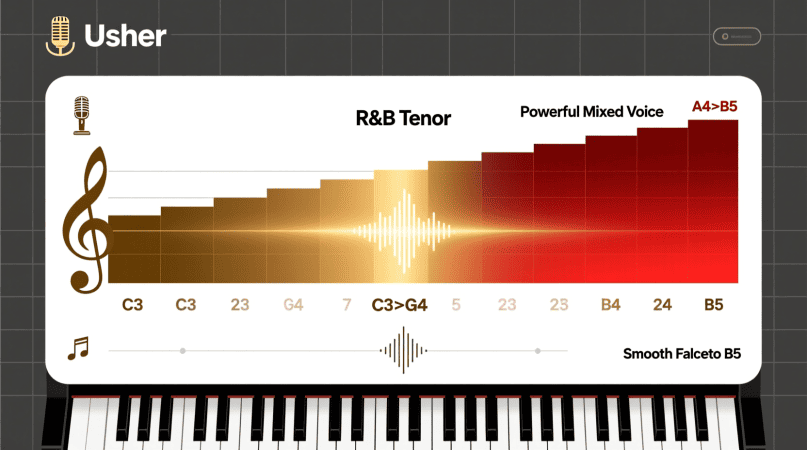
- Approximate Vocal Range: D2 – Bb5 (around three octaves)
- Voice Type: Tenor (often considered a lyric tenor)
- Core Strengths:
- Agile runs and riffs
- Smooth falsetto
- Strong mixed voice
- Breath control while dancing
- Overall Vibe: Polished R&B tenor with pop appeal and serious technical control
Numbers are helpful, but they’re only half the story. How he uses that range is what really sets him apart.
Why Usher’s Vocal Range Is More Impressive Than It Looks on Paper
A three-octave range is great, but lots of singers can claim big numbers.
What makes Usher stand out is:
- He can actually sing those notes live
- He does it while moving, dancing and performing
- And his tone stays controlled, consistent and musical
When I first tried to follow one of his runs in “U Got It Bad”, I thought,
“How hard can it be? It’s just a little slide.”
Thirty seconds later I was completely lost, off key, and laughing at myself.
That’s when you realize:
He doesn’t just have range — he has control.
Usher’s Low Notes: The Underrated Side of His Voice
You don’t usually think of Usher as a “low” singer, but he has a surprisingly usable lower register.
- Approx. Lowest Notes: Around D2 in some performances
- His lows often appear in more intimate R&B tracks and intros
- The tone is warm, rounded and relaxed, not forced
Songs where you can hear his lower range:
- “Nice & Slow” – Some of his smoothest low phrases live here
- “Superstar” – Rich, relaxed low-to-mid phrases
- “Burn” – Drops into lower notes on emotional lines, without losing clarity
The first time I tried to sing “Nice & Slow” in the original key, the low notes were a reality check.
On paper it seems manageable. In practice… yeah, no.
Usher’s low register is not his main calling card, but it gives his voice depth and maturity.
Usher’s High Notes: Bb5 and Clean, Controlled Falsetto
On the high side, Usher can reach up to around Bb5, especially when he leans into falsetto and mixed head voice.
This doesn’t mean he’s screaming up there. If anything, it’s the opposite:
his high notes are light, controlled and often silky rather than shouty.
Songs that show off his higher range:
- “Climax” – One of the cleanest and most controlled male falsetto performances in modern R&B/pop
- “Burn” – Emotional peaks around A4–C5 with a strong, ringing tenor sound
- “Separated” – Smooth lifts into head voice
- “There Goes My Baby” – Effortless, floating upper phrases
I remember trying to sing “Climax” properly.
The first chorus went okay… then I hit the high sustained notes and my voice just bailed out and cracked.
It gave me a new respect for how controlled his upper register really is.
Is Usher a Tenor?
Yes. Usher is widely regarded as a tenor, and more specifically, he fits well into the lyric tenor category.
Why Usher Is a Tenor
- His comfortable singing zone tends to sit around G3–C5
- He can belt mid-to-high notes with ease
- His tone gets brighter and more ringing as he goes up
- He moves around the upper middle area as if it’s home, not a stretch
Lyric Tenor Traits He Shows
- Light, agile upper-middle register
- A naturally bright quality in his higher phrases
- Emotional, expressive approach instead of raw power belting
- Easy flips between chest, mix and falsetto
Sometimes people think he might be a baritone because he can sound warm and rich, but his tessitura — the range he spends most of his time in — is clearly tenor territory.
Song-By-Song: Where His Range Really Shows
Let’s look at some key songs and what they show about his voice.
Burn
- Approx. Range: G3 – C5
- Shows his classic emotional tenor sound
- Those soaring “It’s been said that time…” lines live in the sweet spot of his voice
This was one of the first songs I tried to sing seriously.
The verses felt okay… then the chorus arrived and I realized I was quietly dropping the key without meaning to. Classic cheat move.
Climax
- Approx. Range: F3 – Bb5
- Lean, intense falsetto
- Demands excellent breath control and resonance placement
If you want to understand why singers respect Usher, listen to “Climax” with headphones.
It sounds simple until you try it. Then you immediately discover all your weak spots.
U Got It Bad
- Approx. Range: A3 – B4
- Great example of his agility and phrasing
- The runs here are smooth and precise, like they’re built into his DNA
This is where I tried copying his runs and ended up inventing a new genre of “accidental gospel chaos.”
Yeah!
- Approx. Range: Mainly mid-range
- Not a range showpiece, but a breath control test when you factor in dancing
Songs like this prove something people forget:
Singing well while standing still is one thing.
Singing well while dancing full-out is another sport entirely.
Nice & Slow
- Approx. Range: E2 – G4
- Highlights his lower and mid-range colors
- His delivery feels intimate and conversational, but still beautifully sung
How Usher Makes His Voice Sound So Smooth
It’s not just the notes he can hit. It’s how he hits them.
1. Agility and Runs
Usher’s runs are:
- Fast, but also accurate
- Rhythmic, not messy
- Tasteful; he doesn’t overload every line
A lot of singers can “attempt” runs. Very few place them as cleanly as he does.
2. Falsetto Control
His falsetto is not just a whispery afterthought. It’s:
- Supported
- In tune
- Emotionally expressive
“Climax” is the obvious showcase, but you can hear shades of this control in plenty of other songs too.
3. Breath Control While Dancing
Usher is not just a singer — he’s a full performer.
High-energy choreography usually destroys pitch and tone for most singers.
But he manages to:
- Keep phrases supported
- Maintain pitch
- Avoid heavy gasping in between lines
I once tried singing through a basic R&B song while just walking around the room and doing a light two-step.
Breath was gone by the second verse.
Now imagine doing that with Usher-level choreography. Different league.
To understand how our vocal tools function, you can review the Methodology page, which explains how pitch detection and analysis work across features like the Vocal Range Test. You can also see real user experiences on the testimonials page and try advanced features like the AI Voice Analysis for deeper evaluation.
Usher’s Vocal Range vs Other Male R&B/Pop Singers
Here’s a simple comparison to give your readers context:
| Artist | Approx. Range | Voice Type |
|---|---|---|
| Usher | D2–Bb5 | Tenor |
| Chris Brown | F2–G5 | Tenor |
| The Weeknd | B2–E6 | High Tenor |
| Bruno Mars | A2–D6 | Tenor |
| Justin Timberlake | D3–Bb5 | Tenor |
Usher sits right in the pack of top-tier male R&B/pop tenors — but his combination of range, agility, performance, and longevity is what sets him apart.
How Your Vocal Range Compares to Usher’s
Here’s the fun part:
You don’t have to guess where your voice sits. You can actually test it.
When I first measured my range, I was convinced I was closer to an R&B tenor.
The test gently informed me that reality… was different.
You can do the same with the vocal range test on my site:
- Find your lowest note
- Find your highest note
- Get an idea of your voice type
- See how you compare to singers like Usher
It’s not about matching him — it’s about understanding your own instrument better.
Frequently Asked Questions
What is Usher’s vocal range?
Roughly D2 to Bb5, covering about three octaves.
Is Usher a tenor?
Yes. He is generally classified as a tenor, often described as a lyric tenor.
What’s his lowest note?
Around D2 in certain controlled phrases.
What’s his highest note?
Around Bb5, usually in falsetto or light mixed/head voice.
Is Usher a good live singer?
Yes. He is known for strong live vocals, especially considering the intense choreography he performs.
Why do his runs sound so clean?
Years of practice, great ear training, strong breath support, and excellent control over his vowel shapes and timing.
Can I learn to sing like Usher?
You probably won’t copy his sound exactly (no one can), but you can work on:
- breath support
- simple runs and scales
- smooth transitions between chest, mix and head voice
- singing in a relaxed, speech-like tone