
You don’t forget the first time you hear Vitas.
For me, it was “Opera #2.”
I remember thinking: What am I listening to? Who sings like this? Is this even possible?
Then came “7th Element,” and let’s be honest — we all tried that squeaky high part at least once.
And if you were anything like me, your throat probably made a noise that immediately told you, “Yeah… you’re not Vitas.”
Vitas is one of those rare singers who challenges what we think the human voice can do.
Not just because of how high he sings, but because of the way he controls those extreme notes with precision, tone, and clarity.
Today, we’re breaking down Vitas’ vocal range, his voice type, his real octave count, and how he pulls off those famously surreal high notes.
Quick Summary of Vitas’ Vocal Range
- Approximate Vocal Range: F2 – D8
- Range Width: About 5–6 octaves
- Voice Type: Often described as a countertenor, male soprano, or a high lyric tenor
- Special Talent: One of the world’s most controlled extreme-high head voices and whistle registers
- Signature Songs: “Opera #2,” “7th Element,” “Smile,” “Lucia di Lammermoor (live parody)”
But numbers alone don’t capture what makes him unique.
It’s the sound — pure, metallic, almost synthetic — that makes Vitas unlike anyone else.
Why Vitas’ Vocal Range Feels Unreal
Lots of singers have wide ranges.
But Vitas uses his in ways that feel almost superhuman.
Here’s what makes his voice stand out:
1. His head voice is incredibly bright and piercing
Most male head voices soften as they go higher.
Vitas’ head voice gets sharper, clearer, and more resonant — almost like a laser.
2. His whistle register blends seamlessly with his head voice
Most singers have an obvious “jump” into whistle tones.
Vitas transitions so smoothly that listeners sometimes can’t tell where head voice ends and whistle begins.
3. His breath support and placement are perfect for high tones
Without perfect control, those extreme pitches would sound screechy or painful.
Instead, they sound clean — even beautiful.
I tried practicing a simple head-voice exercise once, inspired by “Opera #2.”
I thought I was doing okay until I hit the top of my range and produced something between a yelp and a squeak.
Humbling… but also a great reminder of how uniquely talented Vitas is.
Vitas’ Highest Notes: The Notes That Made Him a Legend
Vitas is known for reaching notes around:
- C6 – F6 in head voice
- C7 – D8 in whistle register
These are notes you normally hear from:
- Trained sopranos
- Mariah Carey
- Dimash in whistle register
- Certain operatic coloratura sopranos
Except Vitas is a man hitting these pitches with astonishing control.
In “Opera #2,” he delivers his signature climbing high sequence — a run of notes so bright and clean it almost sounds like a flute.
In “7th Element,” he goes into that now-famous squeaky, alien-like sequence.
People joked about it online, but if you’ve ever tried to replicate it, you know how hard it is even to get close.
Increasing your range without strain becomes easier when you follow the advice in the Expand Vocal Range Safely guide and support it with daily exercises from the Daily Vocal Warm-Up. You can monitor your progress using the Vocal Range Test and explore additional planning tools like the Vocal Range Improvement Plan.
Vitas’ Lowest Notes: The Side Most People Don’t Talk About
People focus on his highs, but Vitas actually has a healthy lower range too:
- He dips to around F2–G2
- His speaking voice is surprisingly warm
- He uses lower notes for contrast in ballads and theatrical pieces
He’s not a baritone, but he isn’t a “one-trick high note singer” either.
His lower range gives his voice more emotional depth than most people realize.
What Voice Type Is Vitas?
This is one of the most debated topics in vocal communities.
Here’s the simplest way to explain it: Vitas = a high tenor with a fully developed countertenor / falsetto + whistle register.
He fits several categories:
As a tenor (full voice)
- His chest voice lives in tenor range
- His belts carry brightness and clarity typical of tenors
As a countertenor (head voice)
- He sings extended passages in the alto/soprano range
- His head voice is unusually strong and resonant
As a male soprano (whistle register)
- He hits pitches normally reserved for female coloratura sopranos
This combination is extremely rare.
It’s why fans and vocal experts struggle to label him with a single classical fach.
Vitas’ Vocal Range in His Most Iconic Songs
Opera #2
- Bright head voice around C6
- Whistle-like peaks
- Smooth transitions between registers
- A masterclass in high-note agility
This was the song that made me pause the video, rewind, and ask myself,
“What just happened?”
7th Element
- The highest whistle-register squeals of his career
- Fast, quirky, theatrical runs
- Viral for a reason: nobody sounds like this
Trying to imitate the squeak is a rite of passage for Vitas fans.
Personally, I almost strained my voice the first time I tried.
Lucia di Lammermoor (Live Performance)
- Beautiful classical-like phrasing
- Clean vibrato
- Demonstrates he’s not just a meme—he’s a trained vocalist
This performance proves Vitas isn’t just about shock value.
He can genuinely sing.
How Vitas Hits Those Insanely High Notes
Most people think Vitas was born with some magical vocal gift.
But there’s real technique behind it:
1. Very forward resonance
The sound vibrates in the mask area — not the throat.
2. Extremely thin vocal folds
The lighter the folds, the faster they vibrate — producing higher notes.
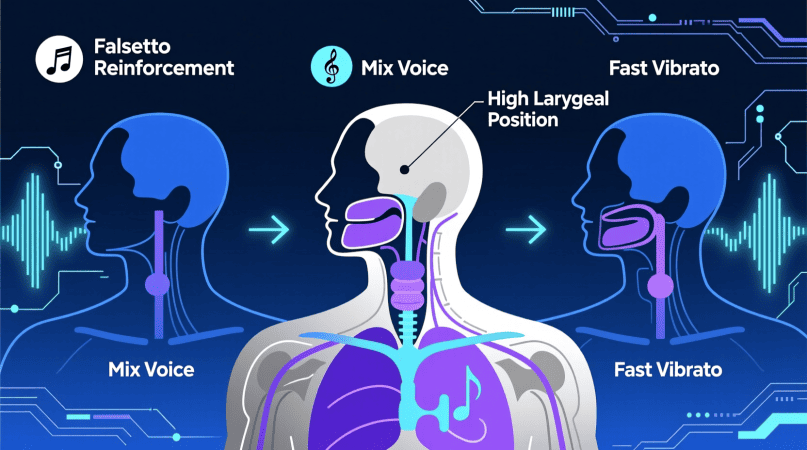
3. High larynx position
This shortens the vocal tract and raises the pitch.
4. Controlled airflow
Too much air = crack.
Too little = nothing.
Vitas finds the perfect balance.
I tried whistle-register exercises once in a quiet room.
Within two minutes, I made such a weird squeak that even my dog looked concerned.
It’s not easy.
Vitas vs Other Extreme-Range Singers
| Singer | Approx. Range | Notes |
|---|---|---|
| Vitas | F2–D8 | Whistle-like high notes, piercing head voice |
| Dimash Kudaibergen | C2–D8 | Classical technique, huge dynamic control |
| Mariah Carey | G2–G7 | Legendary whistle register |
| Axl Rose | F1–B♭6 | Massive rock range |
| Mike Patton | E1–E7 | Versatility across genres |
Vitas absolutely belongs in the “extreme vocalists” category — but with his own unique tone and theatrical style.
Can a Normal Person Learn to Sing Like Vitas?
Short version: No — not fully.
Better version:
You can train your head voice, improve falsetto, and experiment with whistle notes.
But Vitas’ exact combination of:
- genetics
- technique
- tone
- agility
- breath control
…is something you can’t simply “practice into existence.”
I’ve trained for years and still can’t touch the highest Vitas notes.
And that’s okay — appreciating him is part of the fun.
How Your Vocal Range Compares to Vitas’
If you’re curious how your range stacks up against Vitas, use the vocal range test on my site.
It shows:
- Your lowest note
- Your highest note
- Your voice type
- And whether you have any whistle-register potential
And if your range is nowhere near Vitas’?
Welcome to the club.
Frequently Asked Questions
What is Vitas’ vocal range?
Approximately F2–D8, about five to six octaves.
Does Vitas actually hit whistle notes?
Yes — he has demonstrated whistle-register tones live and in studio.
What is his highest note?
Around D8 in whistle register.
Is Vitas a countertenor?
Partially — but he crosses several categories including tenor and male soprano.
Can anyone learn to sing like Vitas?
You can learn elements, but his full ability is extremely rare.
What songs best show his range?
“Opera #2,” “7th Element,” and multiple live operatic performances.