
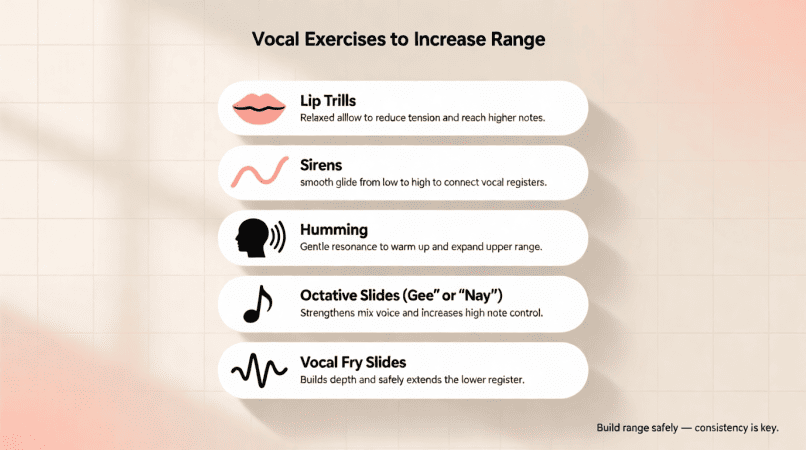
Expanding your vocal range is one of the most important skills a singer can develop. Whether you want to hit higher notes, deepen your lower register, or gain more control across your entire voice, the key is using targeted, scientifically supported vocal exercises that safely increase flexibility, strength, and coordination.
This guide explains how vocal range works, the anatomy behind pitch control, and the most effective exercises singers use to increase their range without strain.
Understanding Vocal Range and How It Expands
Your vocal range is determined by:
- The length, thickness, and flexibility of your vocal folds
- Breath support and subglottal pressure
- The stability and tilt of the larynx
- Resonance placement in the vocal tract
- Coordination between chest, mix, and head registers
While anatomy establishes your baseline potential, technique determines how much of that potential you can access.
Proper training can:
- Strengthen weak registers
- Smooth out vocal breaks
- Improve breath efficiency
- Reduce unnecessary tension
- Extend both high and low ranges
This means most singers can significantly expand their usable range with consistent, correct practice.
Why Vocal Exercises Work for Increasing Range
Effective vocal exercises target the mechanisms that produce pitch:
- The cricothyroid muscle lengthens the vocal folds for high notes
- The thyroarytenoid muscle thickens them for low notes
- Resonance strategies determine how efficiently sound is amplified
- Breath support stabilizes airflow to prevent strain
Expanding range is less about “pushing higher” and more about training the muscles and resonance systems to work together efficiently.
Strengthening breath control becomes easier by following the Breathing Techniques for Singing guide and combining it with routines like the Daily Vocal Warm-Up. You can also enhance high-note stability using tips from the High Notes Singing guide and track your vocal progress with the Vocal Range Test.
Essential Warm-Up Exercises for Range Expansion
Warm-ups prepare your vocal folds for stretching and flexibility.
Lip Trills
Glide smoothly from low to high using relaxed lips.
Benefits:
- Removes throat tension
- Encourages airflow-based phonation
- Blends registers naturally
Gentle Humming Slides
Use a forward hum (“mm”) to slide between pitches.
Benefits:
- Promotes mask resonance
- Warms up both high and low registers
- Encourages steady airflow
“NG” Resonance Warm-Up
Hum the “ng” sound and slide through your mid-range.
Benefits:
- Aligns resonance in the nasal mask
- Reduces tongue tension
- Prepares head voice engagement
Best Vocal Exercises to Increase High Range
Expanding your high range requires increasing flexibility, improving resonance, and strengthening the CT (cricothyroid) mechanism.
Sirens (Full-Range Glides)
Glide from your lowest note to your highest and back down.
Why it works:
- Smooths transitions between chest, mix, and head
- Reduces break tension
- Safely extends upper range
Octave Slides on an Open Vowel
Use “ah,” “oh,” or “ee,” sliding upward across an octave.
Why it works:
- Strengthens CT engagement
- Improves pitch stretch flexibility
- Promotes relaxed high notes
“Nay-Nay-Nay” Brightening Drill
Use a slightly exaggerated “nay” to reach higher notes.
Why it works:
- Encourages forward resonance
- Reduces vocal fold pressure
- Helps lighten the tone for high pitches
Head Voice Activation: “Woo” or “Hoo”
Gently glide upward with a light, airy head voice.
Why it works:
- Builds confidence accessing upper register
- Develops balanced head voice coordination
- Prevents overuse of chest voice
Best Vocal Exercises to Strengthen Low Range
To deepen and strengthen your lower range, focus on exercises that support firm vocal fold closure and relaxed resonance.
Descending “Gee” or “Guh” Patterns
Use a bright attack and descend five-note scales.
Benefits:
- Encourages efficient closure
- Adds clarity and depth to the low register
Low “Uh” Slides
Start slightly above your speaking voice and slide downward.
Benefits:
- Builds stability
- Relaxes larynx for easier low tones
Vocal Fry into Tone
Begin with light fry, then move into full voice.
Benefits:
- Helps develop lower fold closure
- Strengthens the foundation of the low register
Mixed Voice Exercises for Bridging Registers
Developing mixed voice is essential for seamless transitions and safe access to both high and low notes.
“Mum-Mum-Mum” Speech-Level Mix Drill
Use medium volume and a natural speech tone.
Benefits:
- Blends chest and head resonance
- Eliminates strain at the vocal break
Octave Leaps in Mix
Start in chest voice and lightly leap to a mix-dominant higher pitch.
Benefits:
- Teaches upper register stability
- Reduces abrupt register shifts
Advanced Range-Expansion Techniques
These techniques are used by advanced singers and professional voice trainers.
SOVT (Semi-Occluded Vocal Tract) Training
Examples:
- Straw phonation
- Lip trills
- Humming through a narrow tube
Benefits:
- Reduces collision force on vocal folds
- Encourages ideal breath pressure
- Safely increases pitch flexibility
Resonance Tuning
Adjusting vowel shapes to match pitch height improves efficiency.
Benefits:
- Adds resonance “lift” to high notes
- Minimizes laryngeal strain
CT/TA Muscle Coordination Drills
Alternating light and heavy phonation builds balance.
Benefits:
- Extends both high and low range
- Prevents register imbalance
How Often Should You Practice These Exercises?
Recommended routine:
- 5–10 minutes of warm-ups
- 10–20 minutes of targeted range exercises
- 20–30 minutes total, 4–6 days per week
Expected results:
- 2–3 weeks: smoother vocal break
- 4–8 weeks: noticeable range expansion
- 3–6 months: major improvement in flexibility and tone
Common Mistakes That Limit Range Growth
Avoid:
- Pushing chest voice too high
- Over-squeezing the throat
- Singing loudly to reach high notes
- Ignoring breath support
- Skipping warm-ups
- Forcing notes past your comfort zone
Range expansion should feel smooth, not painful or strained.
Measure Your Vocal Range Before Training
Understanding your starting range helps you choose the right exercises.
The Vocal Range Test lets you identify:
- Your lowest and highest controlled notes
- Your comfortable tessitura
- Your likely voice type
- Your register strengths and weaknesses
Tracking progress helps you train more effectively.
Frequently Asked Questions
Can anyone increase their vocal range?
Most singers can expand their usable range with proper technique and consistent practice.
How quickly can vocal range improve?
Some improvements appear within weeks, but long-term range expansion takes months of training.
Do I need head voice to sing higher notes?
Yes. Head voice is essential for accessing the upper register safely.
Can vocal fry help low notes?
Used correctly, vocal fry can strengthen fold closure and deepen your low register.
Does singing louder increase range?
No. Volume does not expand range; technique does.
Conclusion
Increasing your vocal range is a combination of science, consistency, and proper technique. By strengthening breath support, improving register coordination, and practicing targeted exercises for high and low notes, you can safely expand your range and gain greater vocal control.