
Voice Frequency Test
Voice Frequency Test – Measure Your Vocal Hz Range, Speaking Frequency & Voice Depth
Your voice is as unique as a fingerprint. It carries not just words, but emotion, identity, and biological data. At the core of this unique sound signature is Voice Frequency—a measurable metric that defines how high or low your voice sounds to the human ear.
Whether you are a vocalist looking to expand your range, a podcaster seeking that “radio quality” sound, or simply curious about the physics of your speech, understanding voice frequency is the key to unlocking your vocal potential.
In this comprehensive guide, we will dive deep into the science of Hertz (Hz), analyze standard frequency ranges, and provide actionable steps to improve your vocal control using data from our Voice Frequency Analyzer.
The Science of Sound: What is Voice Frequency?
To understand voice frequency, we must look at the physics of sound production. When you speak or sing, air from your lungs passes through your larynx (voice box), causing your vocal folds (cords) to vibrate.
Voice Frequency is the speed of this vibration, measured in Hertz (Hz). One Hertz equals one vibration cycle per second.
- 100 Hz: The vocal cords are vibrating 100 times per second (a lower, deeper sound).
- 300 Hz: The vocal cords are vibrating 300 times per second (a higher, brighter sound).
Fundamental Frequency ($F_0$) vs. Harmonics
When you use our tool, the primary number you see is the Fundamental Frequency ($F_0$). This represents the lowest and strongest component of the sound wave—essentially, the “note” you are speaking or singing.
However, the human voice is complex. Layered on top of this fundamental frequency are harmonics (overtones). These are multiples of the base frequency that give your voice its “timbre” or color (e.g., breathy, brassy, rich, or nasal). While our analyzer tracks the raw Hz of your pitch, understanding the interplay between pitch and tone is crucial for advanced vocalists.
Analyzing Your Results: Standard Frequency Ranges
After running the test above, you will see three key metrics: Average, Lowest, and Highest Hz. But what do these numbers mean in the real world?
While every individual is unique, acoustic research provides us with standard baselines for human speech.
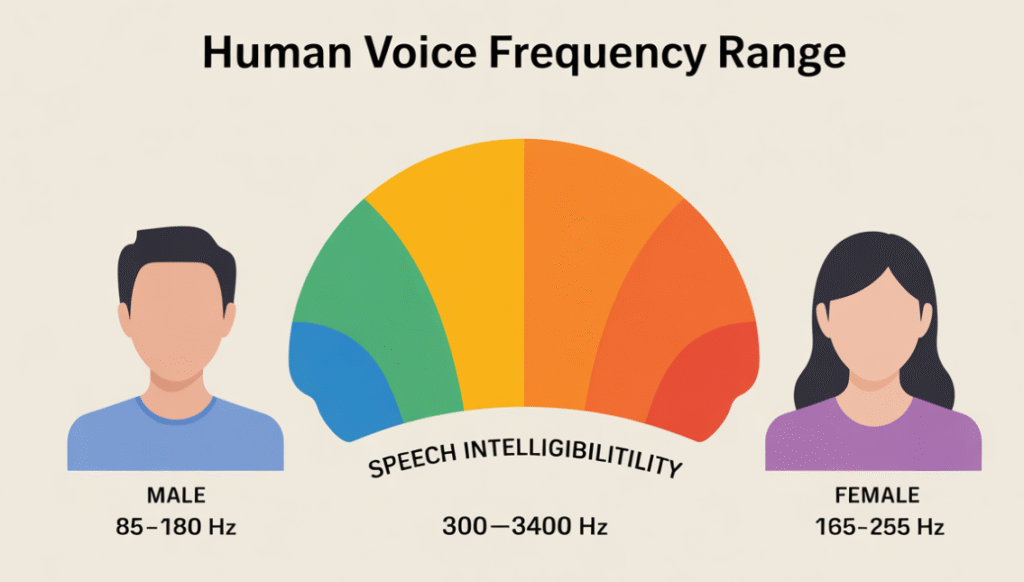
1. Adult Male Voice (Typical Range)
- Average Speaking Frequency: 85 Hz – 180 Hz
- Characteristics: Male vocal cords are typically longer and thicker (often due to the effects of testosterone during puberty), resulting in slower vibrations and a lower pitch.
- Deep Bass Range: Men with exceptionally deep voices may register between 60 Hz and 90 Hz. If your result falls in this lower bracket, you should verify your sub-bass capabilities with our specialized Deep Voice Test.
2. Adult Female Voice (Typical Range)
- Average Speaking Frequency: 165 Hz – 255 Hz
- Characteristics: Female vocal cords are generally shorter and thinner, vibrating at a faster rate.
- Soprano Speaking Voice: Some women naturally speak at a higher pitch, averaging above 250 Hz.
3. Children’s Voices
- Average Range: 250 Hz – 300 Hz+
- Before puberty, vocal cord structure is similar across genders, resulting in higher, brighter frequencies for both boys and girls.
4. The “Androgynous” Range
- Frequency: 145 Hz – 175 Hz
- This is often considered a gender-neutral frequency range. Speakers in this zone may be perceived as either male or female depending on other acoustic factors like resonance and inflection.
Translating Hertz into Musical Notes
For musicians, a raw Hz number might feel abstract. It is often more useful to translate these frequencies into musical notes to understand your position on the piano keyboard.
Here is a quick reference for common speaking pitches:
- E2 (82 Hz): A very deep, resonant bass speaking voice.
- C3 (130 Hz): A typical baritone/tenor speaking pitch.
- G3 (196 Hz): A typical alto/mezzo speaking pitch.
- C4 (261 Hz): Middle C – a high speaking pitch or soprano range.
If you want to map these frequencies precisely to your singing capabilities, we recommend using our Vocal Range Calculator, which converts frequency data into octaves and semitones.
Voice Types and Frequency Correlations
While your speaking voice frequency ($F_0$) is not the only factor in determining your singing voice type, there is often a strong correlation.
A person with a naturally low speaking frequency (e.g., 90 Hz) is statistically more likely to be a Bass or Baritone, while someone with a high resting pitch (e.g., 240 Hz) is likely a Soprano.
The Major Voice Categories
- Bass: The lowest male voice type. Comfortable singing range usually lies between E2 and E4.
- Baritone: The most common male voice type, sitting between bass and tenor.
- Tenor: The highest male chest voice type.
- Alto/Contralto: The lowest female voice type, known for a rich, dark timbre.
- Mezzo-Soprano: The middle female voice type.
- Soprano: The highest female voice type.
To determine exactly where you fit, simply knowing your speaking Hz is not enough; you must test the limits of your singable range. You can do this comprehensively with our Voice Type Guide.
Factors That Influence Your Voice Frequency
You may notice that your results fluctuate if you take the test at different times. Voice frequency is not static; it is a dynamic metric influenced by biology, environment, and psychology.
1. The “Morning Voice” Phenomenon
Most people wake up with a significantly lower voice. During sleep, fluid accumulates in the tissues of the throat and vocal cords, making them heavier and thicker. Heavier cords vibrate slower, resulting in a lower Hz. As you move around and hydrate, the fluid drains, and your pitch rises.
2. Hydration and Health
Your vocal cords are coated in a mucous membrane that requires hydration to vibrate efficiently. Dehydration can lead to sticky, irregular vibrations (jitter), which may artificially alter your detected pitch. Conversely, inflammation from a cold or acid reflux can swell the cords, lowering your pitch.
- Learn more: Vocal Health Tips for Singers
3. Emotional State
Your larynx (voice box) is highly responsive to stress.
- Stress/Anxiety: Muscles tighten, pulling the larynx upward and stretching the cords tight. This raises your pitch (High Hz).
- Relaxation/Confidence: Muscles relax, allowing the larynx to settle. This lowers your pitch (Low Hz) and increases resonance.
4. The Proximity Effect
If you are a podcaster or content creator, the distance from your microphone changes the perceived frequency. Getting very close to a directional microphone boosts low frequencies (the bass range). While this doesn’t change your actual vocal cord vibration, it alters the acoustic profile.
- Check your setup: Microphone Tester
Pitch Stability: The Mark of a Pro
When analyzing your voice, don’t just look at the Average number. Look at the Lowest and Highest numbers to gauge your Pitch Stability and Dynamic Range.
Speaking Voice Dynamics
A “monotone” speaker will have a very narrow gap between their lowest and highest Hz (e.g., staying between 110 Hz and 115 Hz). While this indicates stability, it can be boring to listen to. Dynamic speakers use a wider range of frequencies to convey emotion, emphasis, and charisma.
Singing Pitch Stability
In singing, the goal is different. If you are trying to hold a single note (e.g., A4), you want your Hz to remain dead steady. If the tool shows your frequency jumping wildly while holding a note, you may have issues with breath support or ear-to-voice coordination.
How to Fix Unstable Pitch:
- Breath Control: An unsteady airstream causes an unsteady pitch. Master diaphragmatic breathing to provide a consistent column of air.
- Resource: Breathing Techniques for Singing
- Ear Training: Sometimes the issue isn’t the throat, but the ear. If you cannot hear the micro-fluctuations in your pitch, you cannot correct them.
- Tool: Ear Training Game
Practical Applications of Frequency Analysis
Why should you care about your Hz? Here are practical applications for different users:
For Singers
Use the frequency analyzer to track your warm-up progress. A good Daily Vocal Warm-Up should stretch your cords, allowing you to hit higher highs and lower lows than your resting speaking voice. By tracking your max/min Hz before and after warming up, you can objectively measure the effectiveness of your routine.
For Podcasters and Speakers
A lower fundamental frequency is often associated with authority and calmness, while a highly variable frequency range is associated with excitement and storytelling.
- Actionable Tip: Record yourself reading a script. If your Hz graph looks flat, try to consciously vary your pitch to improve listener engagement.
For Gender Affirming Voice Training
Individuals undergoing voice masculinization or feminization training use Hz tracking as a primary feedback loop.
- Masculinization Goals: Aiming to lower average Hz below 160 Hz and reducing pitch variance (more monotone delivery).
- Feminization Goals: Aiming to raise average Hz above 180 Hz and increasing pitch variance (more melodic delivery).
Advanced Analysis: Beyond the Hz
While the Voice Frequency Analyzer gives you the raw data on your pitch, a truly professional vocal assessment requires analyzing Tone Quality, Rhythm, and Timbre.
For example, two singers might hit the exact same 440 Hz (A4), but one might sound strained and thin while the other sounds resonant and powerful. This difference is not in the frequency, but in the harmonics and technique.
To get a complete picture of your vocal capabilities, we recommend running a full AI Voice Analysis. This advanced tool goes beyond simple pitch detection to analyze your clarity, breath control, and overall vocal health.
How to Compare Your Voice to the Pros
Have you ever wondered if your voice frequency matches your favorite artist?
Many famous singers have distinct speaking and singing frequencies. For example, Barry White had an famously low speaking fundamental frequency, often dipping below 70 Hz, while Ariana Grande possesses a naturally higher, lighter speaking voice.
Comparing your frequency stats to established artists can help you find repertoire that suits your natural physiology. If your fundamental frequency aligns with a specific artist, their songs will likely sit comfortably in your tessitura (most comfortable range).
- Find your match: Singer Comparison Tool