
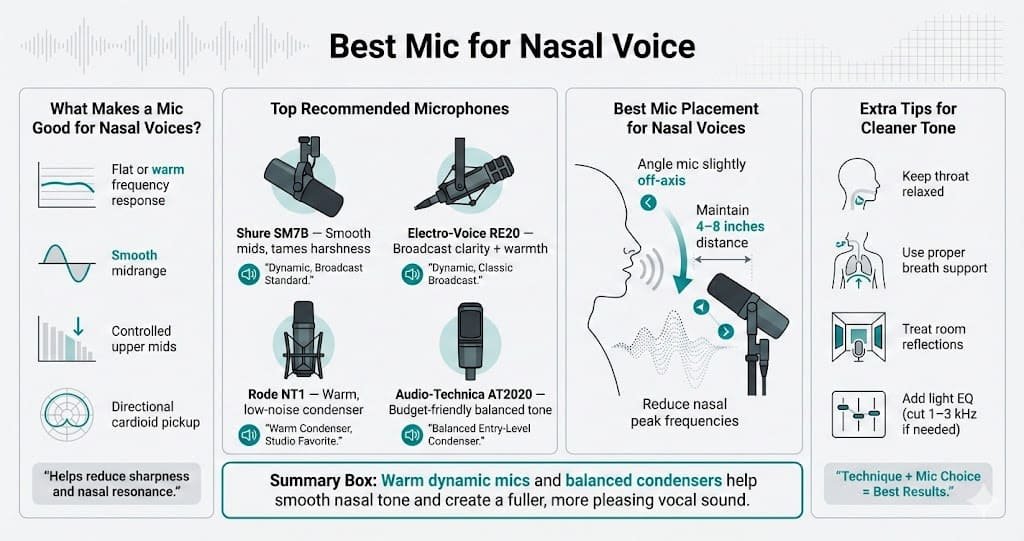
A nasal voice can sound sharp, thin, or honky in recordings—especially on microphones that emphasize the upper midrange. The right microphone, however, can make a nasal voice sound warm, smooth, and professionally balanced.
This guide provides expert insight into the acoustics of nasal tone, the microphone traits that reduce harshness, and the best mics for every budget and purpose.
Why Nasal Voices Sound Worse on Some Microphones
A nasal voice resonates heavily in the nasal cavity rather than the mouth and chest. Acoustically, nasal voices typically have:
- A strong boost in the 1–4 kHz range
- Reduced low-mid warmth
- Narrow resonance peaks
- Thin or pointed timbre
This exact region (1–4 kHz) is where many microphones add a “presence boost.” When a mic exaggerates those frequencies, your nasal tone becomes even sharper.
The solution: choose a microphone that naturally controls upper mids, enhances low-mid warmth, and smooths harsh frequencies.
What Makes a Microphone Good for Nasal Voices
1. Frequency Response
A nasal-friendly mic should have:
- Minimal boost in the 1–4 kHz “nasal” zone
- Balanced or warm low-mid range
- No aggressive high-frequency peaks
2. Mic Type
Dynamic microphones are most forgiving for nasal voices because they soften midrange harshness. Condenser mics must be warm or neutral to avoid exaggerating brightness.
3. Polar Pattern
Cardioid or hypercardioid patterns reduce reflective nasal reflections from the room.
4. Proximity Effect
Dynamic mics allow controlled bass enhancement, adding warmth to thin vocals.
Best Microphones for Nasal Voices (Expert Picks)
Below is the industry’s most comprehensive list of mics that naturally tame nasal harshness.
A. Best Studio Microphones for Nasal Voice
1. Shure SM7B — The Gold Standard for Nasal Voices
Why it works:
- Smooth, flat mids
- Warm low-end fills thin tones
- Controlled highs reduce nasal “bite”
- Fantastic for untreated rooms
Used by major artists and broadcasters, the SM7B almost always improves nasal voices.
2. Electro-Voice RE20 — Best for Broadcast Warmth
Strengths:
- No exaggerated proximity effect
- Elegant, balanced mids
- Radio-quality richness
It adds body and depth to nasal voices without muddying clarity.
3. Shure SM57 + Foam Windscreen — Best Affordable Studio Solution
Warm, controlled mids and a smooth top end make the SM57 a powerful budget option when paired with a thick foam windscreen.
B. Best Live Performance Mics for Nasal Voice
4. Shure SM58 — Best Live Mic to Tame Nasal Harshness
Why it works:
- Gentle upper mids
- Durable and forgiving
- Classic vocal tone without harsh edges
Ideal for singers whose nasal tone becomes sharper on stage.
5. Sennheiser e935 — Clear but Not Harsh
Provides clarity without over-emphasizing nasal frequencies.
C. Best USB Microphones for Nasal Voice
6. Blue Yeti (Cardioid Mode)
Use low gain and slight off-axis placement to reduce brightness. For streaming and podcasting, it’s the best budget USB choice.
D. Best Budget Microphones for Nasal Voice
7. Audio-Technica AT2020 — Best Low-Cost Studio Condenser
Neutral mids and smooth highs make the AT2020 surprisingly forgiving for nasal voices.
8. AKG P120 — Great Warmth for Beginners
Non-hyped upper mids and strong low-mid body make this one of the best cheapest options.
Mic Placement Techniques to Reduce Nasality
Correct placement is just as important as mic choice.
1. Place the mic slightly below your mouth
Reduces airflow from the nose reaching the diaphragm.
2. Use 20°–45° off-axis
Softens sharp nasal harmonics.
3. Keep 6–10 inches of distance
Prevents midrange buildup.
4. Do not point directly toward nostrils
This drastically increases nasality.
5. Use controlled proximity effect
Moving closer adds warmth and masks nasal tone.
Mixing Tips to Fix Nasal Voice in Post-Production
1. Cut 1–4 kHz (nasal peak zone)
Dynamic EQ works best.
2. Add warmth at 150–300 Hz
Restores fullness.
3. Add high-end air (8–12 kHz)
Makes vocals sound open, not dull.
4. Use saturation for thickness
Tape or tube-style saturation reduces sharpness.
5. Light multiband compression
Controls fluctuating nasal resonance.
Signs You’re Using the Wrong Mic for a Nasal Voice
- Voice becomes sharper or harsher
- Sounds thin or papery
- Increased “honk” around 2–4 kHz
- Vocal tone feels unpleasant during monitoring
- High mids dominate even with EQ
If this happens:
Switch to a dynamic mic immediately.
Final Verdict — Best Mic for Nasal Voice
Best Overall: Shure SM7B
Produces the smoothest, warmest tone for nearly all nasal voices.
Best Broadcast Option: Electro-Voice RE20
Adds authority and body without exaggerating midrange.
Best Live Mic: Shure SM58
Reliable and forgiving on stage.
Best Budget Picks:
Shure SM57, AT2020, AKG P120
Best USB Choice:
Blue Yeti (Cardioid Mode)
Conclusion
A nasal voice can absolutely sound professional, warm, and full—with the right microphone and technique. A good mic will minimize harshness, smooth upper mids, and balance tone naturally.
- Cleaning up nasal tone starts with understanding how the vocal cords work.
- Many nasal issues are improved through proper adult vocal coaching focused on resonance control.
- Singers with thin tone benefit from foundational beginner singing lessons.
- Studio clarity improves when you follow proven vocal range exercises.
- Mic choice depends on style, which is why reviewing John Legend’s vocal range gives useful reference for warm baritone recording.
- For pop-oriented nasal reduction, studying Billie Eilish’s vocal range helps model intimate mic technique.
- To compare recording-focused training, the best online singing lessons hub reviews programs that include mic technique.
Erika Parker is a vocal analysis and singing education writer at Vocal Range Test. She focuses on vocal range testing, voice type analysis, pitch recognition, and singing tools for vocalists, musicians, choir singers, and beginners.