
Benson Boone’s vocal range spans approximately C3 to A5, placing him firmly in the high tenor category. His voice is defined by a breath-rich emotional tone, a smooth, resonant mix voice, and a delicate but controlled falsetto that he uses to shape the cinematic, introspective style characteristic of his hits like “Beautiful Things,” “Ghost Town,” and “In the Stars.”
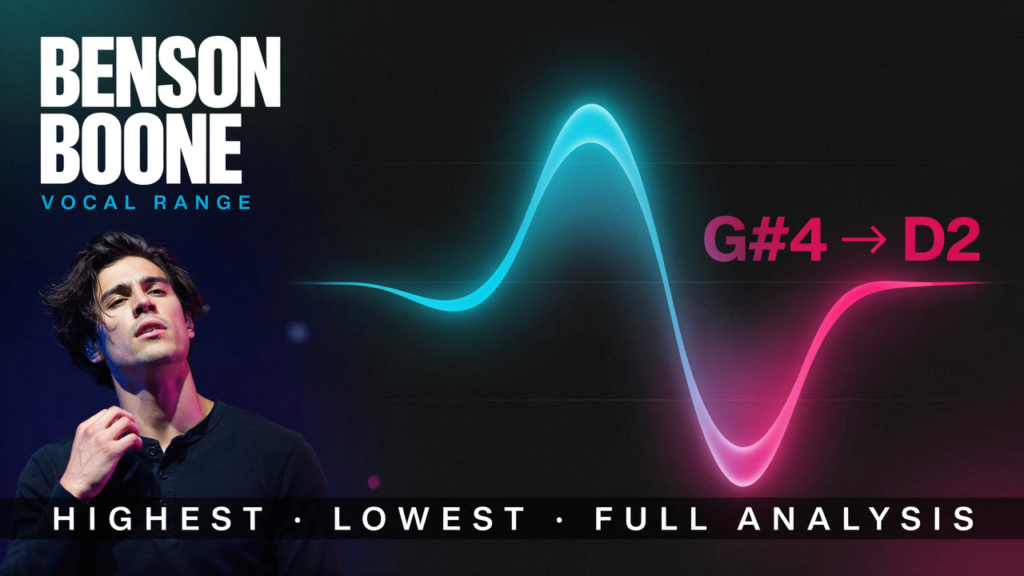
Benson Boone’s Full Vocal Range (C3 – A5)
Benson Boone exhibits a functional, expressive range from C3 in the lower chest register to A5 in falsetto/mix. His range is not unusually large, but what makes him stand out is the quality of tone, control, and stylistic expression across his range.
Technical Range Overview
| Attribute | Detail |
|---|---|
| Total Range | C3 to A5 |
| Tessitura | G3 to E5 |
| Voice Type | High Tenor (Lyric/Pop Tenor) |
| Dominant Registers | Mix voice, falsetto, breathy midrange |
| Signature Tone | Soft, cinematic, emotional, breath-supported |
He prioritizes texture and emotion over extreme notes.
What Voice Type Is Benson Boone? (High Tenor)
Benson Boone is a high tenor, specifically in the lyric-pop tenor category.
Why He Classifies as a High Tenor
- Naturally bright upper register
- Clean access to E5 in mix
- Comfortable falsetto above F5
- Forward-placed resonance
- Agile midrange with pop-friendly coloration
His Vocal Identity Characteristics
- Light but resonant chest voice
- Smooth head-voice connection
- Whispery-falsetto transitions
- Controlled upper dynamic range
Final Classification
High Tenor with a cinematic, emotional vocal aesthetic.
Consistency comes from repetition, and following the daily vocal warm-up helps keep your voice responsive. When your schedule is tight, the quick warm-up routine still activates essential muscles. Over time, you can reinforce these habits through the structured vocal range improvement plan.
Benson Boone’s Highest Notes (Up to A5)
His highest notes typically appear during emotional climaxes in choruses or live embellishments.
Highest Verified Notes
- A5 — falsetto/mix peak (live riffs)
- G5 — common falsetto apex
- E5–F5 — strong mix-voice peaks in chorus climaxes
Song Evidence of High Notes
- “Beautiful Things” — mix voice peaking around E5–F5
- “In the Stars” — elevated falsetto lines reaching G5
- “Ghost Town” — falsetto peaks and controlled soft head-voice
- Live acoustic sessions — improvisational notes around A5
Traits of His Upper Register
- Light, airy falsetto (not reinforced, intentionally soft)
- Mix voice that is warm rather than belt-heavy
- Carefully moderated airflow
- Emotion > volume approach
Boone’s high notes are not about power—they are about intimacy, softness, and emotional vulnerability.
Benson Boone’s Lowest Notes (Down to C3)
His low notes are gentle, contained, and clean—rarely showcased but consistently stable.
Lowest Verified Notes
- C3 — lowest chest note documented
- D3–E3 — commonly used in intros and verses
Low Register Traits
- Light, warm resonance
- Controlled breath flow
- Smooth phrasing with clear articulation
- Not heavy or baritonal—natural for a high tenor
His lower range complements his emotional ballad style.
Register-by-Register Breakdown (Advanced Technical Analysis)
Chest Voice (C3 – G4)
Boone’s chest voice is light, warm, and purposefully understated.
Technical Features:
- Minimal glottal compression
- Soft, rounded vowels
- Pop-ballad dynamic control
- Intimate mic technique
He avoids heavy belting, choosing clarity and vulnerability.
Mixed Voice (G4 – E5/F5)
This register carries his emotional peaks.
Technical Features:
- Balanced chest-head resonance
- Slight “floaty” quality for modern indie-pop tone
- Smooth vowel modification
- Controlled energy without strain
This mix is similar to Shawn Mendes and Stephen Sanchez in tonal approach.
Falsetto / Head Voice (F5 – A5)
One of his signature vocal tools.
Technical Features:
- Breath-led, not reinforced
- Gentle oscillating vibrato
- Crisp, clean tone with minimal rasp
- Seamless transition from mix to falsetto
This falsetto helps create his cinematic, ethereal sound.
What Makes Benson Boone’s Voice Unique?
1. Emotional Breathwork
He uses breath intentionally to create:
- Warmth
- Intimacy
- Space in phrases
- A “sighing” emotional quality
2. Cinematic Pop-Folk Tone
His sound blends:
- Indie folk softness
- Pop clarity
- Singer-songwriter sincerity
3. Light Mix Instead of Heavy Belting
Unlike rock/pop tenors, he maintains:
- Round vowels
- Lower intensity
- Emotional focus
4. Seamless Register Transitions
Transitions are nearly imperceptible—one of his strongest technical assets.
5. Expressive Phrasing
He varies:
- Dynamics
- Vibrato
- Breath length
- Tonal shading
To create emotional depth.
How Benson Boone’s Voice Has Evolved
Early Career (TikTok & Idol Era)
- Softer delivery
- Heavier reliance on falsetto
- Less developed mix
Breakout Phase (Ghost Town → Beautiful Things)
- Stronger chest–mix core
- More consistent pitch accuracy
- Improved breath planning
Recent Era (2023–2025)
- Matured tonal warmth
- Expanded dynamic range
- Better control in emotional belting
- Increased vocal artistry
As a young singer, Boone’s voice will likely grow deeper and darker with age, expanding downwards and strengthening his mix.
Benson Boone Vocal Range Chart
C3 ——— E3 ——— A3 ——— D4 ——— G4 ——— E5 ——— A5
 Low       Low-Mid     Mid       Upper Mid     Mix Zone     Falsetto Peak
His sweet spot lies between A3 and E5, where his tone is most emotionally compelling.
Best Songs to Hear His Range
Low & Midrange
- “Ghost Town”
- “Hollow”
Mix Voice Strength
- “Beautiful Things”
- “Before You”
- “In the Stars”
- “Lovely Darling” (live sessions)
These tracks chart his entire expressive spectrum.
Frequently Asked Questions
What is Benson Boone’s vocal range?
Approximately C3–A5.
What voice type is Benson Boone?
A high tenor with a light, emotional tone.
Does he belt?
Yes, but softly and in a controlled mix—not a heavy belt.
Why does his voice sound emotional?
He uses breath-dominant phrasing, warm resonance, and gentle falsetto to create emotional coloring.
What is his highest note?
Around A5 (falsetto/mix).
What is his lowest note?
Approximately C3.
Does he use falsetto often?
Yes—falsetto is central to his vocal identity.
Is he trained?
Not classically; his technique has matured primarily through stylistic development.
- Benson Boone’s soaring tenor placement is easiest to classify using what are the male vocal ranges.
- His extreme upper extension stands out when compared with is 4 octaves a good vocal range.
- You can map your own highest notes against his by using singingrangetest.
- The mechanics behind his clean high notes are explained in how vocal cords produce different pitches.
- His ability to sustain piercing highs relies on techniques in how to sing high notes without straining.
- To compare his span with other young vocal standouts, which famous singer matches your vocal range offers valuable context.
Erika Parker is a vocal analysis and singing education writer at Vocal Range Test. She focuses on vocal range testing, voice type analysis, pitch recognition, and singing tools for vocalists, musicians, choir singers, and beginners.