
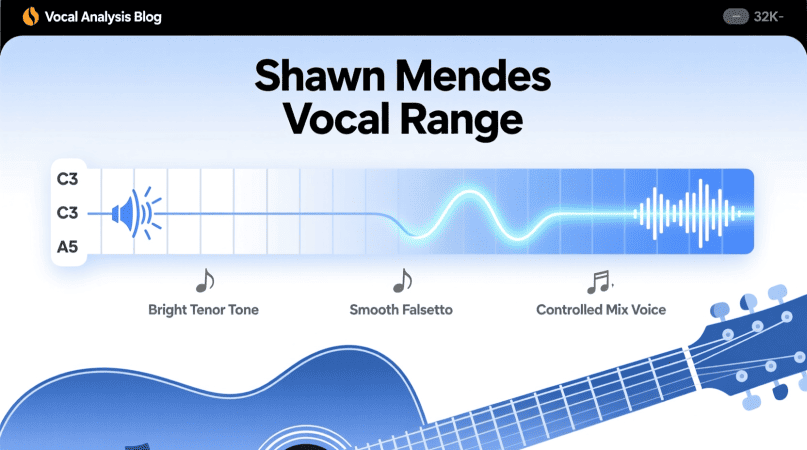
Shawn Mendes has one of those voices that feels effortless and emotional at the same time. He doesn’t rely on massive belts or flashy vocal tricks. Instead, he uses clarity, control, and vulnerability—qualities that make his music hit harder than any high note ever could.
But what exactly is Shawn Mendes’s vocal range, what voice type does he have, and why does his singing feel so comforting and sincere?
To answer that, we’ll look at real vocal analysis, examples from his songs, and—just as importantly—what happened when I tried to sing like him. Spoiler: it was humbling.
Shawn Mendes’s Vocal Range: A2 – A5
Shawn Mendes’s voice spans from:
- Lowest note: A2
- Highest note: A5 (falsetto/live runs)
A full three-octave range, which places him in a strong position among modern pop tenors.
But Shawn’s range itself isn’t what makes him special. Plenty of singers can hit those notes. What sets him apart is how he moves through those notes—with warmth, restraint, and absolute emotional intention.
Shawn Mendes’s Voice Type: Lyric Tenor with a Smooth, Emotional Tone
Shawn Mendes is classified as a lyric tenor, which fits him perfectly. He has:
- A naturally bright upper register
- A gentle, breathy tone during quiet moments
- Smooth, clean phrasing
- A youthful resonance that still carries maturity
One interesting thing about Shawn’s voice is how his tone matured from a slightly nasal, bright teen sound into a warmer, more grounded adult tenor. It’s a beautiful evolution that mirrors his songwriting growth.
What Happened When I Tried Singing Shawn Mendes
I’ll be real with you: singing Shawn Mendes seems easy. He doesn’t belt like Kelly Clarkson or leap around like Bruno Mars. His songs stay in a familiar, comfortable range… until you actually try singing them.
The first song I attempted was “In My Blood.”
The verse felt fine—smooth, conversational, simple.
But the chorus?
Yeah… that part woke me up quickly.
Problem 1: His “breathy softness” is incredibly hard.
When I tried to imitate his gentle, airy delivery, I just ended up sounding weak. Shawn’s breathiness isn’t accidental—it’s supported, controlled, intentional.
Problem 2: His G4–A4 notes require a clean, stable mixed voice.
These notes are deceptively tricky. Shawn hits them with zero strain.
My version?
Let’s just say dogs probably heard me struggling.
Problem 3: He uses long, emotional lines that demand real breath control.
When Shawn sings a phrase, it feels like one smooth emotional exhale.
Me? I ran out of breath halfway through the line like someone pulled my battery.
Trying to copy him taught me something important:
Soft singing isn’t easy singing. It’s advanced singing.
Shawn Mendes Vocal Range Breakdown (By Register + Song Examples)
| Register | Notes | What It Sounds Like | Song Examples |
|---|---|---|---|
| Low Register | A2 – D3 | Warm, quiet, grounded | “Mercy,” “In My Blood” verse |
| Middle Range | E3 – G4 | Clear, emotional, expressive | “Stitches,” “Wonder,” “Treat You Better” |
| Mixed Voice | G4 – A4 | Bright, smooth, slightly breathy | “Lost in Japan,” “There’s Nothing Holdin’ Me Back” |
| Falsetto | A4 – A5 | Soft, intimate, floating | “Never Be Alone,” “Ruin,” “Like to Be You” |
This distribution is part of what makes Shawn so relatable. His songs sit in a range many people can attempt, but few can replicate with his level of control.
Shawn Mendes’s Highest Notes
Shawn regularly hits:
- A4 (chorus peaks)
- B4 (falsetto flips and live variations)
- A5 (in select live falsetto runs)
He doesn’t chase whistle tones or explosive high belts—his highs are gentle and emotional, not showy.
Shawn Mendes’s Lowest Notes
His low notes show up in intimate, emotional sections:
- A2 in some live performance intros
- B2–D3 in ballads and verses (“In My Blood,” “Mercy”)
His lows aren’t booming like a baritone’s, but they’re solid and warm enough to give his songs emotional depth.
Why Shawn Mendes’s Voice Feels So Emotional
Here’s something I learned trying to imitate him:
Shawn Mendes’s voice works because he doesn’t push for perfection. He leans into sincerity.
Here’s what makes his tone so effective:
1. Controlled Breathiness
Shawn adds air to his tone without losing support. This gives his singing a soft glow rather than a weak sound.
2. Clean, rounded vowel shapes
“Aah,” “oh,” and “ee” vowels stay open and relaxed. That’s why his tone feels “smooth around the edges.”
3. A strong but gentle mixed voice
Around G4–A4, many singers either belt too hard or flip too early. Shawn finds the middle.
4. Emotional timing
He sometimes delays a phrase by just a millisecond—enough to make it feel thoughtful and alive.
5. Natural resonance
A signature youthful brightness that still carries weight.
How Shawn Mendes’s Voice Has Evolved Over Time
Early Career (Vine / Handwritten Era)
- Brighter, thinner tone
- More nasal placement
- Reliance on falsetto
Mid Career (Illuminate / Shawn Mendes)
- Stronger chest voice
- Control over mix
- More confident tone
Recent Era (Wonder / Live Performances)
- Warmer resonance
- Reduced nasality
- Better dynamic control
- More emotional phrasing
His evolution shows dedication—not just talent.
How Shawn Mendes Compares to Other Male Pop Vocalists
| Artist | Vocal Range | Voice Type | Key Strength |
|---|---|---|---|
| Shawn Mendes | A2–A5 | Lyric Tenor | Smooth mix & emotional tone |
| Justin Bieber | F#2–C6 | Light Tenor | High agility & bright falsetto |
| Charlie Puth | C2–G5 | Tenor | Perfect pitch & control |
| Harry Styles | C3–A5 | Bari-Tenor | Warm tone & character |
| Bruno Mars | A2–D6 | Tenor | Power belts |
Shawn fits comfortably among top-tier male pop vocalists—not because he’s the most technical, but because he’s one of the most emotionally effective.
Want to Compare Your Vocal Range to Shawn Mendes?
When I checked my vocal range against his, I realized two things:
- My mid-range wasn’t nearly as controlled as his.
- My falsetto lacked the smoothness he makes sound so easy.
Testing your range gives you a clear picture of:
- Where your voice naturally sits
- Why certain Shawn Mendes songs feel easier or harder
- What parts of your technique need attention
It’s one of the fastest ways to understand your singing identity.
- To see how wide your own voice really is, use the vocal range calculator for a precise result.
- His light tenor placement can be confirmed through the voice type test.
- Many of his strongest high notes fall within what’s shown on the tenor vocal range guide.
- You can also check how many octaves you personally sing by trying this tool.
- To analyze the pitch accuracy behind his vocals, the voice frequency test provides real data.
- If his vocal control inspires you to improve, learn more about a structured way to expand your range.
Erika Parker is a vocal analysis and singing education writer at Vocal Range Test. She focuses on vocal range testing, voice type analysis, pitch recognition, and singing tools for vocalists, musicians, choir singers, and beginners.