
Fiona Apple possesses one of the most singular voices in alternative music—dark, chest-heavy, emotionally charged, and delivered with an unfiltered honesty that distinguishes her from both mainstream pop and traditional jazz vocalists. She doesn’t approach singing as an exercise in technical perfection; instead, she treats her voice as an expressive instrument that communicates psychological intensity and lyrical depth.
This comprehensive guide examines Fiona Apple’s vocal range, voice type, highest and lowest notes, tonal architecture, and how her voice evolved across her acclaimed discography.
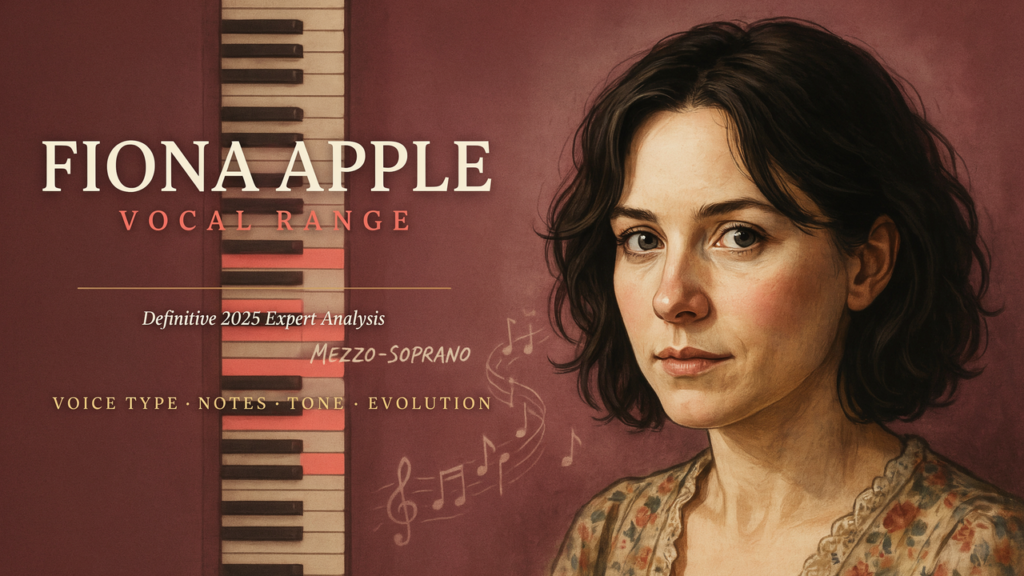
Fiona Apple’s Vocal Range: C3 – E5 (Approx. 2 Octaves)
Fiona Apple’s documented vocal range spans: C3 – E5
(roughly two octaves)
However, the significance of this range lies not in its width but in how she uses it—intentionally raw, dramatically weighted, and emotionally unpredictable.
Lowest Register (C3–E3)
Her lower range is one of her trademarks—dark, smoky, and chest-dominant.
Examples:
- “Shadowboxer” – C3–D3 lows that sound tense and intimate
- “I Know” – resonant lower storytelling tone
- “Newspaper” (2020) – somber mid-low phrasing with emotional restraint
Middle Register (F3–C5): Her Primary Tessitura
This is where Fiona’s vocal identity crystallizes:
- Weighted chest resonance
- Grit-infused edge and vocal fry
- Rhythmic, percussive diction
- Emotional oscillation between fragility and power
Upper Register (C5–E5)
Fiona seldom uses her upper register for clarity or brightness. Instead, highs appear as:
- Emotional exclamations
- Ragged, intense climaxes
- Purposefully unpolished bursts of expression
Examples:
- “Criminal” – controlled E5 peaks
- “Every Single Night” – playful yet tense upper phrases
- “On the Bound” – expressive climactic high tones
Her highs are expressive tools, not technical centers.
Fiona Apple’s Voice Type: Mezzo-Soprano With Contralto-Like Timbre
Though technically a mezzo-soprano, Fiona Apple’s vocal color strongly resembles a contralto due to her tonal shaping and resonance strategy.
Mezzo-Soprano Traits
- Natural tessitura around F3–C5
- Comfortable mid-range strength
- Ability to project with chest-mix in the upper third octave
- Difficulty-free access to moderate head-voice expansion
Contralto-Like Qualities
- Thick, low-centered chest resonance
- Dark tonal palette
- Weighty phonation habits
- Lower-set speaking voice
Fiona’s dark timbre is not simply anatomical—it is an aesthetic choice reinforced by her production style, songwriting, and emotional performance technique.
If you’re curious about vocal outliers, the widest vocal range page highlights singers with exceptional spans. Compare your own range using the vocal range test, then see how your notes align with pro singers through the singer comparison tool.
Why Fiona Apple’s Voice Sounds Dark, Raw, and Emotionally Charged
Fiona Apple’s vocal identity is shaped by three primary elements: placement, texture, and psychological intention.
1. Chest-Dominant Resonance
She anchors most of her singing—low, mid, and even some upper notes—firmly in chest voice.
Effects:
- Full-bodied tone
- Grit and weight
- Intense, almost visceral energy
2. Controlled Rasp & Vocal Compression
Fiona often sings with intentional turbulence in her sound:
- Subtle rasp
- Vocal fry transitions
- Compression-driven “growl” during climaxes
3. Speech-Inflected Phrasing
Her phrasing often resembles spoken language rather than melismatic singing.
This gives her vocals:
- Conversational immediacy
- Rhythmic punch
- Psychological realism
4. Dynamic Volatility
She moves rapidly between whisper-light softness and explosive resonance—matching lyrical emotional states rather than technical expectations.
5. Minimal Traditional Head Voice
She avoids classical head resonance, which preserves emotional rawness but limits bright upper voicing.
Fiona Apple’s singing is an expressive philosophy, not a technical blueprint.
Highest & Lowest Notes (With Verified Song Examples)
Lowest Notes (C3–D3)
- “Shadowboxer” – clear, resonant C3
- “I Know” – warm, grounded D3
- “Fetch the Bolt Cutters” – conversational lows recurring in the C3 range
Her low notes are unusually rich for a mezzo-soprano.
Highest Notes (D5–E5)
- “Criminal” – E5 at emotional peaks
- “Every Single Night” – D5 in expressive bursts
- “On the Bound” – mix-driven high moments
These highs are intentionally strained or emotionally turbulent—they are part of her storytelling, not technical showcases.
Technical Vocal Analysis
1. Heavy Chest Registration
Apple relies on thick, weighted phonation for expressive density.
2. Fry-Driven Onsets
She frequently begins phrases with vocal fry for emphasis and emotional tension.
3. Breath-Pressured Tone
Her breath support is intentionally uneven at times to create instability or urgency.
4. Rhythmic Attack
She uses percussive consonants and speech rhythms to dramatize lyrics.
5. Non-Classical Register Strategy
Her mix voice is functional but not polished; she deliberately rejects smooth, floaty head tones.
6. Production-Influenced Vocal Character
Producers often leave breaths, cracks, and imperfections intact—part of her aesthetic identity.
Fiona Apple’s vocal artistry is rooted in truthful imperfection rather than classical idealization.
How Fiona Apple’s Voice Evolved Across Her Career
Tidal (1996)
- Young mezzo clarity
- Less grit, more traditional tone
- Wider dynamic restraint
When the Pawn… (1999)
- Increased chest power
- More vocal compression
- Stronger rhythmic intensity
Extraordinary Machine (2005)
- Elastic phrasing
- Slightly lighter, whimsical tone
- More experimental vocal textures
The Idler Wheel (2012)
- Maximum rawness
- Heavier vocal fry
- Unfiltered emotional delivery
Fetch the Bolt Cutters (2020)
- Most naturalistic vocal style
- Conversational phrasing
- Richer lows, darker timbre
- Controlled chaos as an artistic motif
Her evolution reflects a journey toward greater emotional directness and sonic authenticity.
Fiona Apple Compared to Other Alternative Vocalists
| Singer | Vocal Range | Voice Type | Distinctive Traits |
|---|---|---|---|
| Fiona Apple | C3–E5 | Mezzo-Soprano | Dark tone, chest-heavy, raw emotional grit |
| Tori Amos | C3–C6 | Mezzo-Soprano | Classical tones, bright highs, elastic phrasing |
| PJ Harvey | D3–E5 | Mezzo-Soprano | Punk-influenced edge, raw resonance |
| Alanis Morissette | D3–E6 | Mezzo-Soprano | Nasal resonance, emotional belts |
| Billie Eilish | Bb2–A4 | Contralto/Mezzo | Whisper-tone, layered production finesse |
Fiona Apple stands apart for her psychological depth, weighty timbre, and chest-dominant signature.
Frequently Asked Questions
What is Fiona Apple’s vocal range?
Approximately C3–E5, around two octaves.
What voice type is Fiona Apple?
A mezzo-soprano with contralto-like coloration.
Why does Fiona Apple’s voice sound so deep or gritty?
Chest-heavy singing, vocal compression, and intentional texture shaping.
Does Fiona Apple use head voice?
Rarely—it’s used sparingly and only for expressive contrast.
Has Fiona Apple’s voice changed over time?
Yes, it has grown darker, rawer, and more speech-inflected.
What is her highest note?
Around E5, typically in emotionally heightened moments.
What is her lowest note?
Approximately C3, delivered with warmth and fullness.
- Fiona Apple’s contralto-leaning color is best understood through what are the female vocal ranges.
- Her darker-than-average tessitura stands out when compared with what is the average vocal range for a female.
- You can see how your own lows and highs compare to hers using how do I know my vocal range.
- The smoky tone she maintains across registers is rooted in the mechanics explained in how do the vocal cords work.
- Her expressive low notes connect closely with techniques in tips to extend your lower vocal range.
- To understand how her range compares with other genre-defining singers, average vocal range of pop vs classical singers gives context.
Erika Parker is a vocal analysis and singing education writer at Vocal Range Test. She focuses on vocal range testing, voice type analysis, pitch recognition, and singing tools for vocalists, musicians, choir singers, and beginners.