
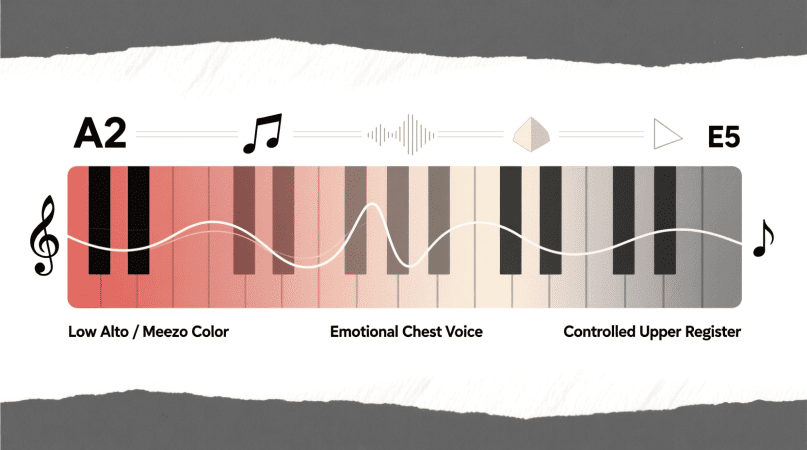
If you’ve ever listened to Mitski and felt something tug at your chest before you even understood the lyrics, you’re not alone.
Mitski has one of those rare voices that doesn’t need to belt or show off to make you feel everything. Her tone is intimate, breathy, almost fragile at times — yet precise and intentional.
When I set out to analyze Mitski’s vocal range, I expected something straightforward.
But the deeper I listened, the more I realized:
her range is only part of the story — her emotional delivery is what makes her unforgettable.
And to be honest with you, I ran into a few surprising challenges trying to map her vocals accurately.
Her softness hides her technique. Her emotional phrasing can mask pitch placement. And her studio style is different enough from her live performances that I had to go back and forth between the two.
But by the end, I walked away with a new level of appreciation for her as a vocalist — not just a songwriter.
Here’s the clearest, most honest breakdown of Mitski’s vocal range, written like we’re two friends chatting about music.
Mitski’s Vocal Range
Mitski’s vocal range spans approximately: D3 – D5
(about two octaves, with slight extensions depending on live phrasing)
Her voice type fits best as a: Lyric Mezzo-Soprano
However, she often sounds lower because of her tone and stylistic choices.
But numbers alone don’t capture what makes her voice so powerful.
Let’s go deeper.
My Personal Experience Analyzing Mitski’s Voice
When I first tried to figure out her range, I hit three small problems right away:
1. Her breathiness makes notes harder to identify
Mitski loves a soft, airy tone that blends into the instrumentation.
This makes it tricky to spot transitions between chest voice, head voice, and falsetto.
There were moments where I found myself thinking:
“Wait — is that D5 head voice or falsetto with airy overlay?”
Replayed.
Checked again.
Still soft as a sigh, but definitely controlled.
2. She rarely “shows off” her range
Unlike powerhouse vocalists who love high belts, Mitski prefers nuance.
This means her highest notes are subtle rather than dramatic.
3. Her emotional interpretation changes her tone
Mitski uses dynamic shifts — whisper to full tone, soft to textured, still to trembling — which makes analyzing her range more about understanding her artistry than measuring notes.
By the time I was halfway through her discography, I realized something:
Mitski doesn’t use her voice to impress. She uses it to confess.
Breaking Down Mitski’s Vocal Range
1. Lowest Notes: D3 – F3 (Quiet, Dark, and Intimate)
Mitski’s lower register is surprisingly steady.
It’s not booming or heavy, but it’s emotionally potent.
Examples:
- “Working for the Knife” – F3 tones carry emotional weight
- “I Bet on Losing Dogs” – soft lower phrasing
- “Two Slow Dancers” – beautifully supported low notes
Her lows feel like she’s sitting in a quiet room telling you a secret — they’re gentle, but they cut deep.
When I tried matching some of her low phrasing, I noticed how much breath support she uses even when singing quietly. It’s a reminder that softness doesn’t mean lack of technique.
2. Middle Range: F3 – C5 (Her Emotional Home Base)
This is where Mitski’s voice becomes unmistakably Mitski.
Warm, melancholic, breathy but controlled — the sonic equivalent of a diary entry.
Examples:
- “First Love / Late Spring”
- “Your Best American Girl”
- “My Love Mine All Mine”
What fascinates me about her mid-range is that she often sings just below what most singers consider their “speech-level” range.
This choice creates a sense of intimacy, like she’s letting you into her internal world.
Her technique here is subtle, quiet, and deceptively controlled.
It’s so easy to mistake softness for simplicity — but it’s actually precision disguised as vulnerability.
3. Upper Range: C5 – D5 (Gentle Head Voice, Never Forced)
Mitski rarely goes above D5, and when she does, she treats those notes with care rather than dramatic power.
Examples:
- “Nobody” – airy, floating upper notes
- “Francis Forever” – light head voice moments
- “Townie” – clear upper phrasing
One thing I learned:
Her high notes are not meant to impress technically — they’re meant to elevate emotion.
She reaches just enough height to create tension, then falls back into her soft delivery.
When I tried singing along, the hardest part wasn’t the pitch — it was the control. Singing softly at higher pitches requires far more technique than belting.
What Voice Type Is Mitski?
Mitski is best classified as a lyric mezzo-soprano.
But she often sounds lower because:
- She prefers lower tessitura
- She uses breathiness as a stylistic tool
- Her tone is warm, rounded, and dark
- She rarely belts
This combination often leads people to mistakenly assume she’s a contralto.
But her ability to access head voice lightly and her placement patterns clearly place her in the mezzo category.
Why Mitski’s Voice Feels So “Haunting”
This was my favorite part of analyzing her.
Her voice feels haunting because she uses:
1. Controlled breathiness
Not weak — deliberate.
2. Dynamic restraint
She rarely goes above mezzo-forte, creating emotional tension.
3. Conversational phrasing
Like she’s singing thoughts instead of lines.
4. Minimal vibrato
She avoids vibrato often, creating a plainspoken sincerity.
5. Slow, intentional diction
Each word feels chosen, not thrown.
Her voice wasn’t built to dominate a stadium — it was built to break your heart quietly.
Best Songs to Understand Her Vocal Range
Low Range
- “I Bet on Losing Dogs”
- “Working for the Knife”
Mid-Range (Her Signature)
- “Your Best American Girl”
- “My Love Mine All Mine”
- “First Love / Late Spring”
Upper Range
- “Nobody”
- “Francis Forever”
Listening to these in order feels like taking a guided tour through Mitski’s emotional universe.
Compare Your Vocal Range to Mitski’s
If you’re curious where your range sits compared to Mitski’s D3–D5, try the Vocal Range Test on our site.
It’s fun, quick, and surprisingly helpful — especially if you naturally gravitate toward soft, expressive singing.
- Learn how vocal cords produce different pitches to understand voice mechanics.
- Strengthen your low and mid-range with tenor vs baritone techniques for better control.
- Compare her range with other artists in average vocal range of pop vs classical singers.
- Build vocal flexibility using how to do vibrato in singing.
- Improve endurance with daily exercises to increase vocal stamina.
- Understand voice classification through vocal fach system explained for beginners.
Erika Parker is a vocal analysis and singing education writer at Vocal Range Test. She focuses on vocal range testing, voice type analysis, pitch recognition, and singing tools for vocalists, musicians, choir singers, and beginners.