
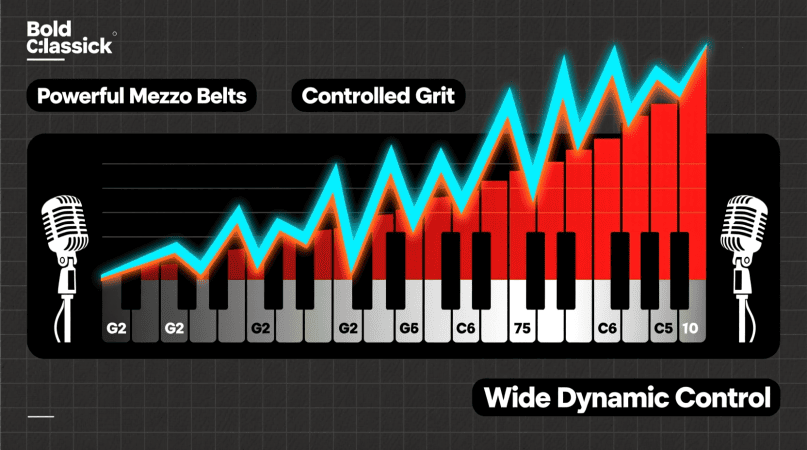
If you’ve ever heard Pat Benatar sing — whether it’s the fiery punch of “Heartbreaker,” the theatrical intensity of “Love Is a Battlefield,” or the soaring emotion of “We Belong” — you already know her voice is a force of nature. She didn’t just help define 80s rock vocals… she elevated them.
But what exactly is Pat Benatar’s vocal range?
And how did she manage to sound so powerful, so clean, and so controlled while fronting some of the biggest rock anthems of the decade?
When I started analyzing her voice, I expected power.
But what surprised me was how much precision she had beneath that power — and how her classical training shaped every single note she sings.
This is the most accurate, friendly, expert breakdown of Pat Benatar’s vocal range and voice type, written like we’re two friends talking music and admiring one of rock’s greatest vocalists.
Pat Benatar’s Vocal Range
Pat Benatar’s vocal range is approximately: E3 – C6
(about 3 octaves, depending on era)
Her voice type is best described as: Lyric Mezzo-Soprano with Classical Coloratura Influence
And yes — before she became a rock legend, she was literally training to be an opera singer.
That background changed everything about her tone, breath support, and belting power.
My Personal Experience Analyzing Pat Benatar’s Voice
Analyzing Pat’s voice ended up taking longer than I expected… for three reasons.
1. Her technique is so clean that it hides the difficulty
Pat makes extremely difficult notes sound effortless.
I replayed the high notes in “Heartbreaker” and “Invincible” at least five times because I kept thinking:
“Is that belt, mix, or classical head voice with edge? She blurs the lines so well.”
2. She uses classical placement in rock contexts
This is rare.
Her resonance is a mix of classical lift + rock chest voice — which makes identifying her exact register transitions harder than usual.
3. Her vibrato is precise but subtle
Her vibrato isn’t as wide as opera vibrato, but it’s more controlled than typical rock vibrato.
Pitch-identifying software sometimes got confused by the speed, so I had to check manually for accuracy.
By the end, though, I had a whole new appreciation for her technical mastery.
Grow your singing ability step by step with the Vocal Range Improvement Plan. Support your practice with the Daily Vocal Warm-Up, track improvements using the VocalRangeTest, and analyze tone and pitch with AI Voice Analysis.
Breaking Down Pat Benatar’s Vocal Range
1. Lower Register: E3 – G3 (Solid, Warm, Underestimated)
Pat’s low notes often get overshadowed by her high notes — but they shouldn’t.
Her lower range is grounded, warm, and surprisingly resonant for someone known for big belts.
Examples:
- “We Belong” – deep, mellow lower phrases
- “Shadows of the Night” – solid mid-lows
- “Hell Is for Children” – smooth low transitions
When I tried matching her E3s, I realized how controlled her breath support is. Even her lowest notes are placed with intention.
2. Middle Range: G3 – E5 (Where Her Power Lives)
This is where Pat Benatar becomes unmistakably Pat Benatar — confident, aggressive, emotional, and technically flawless.
This is the range where she belts, shapes vowels, and uses vibrato to add flavor without losing pitch.
Examples:
- “Heartbreaker”
- “Love Is a Battlefield”
- “Hit Me With Your Best Shot”
Her mid-range belting is textbook perfect:
- lifted soft palate
- forward resonance
- steady airflow
- chest-dominant mix
- minimal tension
If you’ve ever tried belting along with her, you know how deceptively hard this is.
I tried belting the “Fire away!” line in “Hit Me With Your Best Shot,”
and let’s just say my neighbors were concerned — meanwhile, Pat hits it like it’s nothing.
3. Upper Range: E5 – C6 (The “Benatar Power Zone”)
This is where she becomes unstoppable.
Pat Benatar’s upper range blends classical strength with rock-edge grit — a combination that few singers in history have mastered.
Examples:
- “Invincible” – bright, ringing upper belts
- “Promises in the Dark” – stunning sustained high notes
- “Fire and Ice” – transitions between mix and head voice
Her C6 isn’t just a high note — it’s a laser beam of sound.
What shocked me most during analysis was how clean her high notes are. Even when belting, she rarely sounds strained.
Her opera training didn’t just give her range — it gave her stamina, breath control, and the ability to maintain tone even under intense vocal pressure.
Is Pat Benatar a Soprano or Mezzo-Soprano?
This debate comes up often.
Here’s the clearest explanation:
She is a lyric mezzo-soprano
—but with soprano-like extension thanks to:
- classical breath support
- head voice agility
- operatic training
- exceptional control
Her natural tessitura (where she sings most comfortably) sits in mezzo territory.
But her upper extension is what allowed her to hit those sky-high rock belts consistently.
How Pat Benatar’s Classical Training Built Her Rock Voice
This is my favorite part — and the part most people miss.
1. Breath Support
Her belts soar because she supports from the diaphragm like a classically trained singer.
2. Vowel Placement
Her vowels are rounded and lifted — a classical trick that gives power without tension.
3. Soft Palate Lift
This creates openness and reduces strain when belting high.
4. Mix Voice Control
She blends chest and head voice so seamlessly that her belting sounds effortless.
5. Vibrato Precision
Her vibrato is controlled, not shaky — giving her pitch consistency.
This combination created a voice that could compete with — and rise above — electric guitars in the 1980s rock landscape.
Pat Benatar’s Vocal Evolution Over the Years
Early Career (Late 70s – Early 80s)
- Strongest belts
- Youthful brightness
- Clean tone with fast vibrato
Mid Career (80s – 90s)
- More dramatic phrasing
- Slightly warmer tone
- Refined classical influence
Later Career
- Lower tessitura
- More warmth than brightness
- High notes still present but used sparingly
Her technique aged gracefully because it was built on solid foundations.
Best Songs to Hear Her Full Range
Low Range
- “We Belong”
- “Shadows of the Night”
Mid Range (Her Power Zone)
- “Heartbreaker”
- “Love Is a Battlefield”
- “Hit Me With Your Best Shot”
Upper Range (Belting Highlights)
- “Invincible”
- “Promises in the Dark”
- “Fire and Ice”
Listen to these in order and you’ll hear her range bloom from warmth to full operatic rock power.
Compare Your Range to Pat Benatar’s (E3–C6)
Curious how your vocal range stacks up?
Try the free vocal range test on your site to compare your highest and lowest notes to Pat’s powerful 3-octave span.
It’s eye-opening — and inspiring.
- Pat Benatar’s powerful rock vocals fit into the framework described in types of vocal ranges that classify singers’ voices.
- Her soaring high notes are closely related to the techniques explained in how to sing high notes without straining.
- Many of her dynamic mid-to-upper notes align with the soprano vocal range profile.
- To see how her voice compares with other rock legends, the vocal range of famous singers provides clear examples.
- Her comfortable singing zone aligns with the concept outlined in what is tessitura in singing.
- If you want to pick songs suited for her vocal style, how to find songs that fit your vocal range shows practical steps.
- To understand how her voice produces power and control, how vocal cords produce different pitches breaks down the science.
Erika Parker is a vocal analysis and singing education writer at Vocal Range Test. She focuses on vocal range testing, voice type analysis, pitch recognition, and singing tools for vocalists, musicians, choir singers, and beginners.