
Roy Orbison had one of those voices that stops you mid-sentence.
You don’t analyze it at first — you feel it. There’s this haunting mix of strength and vulnerability, a trembling sadness layered over a soaring, operatic power.
When I first got curious about his actual vocal range, I expected something impressive… but not this impressive.
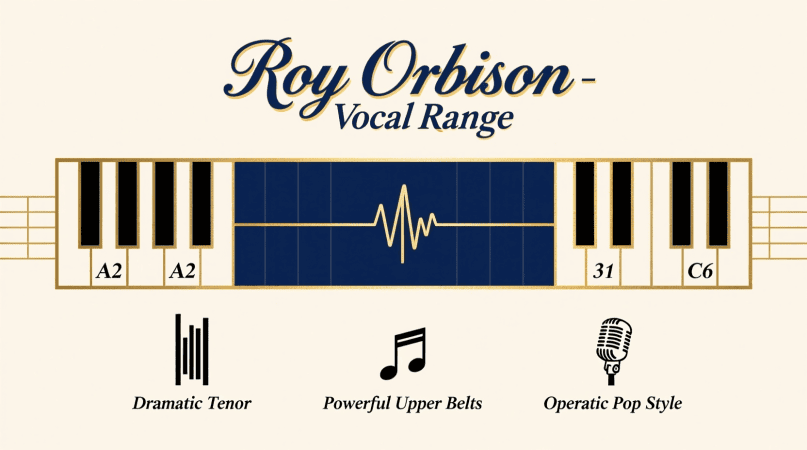
Roy Orbison’s real vocal range: F2 to D6 — around 3½ octaves
And the wild part?
He made that range sound effortless, even though singers spend years trying to master half of what he did.
But numbers only tell part of the story — so let’s break down what made Roy Orbison’s voice not just wide, but emotionally unforgettable.
How I First Tried Singing Roy Orbison
Let me be honest: The first time I tried singing “Crying,” I genuinely thought I could handle it.
Confidence can be delusional.
I hit the lower phrases just fine…
I eased into the middle…
And then I reached the iconic ascending line.
That note absolutely wrecked me.
It wasn’t even a normal crack — it was the kind of sound a balloon makes when it’s questioning its life choices.
And in that moment, I realized just how much technique, breath control, and emotional discipline Orbison hid inside what sounds deceptively simple.
That experience made me appreciate him a whole lot more — and it’s why we’re diving deep into what made his range extraordinary.
Roy Orbison’s Vocal Range Explained
Lowest note: F2
Deep, warm, almost baritone-like.
You hear this tone in the lower verses of “In Dreams.”
Highest note:
D6 (head voice/falsetto)
This is incredibly rare for a male singer, especially delivered with such clarity and emotional weight.
Octave span: Approximately 3.5 octaves
For context:
- Most male singers have 1.5–2 octaves
- Trained vocalists reach around 2.5
- Elite-level artists hit 3 or more
Roy belonged to the elite group — without ever sounding like he was showing off.
What Voice Type Was Roy Orbison?
Most vocal experts classify him as a: Lyric Tenor with dramatic qualities
This classification fits because:
- His comfortable singing zone is tenor territory
- His lower notes carried a rich baritone-like warmth
- His upper register was bright, emotional, and easily accessible
- His vibrato and phrasing leaned toward a classical, almost operatic style
Some experts even argue he had dramatic tenor tendencies due to how he powered through emotional climaxes.
He was one of those rare vocalists who didn’t just fit a category — he expanded it.
Why Roy Orbison’s Voice Was So Rare
Many singers have impressive ranges.
Roy Orbison had something harder to define: emotional mastery paired with flawless technique.
Here’s what actually made him stand out.
1. Seamless Chest-to-Head Voice Transition
Roy could slide between vocal registers with no audible break.
Most singers struggle with that awkward “flip” when shifting from chest voice to head voice.
When I tried studying this transition myself, I kept hitting that embarrassing little hiccup — the moment your voice betrays you.
Roy didn’t have hiccups.
He had pure vocal fluidity.
2. A Trembling, Operatic Vibrato
His vibrato wasn’t overpowering or overly dramatic.
It was controlled, emotional, and perfectly timed.
You hear this especially in:
- Crying
- It’s Over
- Blue Bayou
It’s the sound of someone who knows how to make a note weep.
3. A Gentle Yet Powerful Timbre
Orbison’s strength wasn’t in belting — it was in his ability to sound both fragile and powerful at the same time.
Very few singers can strike that balance.
4. High Notes That Felt Effortlessly Lifted
Roy didn’t push into high notes.
He floated into them.
That final note in “Running Scared” feels like it appears out of thin air.
Most tenors would have to work hard for that note.
Roy delivered it like he was born for it.
Start your vocal warm-up by visiting here.
Roy Orbison’s Range in His Most Famous Songs
Here’s where his true vocal ability reveals itself.
Running Scared
The song gradually climbs until the famous high D at the end.
It requires breath control, precision, and perfect tone placement.
Crying
The final ascending line is deceptively difficult and demands mastery of head voice and emotional vibrato.
In Dreams
The song shifts key multiple times, and Roy navigates each shift as if the song were written to display his natural range.
Oh, Pretty Woman
A more chest-voice-dominant performance, but one that shows his tenor strength and clarity.
How Roy Orbison’s Range Compares to Other Iconic Singers
| Singer | Vocal Range | Voice Type | Unique Strength |
|---|---|---|---|
| Roy Orbison | F2–D6 | Lyric Tenor | Emotional timbre and smooth transitions |
| Freddie Mercury | F2–F6 | Tenor | Power and theatrical resonance |
| Elvis Presley | A1–B5 | Baritone | Rich, iconic mid-to-low range |
| Axl Rose | F1–B♭6 | High Tenor | Extreme range and raw power |
| Michael Jackson | G2–G6 | High Tenor | Agility and precision |
Roy didn’t rely on aggressive belting or extreme theatrics.
His voice was cinematic — soft, soaring, emotional, and controlled.
Can You Sing Like Roy Orbison?
Here’s the honest answer.
Yes — because:
- He used technique over brute force
- His head voice can be trained
- His emotional style can be studied
No — because:
- His timbre was unique
- He possessed rare natural resonance
- His vocal control was on another level
But you can absolutely learn elements of his style.
These tips helped me: Strengthen your head voice
Orbison treated his head voice like his home base.
Practice soft, emotional vibrato
This is where most singers overdo it.
Practice breath control
Long, gentle phrases are key.
Work on quiet-to-loud dynamic exercises
Roy mastered gradual crescendos better than almost anyone.
Never force high notes
If you’re straining, you’re moving away from Orbison’s technique, not toward it.
See How Your Vocal Range Compares to Roy Orbison
If you’re curious where you stand next to Roy’s F2–D6 range, you can measure your vocal range instantly using your site’s tool.
It’s private, safe, and surprisingly eye-opening.
I still remember the first time I tested mine — it explained exactly why that high note from “Crying” nearly sent me into early retirement.
- Roy Orbison’s soaring tenor lines are easier to contextualize when you explore the vocal range analysis hub built for singers.
- To find out how wide your own voice really is, you can check your vocal limits with an interactive tool.
- His operatic tone fits into a category you can identify using the voice classification quiz.
- Many of his sustained high notes sit near the upper edge described on the highest vocal range reference page.
- You can also see how many octaves you personally cover by taking the octave span test.
- To understand the actual pitch behind his recordings, the vocal frequency analyzer provides precise data.
- If his effortless highs inspire you to improve, this guide on singing high notes without straining explains how to do it safely.
Erika Parker is a vocal analysis and singing education writer at Vocal Range Test. She focuses on vocal range testing, voice type analysis, pitch recognition, and singing tools for vocalists, musicians, choir singers, and beginners.