
Axl Rose’s vocal range spans approximately F1 to Bb6, giving him one of the broadest documented vocal ranges in rock history. His natural singing voice is that of a high tenor, but he can access baritone-depth lows and extreme upper-register screams extending into whistle-like territory. His versatility across clean vocals, raspy belts, mixed voice, falsetto, and scream registers makes his range uniquely complex and widely studied.
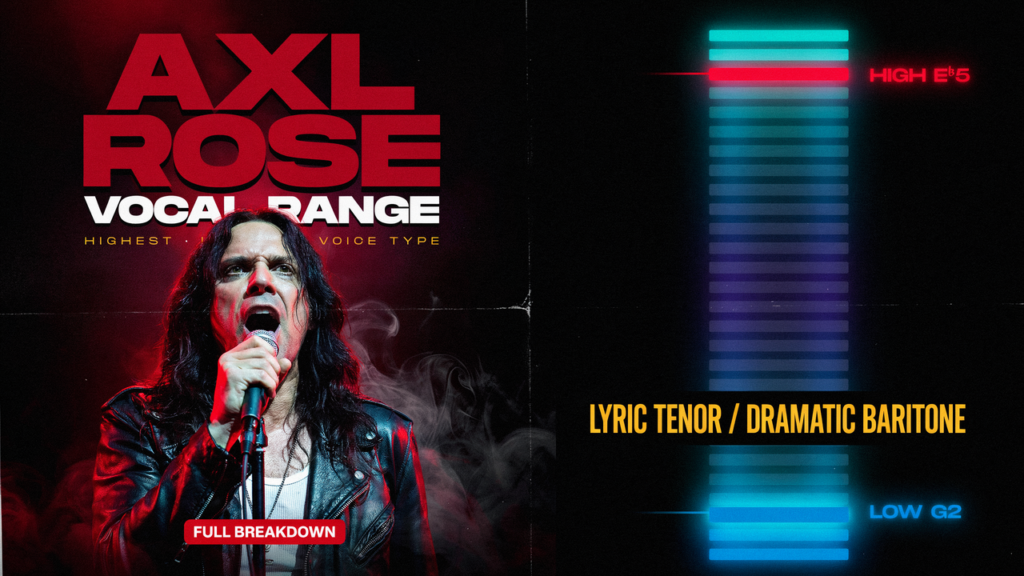
Axl Rose’s Full Vocal Range (F1 – Bb6)
Axl Rose is frequently cited as one of the most versatile and wide-ranging rock vocalists ever recorded. His combined studio, live, and distorted ranges form a remarkable spectrum exceeding 5½ octaves.
Technical Vocal Range Overview
| Attribute | Detail |
|---|---|
| Extended Total Range | F1 – Bb6 |
| Practical Singing Range | C3 – E6 |
| Natural Voice Type | High Tenor |
| Extended Low Capability | Baritone-like (F1–B2) |
| Extended High Capability | Scream & whistle-like tones (F6–Bb6) |
| Vocal Persona Types | Clean tenor, gritty rock rasp, falsetto, shriek scream |
Axl’s range is not just wide—it is stylistically multidimensional, enabling radically different tones across songs and eras.
What Voice Type Is Axl Rose?
Axl Rose’s voice often confuses listeners because his speaking voice is deep, yet he sings extremely high.
Why He Is Classified as a High Tenor
- His natural resonance favors bright, high placement
- Easily transitions into the 5th octave
- Signature rock screams come from a tenor-oriented mix and head voice
- Clean singing in songs like “Sweet Child O’ Mine” sits comfortably in tenor tessitura
Why He Also Exhibits Baritone Characteristics
- Can produce extremely low notes (F1–B2)
- Speaking voice lands in baritone range
- Dark tonal coloration in softer passages
Final Voice Type Classification
Axl Rose = High Tenor with Baritone Extension + Scream Register Range
He essentially possesses multiple vocal identities, which expand his functional range beyond standard categorization.
Axl Rose’s Highest Notes (Head Voice, Falsetto & Extreme Scream Range)
Axl Rose’s high register includes traditional falsetto, clean head voice, mixed belts, and extreme distortion tones.
Highest Verified Notes
- Bb6 — extremely high scream register
- F6–G6 — shriek tones during live improvisation
- C6–D6 — occasional clean/raspy head voice peaks
- A5–B5 — consistent scream-range notes across GNR recordings
Song Examples of High Notes
- “Welcome to the Jungle” — high screams (E6 range)
- “You Could Be Mine” — G5–A5 aggressive screams
- “Rocket Queen” — hybrid clean + rasp high tones
- “Reckless Life” — extreme upper-register shrieks
- “Out Ta Get Me” — long sustained scream peaks
High Register Characteristics
- Distortion layered over controlled pitch
- High airflow velocity
- Blended head resonance + supraglottic distortion
- Powerfully bright harmonics
His high register is one of the most unique and powerful in rock history.
Axl Rose’s Lowest Notes (F1 Baritone-Level Depth)
Although known for high screams, Axl Rose also produces surprisingly deep, smooth low notes.
Lowest Verified Notes
- F1 — documented low note in studio analysis
- G1–A1 — appears in rare low-intonation lines
- C2–E2 — comfortably sung in several intros
- G2–B2 — common in clean low passages
Low Register Traits
- Strong vocal fold closure
- Rich chest resonance
- Dark, spoken-like timbre
- Most stable in studio recordings
This low capability adds an unexpected depth and dramatic contrast to his vocal palette.
To understand how your voice compares to his highest screams and lowest growls, you can measure your limits using the vocal range test and get a clearer picture of your register with the voice type test. If you want even deeper insight into tonal placement and frequency accuracy—similar to how Axl’s voice can be analyzed—our AI voice analysis tool provides a detailed breakdown of your vocal characteristics.
Axl Rose’s Vocal Registers
Chest Voice (C3 – G4)
Axl’s chest voice is aggressive, bright, and powerful.
Features:
- Crisp articulation
- High twang, adding brightness
- Strong compression for rasp
- Smooth transition into mixed voice
Mixed Voice (G4 – D5)
The hallmark of Axl’s signature sound.
Features:
- Tenor mix with chest dominance
- Cutting, metallic resonance
- High stamina for repeated high notes
- Used heavily in “Appetite for Destruction” era
This register defines his classic rock identity.
Head Voice (C5 – E6)
Used for clean high notes and pre-distortion placement.
Features:
- Clear, ringing resonance
- Surprisingly smooth when not distorted
- Functions as a foundation for scream tones
Falsetto + Scream Register (E6 – Bb6)
Where Axl becomes uniquely extreme.
Features:
- Ventricular fold engagement
- Supraglottic distortion
- Harmonics that extend perceived pitch
- Controlled chaos—rare technical skill in rock
This range contributes to rumors of a “6-octave voice.”
What Makes Axl Rose’s Voice So Unique?
1. Multi-Timbre Flexibility
Axl can switch between:
- Clean tenor
- Raspy mix voice
- Screaming distortion
- Deep baritone tones
- Falsetto / head voice
Few singers in rock display this level of tonal shape-shifting.
2. Distortion That Preserves Pitch
His distortion is not uncontrolled—it maintains a clean pitch underneath rasp layers.
3. Extreme Agility
Axl quickly transitions between:
- Chest → mix → head → scream
- Soft clean tone → gritty rasp → falsetto
4. Natural High Placement
Even with a low speaking voice, his singing resonance sits naturally high, giving him access to powerful mid-high registers.
5. Rare Combination of Low + High Capability
Most tenors cannot hit F1. Most baritones cannot hit Bb6. Axl can do both.
This duality is what sets him apart from both classic rock tenors and metal shriek vocalists.
How Axl Rose’s Voice Changed Over Time
1985–1993 (Classic Era)
- Clean, bright, agile
- Extreme highs in mix/scream
- Highly flexible resonance
- Most iconic “Axl tone”
1994–2007 (Transitional Era)
- More nasal placement
- Increased reliance on head voice
- Altered rasp from technique changes
2010s–2025 (Modern Era)
- Lower overall tessitura
- Greater emphasis on chest voice
- Screams less frequent but still present
- Thicker, warmer tone with age
Despite changes, Axl retains an exceptional functional range for a decades-long touring vocalist.
Why Axl Rose’s Vocal Range Is So Debated
1. Distortion Produces Harmonics
Screams can appear higher than the fundamental pitch.
2. Studio Effects Influence Perception
Pitch-shaping reverbs and EQ can exaggerate highs or lows.
3. Low Notes Can Be Spoken or Styled
Baritone speech dips into low-frequency resonance that some charts include.
4. The “Rock vs Classical” Definition Problem
Classical voice teachers measure range differently than rock vocal analysts.
The Reality
When measured accurately:
- C3–E6 = reliable SINGING range
- F1–Bb6 = extended range including stylistic extreme notes
This makes Axl legitimately one of the most wide-ranging voices in rock history.
Axl Rose Vocal Range Chart
F1 ——— C2 ——— G2 ——— C3 ——— G3 ——— C4 ——— G4 ——— C5 ——— G5 ——— E6 ——— Bb6
 Low        Baritone Zone      Tenor Range       Mix Belts        Head Voice        Scream Pitch
His signature zone for classic Axl sound lies between G3 and D5.
Best Songs to Hear His Full Range
Lower Register
- “There Was a Time”
- “Prostitute”
- “Ain’t It Fun”
Mid-Range Power
- “Sweet Child O’ Mine”
- “November Rain”
High Mix & Rasp Belts
- “Welcome to the Jungle”
- “You Could Be Mine”
- “Nightrain”
Extreme High Scream Notes
- “Reckless Life”
- Live performances of “Knockin’ on Heaven’s Door”
These tracks collectively showcase Axl’s multidimensional vocal skillset.
Frequently Asked Questions
What is Axl Rose’s vocal range?
Approximately F1–Bb6.
What voice type is Axl Rose?
A high tenor with baritone extension.
What is his highest note?
Roughly Bb6, achieved using extreme scream techniques.
What is his lowest note?
Approximately F1, unusually low for a tenor.
Does Axl Rose have a 6-octave range?
His extended range approaches 5½–6 octaves, depending on criteria for distortion and extreme lows.
Why does he sound so raspy?
He uses controlled supraglottic distortion layered over a clean pitch.
How has his voice changed over time?
Tessitura lowered, tone thickened, fewer extreme screams, but range remains substantial.
- To see how Axl Rose’s extreme highs compare across rock history, studying Whitney Houston’s vocal range offers a powerful cross-genre benchmark.
- Understanding how he achieves those piercing notes starts with learning how vocal cords produce different pitches.
- His multi-register technique becomes clearer when you explore does head voice count in vocal range.
- To quantify just how wide his span is, this guide on how many octaves is a normal vocal range puts his numbers into context.
- Rock singers pushing limits benefit from these breathing techniques to improve vocal range.
- Long tours test durability, which connects directly to does vocal range change with age.
- For those inspired by his style, this resource on can you improve your vocal range explains what training can realistically achieve.
Erika Parker is a vocal analysis and singing education writer at Vocal Range Test. She focuses on vocal range testing, voice type analysis, pitch recognition, and singing tools for vocalists, musicians, choir singers, and beginners.