
Stevie Nicks has one of the most instantly recognizable voices in music history.
It’s warm, smoky, raspy, mystical, and emotional in a way that makes you stop what you’re doing and listen. Whether she’s whispering vulnerability in “Landslide,” summoning storm energy in “Rhiannon,” or belting gritty rock lines in “Edge of Seventeen,” Stevie’s voice feels alive—raw but elegant, wild but controlled.
Her voice doesn’t rely on huge range or extreme highs.
Instead, it relies on character, texture, and soul—the things most singers can’t manufacture.
But what exactly is Stevie Nicks’ vocal range, what voice type does she have, and why does her tone sound unlike anyone else?
And because I’ve tried singing her songs (and failed, learned, and failed again), I’ll share the real experience of attempting to sing like Stevie Nicks.
Let’s dive into the voice of the “High Priestess of Rock.”
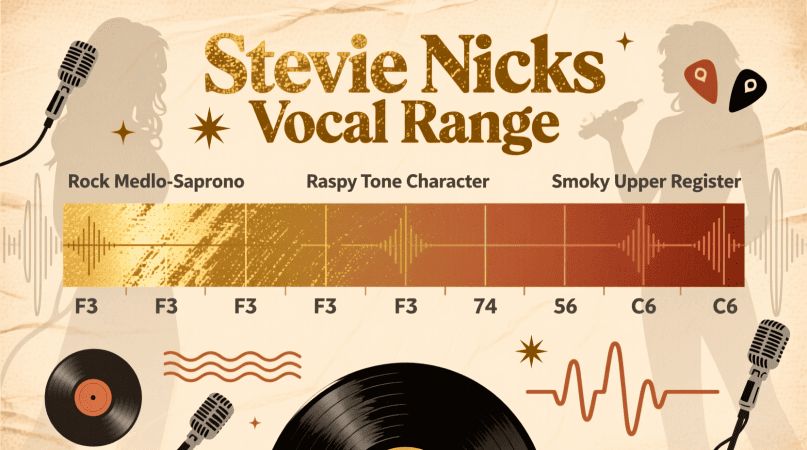
Stevie Nicks’ Vocal Range: C3 – E5 (Just Over 2 Octaves)
Stevie Nicks’ documented vocal range is:
- Lowest note: C3
- Highest sustained note: E5
This gives her a little over two octaves, which is modest compared to big belters—but range is not where her brilliance lives.
Stevie’s magic comes from:
- Her dark, smoky timbre
- Her storytelling phrasing
- Her emotional authenticity
- Her haunting vibrato
- Her signature rasp
- Her ability to turn simple melodies into spiritual experiences
There’s only one Stevie Nicks because nobody else sounds remotely like her.
What Voice Type Is Stevie Nicks?
Stevie Nicks is widely considered a contralto, the rarest female voice type.
But because her voice evolved over decades, she also displays low mezzo-soprano qualities, especially in her 20s.
Her vocal identity includes:
- A naturally low speaking voice
- Strong chest resonance
- Very little use of head voice in later years
- A thick, warm mid-range
- A rasp that became more pronounced after years of touring
- A tone that carries more emotion than brightness
Her voice sits lower than most women in rock—giving her songs a grounded, earthy feel.
My Real Experience Trying to Sing Stevie Nicks
I’ve attempted singing Stevie Nicks many times, usually thinking,
“Her songs don’t seem super hard. She doesn’t belt high notes… I can totally do this.”
Every time, I’m reminded that simple does not mean easy.
Here’s what actually happened:
1. Her low notes? Way harder than they sound.
Songs like “Dreams” sit in a deceptively low pocket.
I could hit the notes, but they lacked her warmth.
Stevie fills those low notes with richness—I mostly filled them with air.
2. Her rasp? Impossible to fake safely.
I tried mimicking it once…
Instant throat scratch.
Stevie’s rasp isn’t “forced”—it’s naturally part of her instrument and long-term vocal habits.
Trying to copy it without technique is asking for vocal damage.
3. Her phrasing requires deep emotional timing.
Stevie sits behind the beat slightly, giving her voice a dreamy, floating feel.
My attempt sounded like I just missed the cue.
4. Her consistency is underrated.
Even in laid-back songs, she shapes her vowels and dynamics so intentionally.
I found myself either overpowering the lines or fading out.
Singing Stevie Nicks taught me that her voice isn’t about range—it’s about presence.
Her tone isn’t something you “sing”—it’s something you feel.
Stevie Nicks Vocal Range Breakdown
| Register | Note Range | Song Examples | Tone Quality |
|---|---|---|---|
| Lower Register | C3 – E3 | “Landslide,” “Sara” | Velvety, intimate, earthy |
| Middle Register | F3 – C5 | “Rhiannon,” “Dreams” | Smoky, mystical, warm |
| Upper Register | C5 – E5 | “Edge of Seventeen” | Raspy chest voice, powerful |
| Head Voice | Rare in later years | Early “Rhiannon” live takes | Light, breathy, youthful |
Her signature sound lives in the low–mid range, where most female singers don’t spend much time.
Stevie Nicks’ Highest Notes
Stevie’s highest notes (E5 range) appear in:
- “Edge of Seventeen” (live and studio versions)
- “Stand Back” (upper chest push)
- Some live improvisations in the 80s
These aren’t whistle notes or operatic highs—they’re bold, raspy, chest-driven tones that match her gritty rock energy.
Stevie Nicks’ Lowest Notes
Her lows are consistently impressive:
- C3 in select live and studio recordings
- D3–E3 frequently in Fleetwood Mac ballads
Her low notes carry a haunting emotional resonance that pulls you into the story.
Why Stevie Nicks’ Voice Sounds So Unique
Stevie’s voice is iconic because of several rare vocal features:
1. Natural Rasp + Vocal Fry
Many singers try to imitate rasp.
Stevie has it effortlessly, woven into her vocal identity since her early 20s.
2. Dark Timbre + Chest Dominance
She avoids bright head voice and instead relies on her chest voice, even when singing high in her register.
3. “Behind the Beat” Phrasing
This relaxed rhythmic placement gives songs like “Dreams” their ethereal flow.
4. Slow Vibrato
Her vibrato isn’t dramatic—it’s smoky and subtle, almost like a sigh.
5. Emotional Delivery
Stevie doesn’t aim for perfection.
She aims for connection.
Her voice tells a story even when she sings one note.
How Stevie Nicks’ Voice Changed Over the Decades
1970s (Fleetwood Mac Early Era)
- Lighter rasp
- Clearer tone
- More head voice
- Youthful shimmer
1980s (Solo Breakout Era)
- Stronger rasp
- Heavier chest voice
- Increased vocal fry
- More dramatic phrasing
1990s–Present
- Lower tessitura
- Reduced upper register usage
- Rasp became signature
- Still powerful and expressive, just different
Her voice aged, yes—but it also gained character, depth, and weight that fans cherish.
Stevie Nicks vs Other Female Rock Singers
| Singer | Vocal Range | Voice Type | Strength |
|---|---|---|---|
| Stevie Nicks | C3–E5 | Contralto | Rasp + emotional storytelling |
| Ann Wilson | F3–E6 | Soprano | Power, clarity, belting range |
| Janis Joplin | D3–D5 | Mezzo | Raw, bluesy rasp |
| Christine McVie | A3–B5 | Mezzo | Smooth tone, emotional warmth |
| Florence Welch | C3–C6 | Mezzo | Dramatic belts + vibrato |
Stevie Nicks stands apart not because she sings higher or louder—but because she sings with soul, mystery, and intent.
Want to Compare Your Voice to Stevie Nicks’ Range?
When I tested my own range against hers, I learned:
✔ My low notes lacked her warmth
✔ My rasp attempts were unsafe
✔ My phrasing wasn’t nearly expressive enough
Stevie’s voice isn’t about high notes or technical tricks — it’s about tone and transporting the listener into her world.
- Stevie Nicks’s smoky, mystical vocal style can be explored more deeply through the vocal range test online used to analyze different singing voices.
- To see how wide your own voice really is, you can calculate your vocal range with a precise online tool.
- Her distinctive tone fits into a category you can identify using the voice type test.
- Many of her expressive high notes fall within what’s shown on the mezzo soprano vocal range reference page.
- You can also find out how many octaves you personally cover by trying this tool.
- To understand the pitch values behind her recordings, the voice frequency test provides detailed note data.
- If her ethereal delivery inspires you to improve, learn more about a structured way to build range and control.
Erika Parker is a vocal analysis and singing education writer at Vocal Range Test. She focuses on vocal range testing, voice type analysis, pitch recognition, and singing tools for vocalists, musicians, choir singers, and beginners.