
Taehyung (V of BTS) has one of the most captivating voices in modern pop—smooth, warm, deep, emotional, and instantly recognizable.
In a group filled with bright tenors and agile high notes, he stands out with a tone so velvety and rich that even a single line can shift the entire mood of a song.
Whether it’s the haunting elegance of “Singularity,” the emotional tension in “Stigma,” or the jazzy calmness of “Slow Dancing,” Taehyung brings a level of depth that is unusual in K-pop.
His voice doesn’t overpower—it invites you in.
But what exactly is Taehyung’s vocal range, what voice type does he have, and why does his voice feel so different from everyone else’s?
And because I’ve attempted to sing his parts myself (with some real surprises), I’ll share the actual challenges that come with trying to sound even remotely like him.
Let’s break it all down.
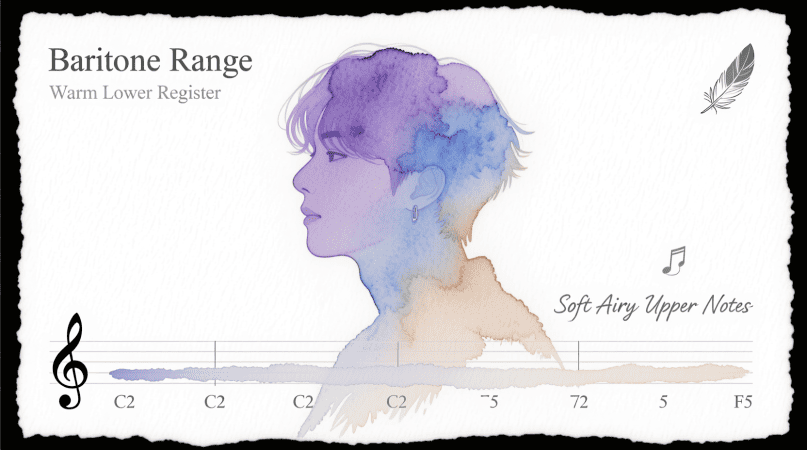
Taehyung’s Vocal Range: C2 – C5 (Around 3 Octaves)
Taehyung’s approximate vocal range spans from:
C2 – his lowest documented note
C5 – his highest controlled note
This gives him roughly three octaves, but range isn’t what sets him apart.
What truly defines Taehyung is his timbre—a rare, deep, baritone warmth that cuts through modern pop’s bright soundscape. His tone feels intimate and emotional, no matter the pitch.
What Voice Type Is Taehyung?
A Lyric Baritone With Rare Warmth in K-Pop
Taehyung is widely classified as a lyric baritone, a voice type uncommon in K-pop where most male vocalists are tenors.
Key baritone characteristics he displays:
- Naturally low speaking voice
- Thick, resonant tone in chest voice
- Smooth, rounded vowels
- Rich middle register
- Controlled, airy head voice
- Emotional depth in sustained notes
His voice naturally sits lower, giving BTS songs tonal balance and depth.
My Honest Experience Trying to Sing Like Taehyung
(And the Unexpected Problems I Ran Into)
Like many fans, I once thought Taehyung might be easier to sing than someone like Jungkook or Jimin because he doesn’t belt extremely high notes.
I was wrong.
Here’s what actually happened:
Low Notes Are Far Harder Than They Sound
Trying to match the low lines in “Singularity” or “Inner Child,” my voice either disappeared into a whisper or sounded thin.
Taehyung’s lows are not just low—they’re resonant.
That resonance is extremely hard to reproduce.
His Smooth Tone Requires Serious Control
His voice has a rounded, soft-edged quality.
When I attempted it, I ended up sounding flat or nasal.
His tone sits deeper in the chest, and shifting it there takes consistent training.
Transitions to Head Voice Are Shockingly Clean
In “Stigma,” that lift into head voice is seamless.
Mine was… not.
It felt like falling off a cliff between registers.
Breath Support Is Everything
In slower songs like “Slow Dancing,” he uses long, gentle phrases that require breath stability.
I ran out of air halfway through most lines.
Trying to imitate Taehyung showed me that soft singing is harder than loud singing—and that his tone isn’t just genetics; it’s control.
Taehyung Vocal Range Breakdown
| Register | Range | Song Examples | Tone Quality |
|---|---|---|---|
| Low Register | C2 – G2 | “Singularity,” “Inner Child” | Deep, resonant, warm |
| Middle Register | A2 – E4 | “Christmas Tree,” “Sweet Night” | Emotional, smooth, expressive |
| Upper Register | F4 – C5 | “Stigma,” “Love Me Again” | Light, clean, airy |
| Head Voice | Soft C5 range | Live versions, ad-libs | Gentle, breathy, intimate |
Taehyung rarely uses power vocals.
Instead, he focuses on texture and control.
Taehyung’s Highest Notes
Taehyung’s notable high notes include:
- C5 – heard in “Stigma”
- B4 – emotional ad-libs in “Love Me Again”
- A4–A#4 – present in harmonies throughout BTS’ discography
He doesn’t belt these out; he shapes them softly for emotional impact.
Taehyung’s Lowest Notes
Some of his lows include:
- C2 – filtered or layered deep notes
- D2–G2 – common in early verses and intros
- Soft bass-like harmonies in ballads
Taehyung’s lower voice has become one of the most loved aspects of BTS’ vocal sound.
Why Taehyung’s Voice Sounds So Unique
(A Technical Breakdown That Finally Makes It Make Sense)
Chest-Dominant Resonance
Taehyung sings from the chest, producing a tone that feels warm, round, and slightly dark.
Velvet Timbre
His vocal cords create a naturally smooth frequency balance, giving that “velvet” sound fans talk about.
Controlled Airflow
He uses breath strategically to soften edges without losing pitch.
Slow, Emotional Vibrato
His vibrato is slow and wide, adding sadness or nostalgia to his lines.
Jazz and R&B Influence
His phrasing is heavily influenced by jazz and neo-soul, creating a more fluid, emotional delivery.
How Taehyung’s Voice Has Evolved Through the Years
Early BTS Era
- Naturally deep tone but less refined
- More breathiness
- Less control over vibrato
Wings / Love Yourself Eras
- Strong improvement in control
- “Stigma” established his vocal identity
- Better range stability
BE / Proof / Solo Era
- Mature, smooth tone
- Better upper register control
- Jazz-inspired vocal style in solo songs
Taehyung’s voice aged gracefully—becoming even warmer and more expressive.
How Taehyung Compares to Other BTS Vocalists
| Member | Voice Type | Tonal Style | Strength |
|---|---|---|---|
| Taehyung (V) | Lyric Baritone | Deep, velvet tone | Emotional warmth, low range |
| Jungkook | Tenor | Bright, versatile | Power + technique |
| Jimin | Light Tenor | Airy, high register | Beautiful high notes |
| Jin | Tenor | Clear, bright | Emotional belting |
Taehyung grounds BTS’ sound with richness and depth—something few other idols can replicate.
For song key analysis, go to this link.
Want to Compare Your Range to Taehyung’s?
Here’s What I Learned When I Tried**
When I tested my range:
- His low notes required far more breath support than I expected
- His soft singing revealed every pitch flaw I had
- His chest resonance was much deeper than mine naturally sits
- His head voice transitions were harder to imitate than high belting
It became clear:
Taehyung’s voice is simple on the surface, but technically complex underneath.
- Taehyung’s warm baritone-leaning tone fits well within the spectrum explained in the types of vocal ranges used to classify singers.
- His smooth transitions between soft and powerful notes relate closely to the chest voice vs head voice breakdown.
- Many of his richer lower notes overlap with what’s described in the baritone vocal range profile.
- To see how his range compares with other famous voices, the which famous singer matches your vocal range guide gives useful insight.
- His balanced placement across songs fits the concept outlined in what is tessitura in singing.
- If you want to choose music that suits a similar vocal style, how to find songs that fit your vocal range shows how to do it.
- To understand the physical side of how his voice produces pitch, how vocal cords produce different pitches explains the mechanics.
Erika Parker is a vocal analysis and singing education writer at Vocal Range Test. She focuses on vocal range testing, voice type analysis, pitch recognition, and singing tools for vocalists, musicians, choir singers, and beginners.