
Audra McDonald’s vocal range spans approximately G3 to C6 — around two and a half octaves — with a lyric soprano instrument that is widely regarded as one of the finest in Broadway history. The holder of a record-breaking six Tony Awards, and the only performer to have won in all four acting categories, McDonald is not primarily known as a vocal gymnast. What she is known for is a voice of extraordinary beauty, precision, and dramatic intelligence that makes technically demanding material feel inevitable rather than effortful.
She’s also refreshingly clear about how she thinks about her own voice. In her own words: “I’m a lyric soprano with low notes — that’s how my voice teacher likes to describe me.” That single sentence does more work than a paragraph of analysis: it tells you the timbre is soprano, the training is classical, and the range extends further downward than the label implies.
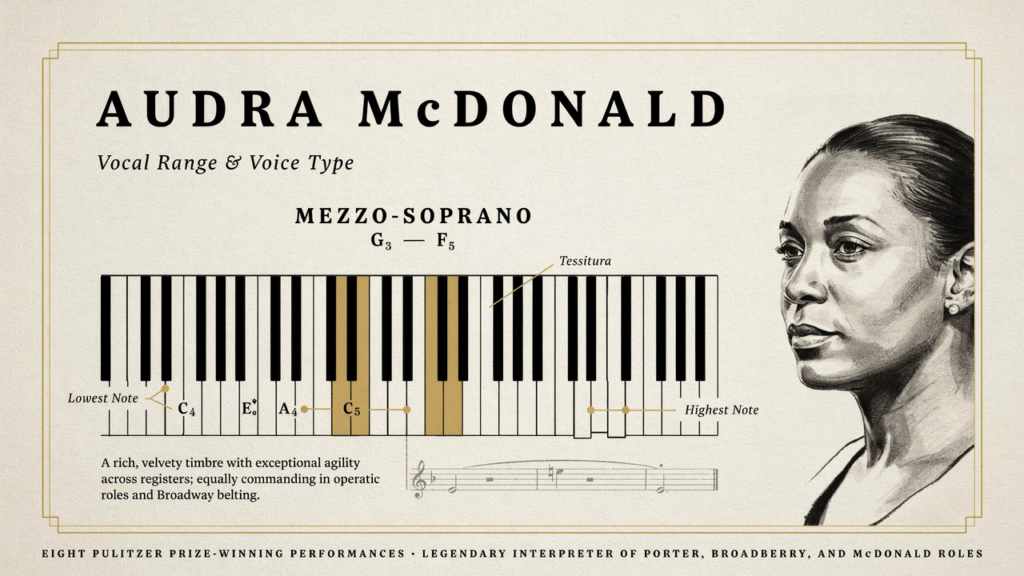
Audra McDonald’s Vocal Range at a Glance
Vocal range: approximately G3 – C6 Voice type: Lyric soprano Vocal registers in use: Chest voice, mixed voice, head voice Approximate span: Around 2.5 octaves Tessitura (comfortable center): Roughly E4 to B5 Training: Juilliard School, classical vocal program (graduated 1993).
What Voice Type Is Audra McDonald?
McDonald is a lyric soprano — a voice type defined by warmth, brightness, and flexibility rather than sheer volume or extreme high-note athleticism. The lyric soprano sits between the lighter coloratura soprano (who specializes in rapid ornamental passages in the upper register) and the heavier dramatic soprano (built for operatic power and stamina). It’s the voice type most at home in the core musical theater repertoire: expressive, emotionally versatile, and capable of carrying a sustained melodic line with beauty across a wide dynamic range.
What makes McDonald’s classification slightly complicated is that she also has a genuine lower register that most sopranos don’t possess. She’s described herself as being frequently labeled a mezzo-soprano — and pushed back firmly on that categorization. Her timbre is soprano, her upper range is soprano, and her trained placement is soprano. But she can access chest voice notes in the low third octave that a pure soprano wouldn’t be expected to reach comfortably. That combination makes her repertoire unusually broad.
The soprano vocal range page covers where a lyric soprano sits relative to other female voice types if you want to map the full picture.
Her Lower Register: G3 and the Chest Voice Foundation
G3 sits just below middle C, and for a lyric soprano to reach it with usable tone rather than a forced, thin sound is genuinely notable. McDonald’s songs document her regularly working from Ab3 upward — “Your Daddy’s Son” from Ragtime, for instance, sits in the G3–F5 range according to tracked repertoire data, and her chest voice in that lower territory carries real weight.
This is partly what generates the mezzo-soprano confusion. Mezzos tend to sit in the lower third octave more naturally, and their timbre often carries a darker quality in that register. McDonald’s lower notes don’t have the dark mezzo warmth — they’re still bright and forward in placement — but they’re there and usable, which is rarer than it sounds for a high soprano instrument.
Her Upper Register: The Fifth and Sixth Octave
McDonald’s documented upper range reaches C6 — soprano high C — which is the standard benchmark for a full lyric soprano and the note that divides working sopranos from singers who merely approximate the upper register. She’s been described as “a member of the exclusive high C club,” and live concert performances have documented her ability to reach and sustain notes in that territory cleanly.
Song data from her recorded repertoire places her consistently into the G5 range in performance — “When Did I Fall in Love” from Fiorello runs to G5 — with the sixth octave accessible for her highest extensions. The tone up there retains the characteristic lyric soprano brightness without the shrillness that comes from a voice pushing beyond its natural ceiling.
Whether those very highest notes count as part of her practical working range or her technical extension is worth understanding. The breakdown of whether head voice counts in vocal range explains the distinction, but for McDonald the question is largely academic — her upper range is well within soprano territory by any definition.
The Vibrato: One of Her Most Distinctive Technical Qualities
Audra McDonald’s vibrato — the slight, controlled oscillation in pitch that gives a sustained note warmth and resonance — is one of the most frequently cited features of her voice. Concert reviewers have described it consistently as “seamless” and “caressed,” particularly in legato passages. In her 2022 concert performance of “Summertime,” she temporarily asked for her microphone to be turned off — a choice that signals complete confidence in the acoustic projection of an unamplified voice — and sang with a vibrato that reviewers called seamless.
A well-produced vibrato is the product of correct breath support, relaxed laryngeal muscles, and consistent subglottal pressure — in other words, it’s a byproduct of good technique rather than something you add on top. McDonald’s Juilliard training is directly responsible for how even and controlled hers is. Singers who force vibrato produce a wobble; those who haven’t developed sufficient support produce a straight tone that sounds stiff. McDonald’s sits in the right place, which is why it feels like the voice is simply doing what it’s supposed to do rather than a technique being demonstrated.
Juilliard Training and What It Means for Her Voice
McDonald began taking voice lessons at age nine in Fresno, California, and trained at the Juilliard School in New York City, graduating in 1993. Juilliard’s classical vocal program is one of the most rigorous in the world, and what it produces in a singer is not just range extension or volume — it produces consistency, breath management, vowel placement, legato phrasing, and the ability to deliver technically demanding material night after night without vocal fatigue.
The practical consequence is that McDonald can sing repertoire that spans from raw blues (her portrayal of Billie Holiday in Lady Day at Emerson’s Bar & Grill) to operatic Gershwin (Porgy and Bess) to Sondheim to contemporary musical theater, and the voice holds up across all of it. That kind of versatility across stylistic extremes is only possible with a deeply trained instrument. You can’t casually switch between the vocal demands of Rodgers and Hammerstein, Kurt Weill, and Gershwin without a technical foundation that can handle each idiom on its own terms.
It’s also why her diction is so precise. Classical training treats text and tone as inseparable — the vowel shapes that produce correct resonance are also the shapes that produce clear words. McDonald’s intelligibility at full voice and at soft dynamics is exceptional, which matters considerably in dramatic material where the lyric content is as important as the sound.
Notable Vocal Performances
Carousel (1994): Her Tony-winning Broadway debut as Carrie Pipperidge. The role is not a lead soprano showcase, but it announced the voice to a wide audience and established her reputation immediately.
Ragtime (1998): “Your Daddy’s Son” is one of the most harrowing pieces in the Broadway soprano repertoire — a song requiring both raw emotional range and technical control across the lower and middle fourth octave. McDonald’s performance on the original cast recording remains the definitive version.
Porgy and Bess (2012): Playing Bess in Gershwin’s opera — a role rooted in the African-American blues and gospel tradition but requiring genuine operatic technique — demonstrated the full range of McDonald’s voice and her ability to negotiate the space between classical and vernacular vocal styles.
Lady Day at Emerson’s Bar & Grill (2014): Her sixth Tony. As Billie Holiday, she radically stripped back the classical placement and vibrato to inhabit Holiday’s spoken-voice-adjacent style, showing that her control is deep enough to deliberately suppress her trained technique in service of a character. That’s a level of mastery most trained singers don’t achieve.
How Her Voice Has Evolved
McDonald has spoken openly about the normal physical changes a voice undergoes with age. She began performing professionally in 1993 and has maintained a continuous performing career since. Early recordings from the mid-1990s show a voice with slightly more girlish brightness; later recordings and concert footage reveal a voice that has settled into richer, more authoritative tone in the lower-to-mid range while retaining its upper register clarity.
This is the expected trajectory for a well-managed lyric soprano instrument. The very highest extensions may soften slightly over decades of performance, but the core range deepens in quality. For more on how this process works physiologically, the piece on how age affects your vocal range over time covers the mechanics in detail.
Where McDonald Stands Among Broadway Sopranos
The comparison that comes up most often is Barbra Streisand — McDonald’s soprano has been described as drawing comparisons to Streisand’s in terms of range and presence. Both are lyric sopranos with strong lower registers and exceptional dramatic instincts. The timbres are different: Streisand’s voice carries a distinctive nasal brightness, while McDonald’s is more purely classical in placement. But the breadth of what each voice can do is comparable.
Among her contemporaries and the generation that followed, singers like Kristin Chenoweth represent the lighter, more coloratura end of the Broadway soprano spectrum. McDonald’s voice is warmer, fuller, and more dramatically grounded. If you want to see how your own range compares to hers or other Broadway sopranos, the singer comparison tool maps ranges across the full database.
If you haven’t determined your own voice type yet, the voice type test is the place to start — understanding whether your instrument is soprano, mezzo, or something else entirely shapes what repertoire is actually right for your voice.
FAQs About Audra McDonald’s Vocal Range
What is Audra McDonald’s vocal range?
Her range spans approximately G3 to C6 — around two and a half octaves. Her documented repertoire places her consistently in the G3–G5 range in performance, with extensions to high C (C6) in her upper register.
What voice type is Audra McDonald?
She’s a lyric soprano — her own description is “a lyric soprano with low notes.” Her timbre and trained placement are soprano, but she has usable chest voice notes in the lower third octave that are unusual for the voice type.
Is Audra McDonald a mezzo-soprano?
No — and she’s said so directly. The mezzo-soprano label gets applied to her because of her chest voice depth and the dramatic weight of her middle register, but her timbre, tessitura, and trained placement are soprano. Her voice teacher’s description — lyric soprano with low notes — is the most accurate framing.
How many Tony Awards has Audra McDonald won?
Six — more than any other performer in Tony history, and the only person to win in all four acting categories (featured actress in a musical, featured actress in a play, leading actress in a musical, leading actress in a play).
How did Audra McDonald train her voice?
She began voice lessons at age nine and trained at the Juilliard School in New York City, earning her Bachelor of Music in 1993. Juilliard’s classical vocal program is the foundation of her technique, breath management, vibrato, and stylistic versatility.
Erika Parker is a vocal analysis and singing education writer at Vocal Range Test. She focuses on vocal range testing, voice type analysis, pitch recognition, and singing tools for vocalists, musicians, choir singers, and beginners.