
Geoff Castellucci’s vocal range spans approximately C#1 to A5 — nearly four octaves in modal voice, with documented extensions into the sub-bass register that sit below the lowest note on a standard piano. The bass vocalist of the Orlando-based a cappella group VoicePlay, Castellucci has built a YouTube following through solo cover videos that place his extraordinarily low voice in orchestrated contexts that make the range viscerally audible. His cover of “Far Over the Misty Mountains Cold” from The Hobbit soundtrack has accumulated over 14 million views — which tells you something about how rare and compelling a true basso profundo sounds to ears accustomed to the baritone-tenor range of most popular music.
He has described developing his lowest vocal extensions as a process that “working through a lot of pain” — a candid acknowledgment that the extreme sub-bass range isn’t simply given by genetics but built through technique and sustained practice.
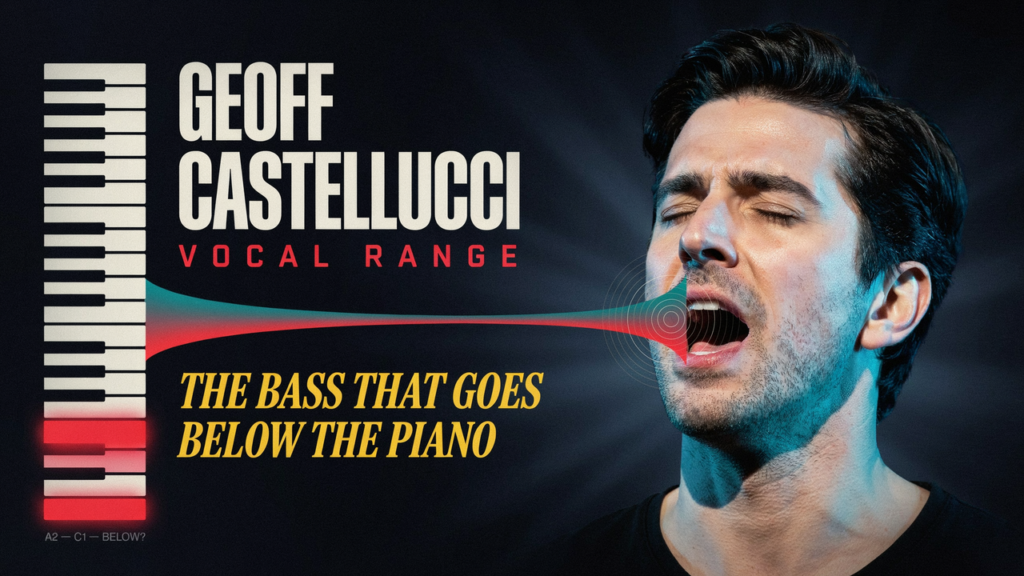
Geoff Castellucci’s Vocal Range at a Glance
Vocal range: approximately C#1 – A5 (nearly four octaves modal) Sub-bass extensions: documented to Bb0 and below in some analyses Voice type: Basso profundo / contrabass Vocal registers in use: Sub-bass (pulse/growl), chest voice, mixed voice, falsetto Approximate span: Nearly 4 octaves modal; approaching 5 with falsetto Active career: VoicePlay founding member; solo YouTube career
What Voice Type Is Geoff Castellucci?
Castellucci is a basso profundo — the deepest of the standard bass voice classifications, sometimes called a contrabass. This is the rarest of all voice types: while basses in general represent only about 8–10% of male singers, true basso profundos are a small fraction of that already-small group.
The characteristic quality of the basso profundo is not simply low notes — it’s a specific combination of vocal fold length, thickness, and resonance that produces depth and darkness at pitches where other voice types produce nothing but air. Castellucci’s lowest documented notes sit below C1 (the bottom of the standard piano keyboard’s first octave), in a frequency range where the vibration is felt as much as it is heard.
One profile describes his range as falling “somewhere between a high bass and a low baritone” in terms of natural speaking voice, which is a reminder that the most extreme low extensions are technique-developed rather than simply natural — his speaking voice is deep, but the sub-bass production requires specific phonation beyond what speech produces.
The bass vocal range page covers where even a standard bass sits relative to other voice types, and the lowest vocal range page gives context for where Castellucci’s extreme extensions sit in the wider documented landscape of deep voices.
His Sub-Bass Lower Register: Below the Piano
The lowest documented notes in Castellucci’s range analyses — Bb0 in some YouTube analyses, C#1 as the floor in the most conservative estimates — sit below the standard piano’s lowest key (A0). At these frequencies, conventional pitch perception begins to break down: the human auditory system processes pitches below approximately C2 more as vibration than as distinct musical tones, which is why sub-bass vocal performance requires high-quality audio equipment to hear clearly.
The Music Man analysis of his technique notes that while he has a naturally deep speaking voice, “his ability to sing low bass is the result of technique, extensive practice, and, in the case of ‘the growl’, working through a lot of pain.” This is an important distinction: the sub-bass register isn’t simply what happens when a low voice descends — it requires specific technical development of the vocal mechanism to access reliably and safely.
The primary mechanism for the lowest extensions is vocal fry (pulse register) and subharmonics — modes of phonation that engage the vocal folds in patterns different from modal chest voice. These produce a rumbling, pulse-like tone quality that is acoustically distinct from regular singing. Castellucci has specifically documented and taught aspects of this technique, making him one of the more transparent practitioners of a skill that is rarely explained in accessible terms.
His Upper Register: A5 and the Falsetto Extension
A5 — the A in the fifth octave, sitting well above soprano high C territory — is the documented upper ceiling with falsetto included. C#5 and Eb5 are specifically noted as mixed voice in his vocal range analysis videos, with A5 being a lighter falsetto extension.
The four-octave span from C#1 to A5 in modal voice (excluding the sub-bass extensions) is extraordinary even without accounting for the extreme bottom. Most professional singers operate comfortably within a two-octave window; singers with three octaves of reliable, quality range are genuinely rare. Four octaves of functional modal range — from deep bass to light falsetto — puts Castellucci in a category that has almost no equivalents in contemporary vocal performance.
What’s notable about the upper register in this context is how it demonstrates that his voice isn’t simply a “low voice” — it’s a full instrument that happens to have exceptional downward extension. His a cappella work with VoicePlay places him in ensemble arrangements that use his full range, not just the sub-bass floor.
The widest vocal range page covers what documented four-plus octave ranges look like in the broader landscape of singers.
VoicePlay and The Sing-Off
VoicePlay — the a cappella group of which Castellucci is the bass — is based in Orlando, Florida, where it began as a street corner barbershop act before progressing to theme park performances and eventually a YouTube channel launched in 2012. The group gained national recognition through Season 4 of NBC’s The Sing-Off.
In the group context, Castellucci functions as what one profile describes as “the human bass guitar” — providing the sub-bass floor that anchors harmonic arrangements and gives VoicePlay’s sound a textural depth unavailable to a cappella groups without a true basso profundo. The group’s theatrical, video-production-forward approach to YouTube content has helped them build a following that understands and appreciates what his extreme range contributes.
The working process — members recording individually at home, sending files to a mix engineer for final production — reflects the technical sophistication required to make sub-bass vocals audible and impactful in a digital distribution context. Recording a Bb0 that listeners can actually hear requires specific microphone technique, preamp settings, and mixing decisions that go well beyond standard vocal recording practice.
Notable Vocal Performances
Far Over the Misty Mountains Cold (The Hobbit cover): His most-viewed video at 14.47 million YouTube views. The sub-bass register in a context listeners recognise (the iconic Tolkien/Shore melody) is what made the video viral — hearing a voice produce those notes in a recognisable song creates an immediate and visceral response.
Ain’t No Sunshine (Bill Withers cover): The analysis subject of The Music Man’s detailed breakdown, which documented how his technique works across the full range from sub-bass to upper extensions.
King of the Road (Roger Miller cover): Another widely analyzed performance, with multiple TikTok vocal coaches documenting his range across the song.
FAQs About Geoff Castellucci’s Vocal Range
What is Geoff Castellucci’s vocal range?
His documented modal range spans approximately C#1 to A5 — nearly four octaves — with sub-bass extensions documented to Bb0 and below in some analyses. His most conservative documented figure is C#1 at the floor; his falsetto ceiling is around A5.
What voice type is Geoff Castellucci?
He’s a basso profundo — the deepest of the bass voice classifications, sometimes called a contrabass. This is the rarest of all voice types, requiring specific vocal physiology and technique to access notes below the standard bass range.
How does he reach such low notes?
Through a combination of natural vocal fold dimensions (longer, thicker cords produce lower frequencies) and specific technique — including vocal fry and subharmonic production — developed through sustained practice. He has publicly acknowledged that developing the extreme low extensions involved “working through a lot of pain.”
What is Geoff Castellucci’s most popular video?
His cover of “Far Over the Misty Mountains Cold” from The Hobbit soundtrack, which has over 14 million YouTube views. The combination of a recognisable melody and extreme sub-bass vocal production made it one of the most widely circulated deep voice performances on the platform.
How does his range compare to Tim Storms?
Tim Storms holds the Guinness World Record for the lowest vocal note (G-7) — well below Castellucci’s documented floor. Castellucci’s range is extraordinary by any standard short of the record holders, and his combined modal range of nearly four octaves is arguably more musically useful than an extreme low note in isolation. The Tim Storms vocal range page covers the record holder’s instrument in full.
Erika Parker is a vocal analysis and singing education writer at Vocal Range Test. She focuses on vocal range testing, voice type analysis, pitch recognition, and singing tools for vocalists, musicians, choir singers, and beginners.