
Gavin Creel’s vocal range spanned approximately B2 to B4, with a soulful lyric tenor instrument that People magazine described as “soulful” and that drove some of the most praised performances of his generation in contemporary musical theatre. Born on February 17, 1976 in Findlay, Ohio, and raised to love musical theatre after landing a role in a high school production of Camelot, Creel went on to win a Tony Award, a Grammy, and a Laurence Olivier Award across a two-decade career on Broadway and the West End. He died on September 30, 2024, at the age of 48, after being diagnosed in July of that year with metastatic melanotic peripheral nerve sheath sarcoma, a rare and aggressive form of cancer.
His passing was mourned widely by the Broadway community — Sara Bareilles, who starred opposite him in Waitress, called him “perfectly imperfect” and praised his “wandering childlike wonder” and “optimism.” What he left behind is one of the most complete bodies of work in contemporary musical theatre, anchored by a tenor voice that served character and emotion before technique.
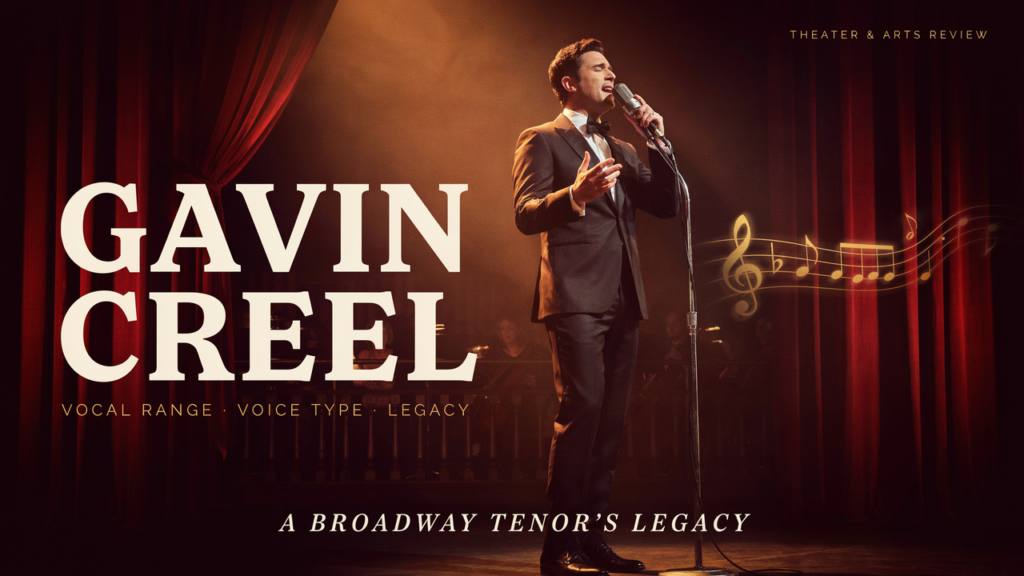
Gavin Creel’s Vocal Range at a Glance
Vocal range: approximately B2 – B4 (practical range), with falsetto extensions above Voice type: Lyric tenor Vocal registers in use: Chest voice, mixed voice, falsetto Approximate span: Around 2 octaves in primary working range Tessitura (comfortable centre): Roughly D3 to G4 Active career: 2002–2024
What Voice Type Was Gavin Creel?
Creel was a tenor — specifically a lyric tenor. AllMusic credits him as “Tenor (Vocal)” across his recorded work, and People’s description of his “soulful tenor voice” aligns with how critics and colleagues consistently heard the instrument.
The lyric tenor in musical theatre is defined by warmth, flexibility, and emotional expressiveness rather than raw power or extreme high notes. It’s the voice type built for leading men in the contemporary Broadway idiom: present and projecting enough to carry a theatre, but intimate enough to deliver a confessional lyric in a way that feels unguarded. Creel’s voice had all of these qualities, and his approach to song — a masterclass he taught at Ohio Northern University focused explicitly on “adding heart and depth to performance” and “conveying what the song is trying to communicate” — reflected an understanding of the voice as an interpretive tool rather than a display instrument.
The tenor vocal range page covers where the lyric tenor sits within the full male voice type spectrum.
His Lower Register: Warmth in the Baritone Zone
His practical chest voice floor sits around B2 — the lower end of tenor territory, approaching baritone. In this lower register his voice carried warmth and weight without sacrificing the brightness that characterises a true tenor timbre. This lower chest quality was most audible in the book scenes and quieter ballad passages of roles like Cornelius Hackl in Hello, Dolly! and Claude in Hair — moments that required the voice to carry dramatic weight rather than melodic spectacle.
His willingness to inhabit the lower, darker part of his register rather than pushing everything upward was a mark of theatrical intelligence. A singer who stays only in the bright, projecting upper register misses the emotional grounding that the lower voice provides.
His Upper Register: The Lyric Tenor Peak
B4 — the B just above middle C’s octave — sits comfortably within lyric tenor territory. His repertoire choices consistently kept him in the most characterful part of his range rather than testing its extremes, which is the sign of a singer who understood that the emotional quality of a note matters more than its pitch.
His falsetto extended the ceiling above the chest/mix register, used selectively for tonal colour rather than range demonstration. The Book of Mormon role of Elder Price — which won him the Olivier Award in 2014 for the West End production — requires a tenor with facility in the upper register for the musical’s demanding score, and his performance across that run demonstrated the sustained reliability of his upper range under performance conditions.
The Roles That Defined Him
Cornelius Hackl, Hello, Dolly! (2017): The Tony Award-winning performance, opposite Bette Midler. “Put on Your Sunday Clothes” and “It Only Takes a Moment” place the lyric tenor in classic Jerry Herman territory — bright, warm, optimistic, the voice as embodiment of carpe diem enthusiasm. His Tony win in this role came as the culmination of three nominations across fifteen years.
Claude Hooper Bukowski, Hair (2009): The Tony-nominated performance that showed the other dimension of his voice — the rawer, more emotionally exposed quality that the rock-influenced Hair score demands. Where Hello, Dolly! showcased warmth and charm, Hair required vulnerability and intensity.
Elder Price, The Book of Mormon West End (2014): The Olivier Award-winning performance. The role’s score is demanding in terms of range and sustained high-note access, and his consistency across a full West End run demonstrated the robustness of his technique beyond what a single audition or recording can show.
Dr. Pomatter, Waitress (2019): His collaboration with Sara Bareilles — who would later deliver one of the most moving eulogies at his memorial — in a role that sits in the warmest, most intimate part of a lyric tenor’s range.
Grammy, Tony, and Olivier: The Scope of the Career
Three major awards in three different performance contexts is unusual even by Broadway standards. His Tony Award for Hello, Dolly! (2017) recognised a single defining performance. His Olivier Award for The Book of Mormon (2014) recognised sustained work in a different context on a different continent. His Grammy Award for Best Musical Theater Album for the Broadway revival of Into the Woods (2023) recognised his contribution to a cast recording — the last of the three, and perhaps the most quietly meaningful, coming in the final years of his life.
He co-founded Broadway Impact with Rory O’Malley and Jenny Kanelos to advocate for marriage equality during the early years of the campaign, using his visibility as an out gay performer to platform a cause. His activism was not separate from his artistry; multiple eulogists at his memorial service described the two as inseparable.
The vocal range of famous singers page offers context for where Creel’s instrument sits alongside other celebrated Broadway tenors.
FAQs About Gavin Creel’s Vocal Range
What was Gavin Creel’s vocal range?
His practical working range spanned approximately B2 to B4, with the most natural and authoritative zone in the D3–G4 area. His falsetto extended above the chest/mix ceiling for selective tonal use in certain roles.
What voice type was Gavin Creel?
He was a lyric tenor — described by People as having a “soulful tenor voice” and credited as tenor (vocal) across his recorded work on AllMusic. His voice combined warmth, emotional expressiveness, and the flexibility to serve both comedic and dramatic leading roles across his career.
What awards did Gavin Creel win?
He won a Tony Award for Best Featured Actor in a Musical for Hello, Dolly! (2017), a Laurence Olivier Award for The Book of Mormon West End (2014), and a Grammy for Best Musical Theater Album for the Broadway revival of Into the Woods (2023). He received two additional Tony nominations for Thoroughly Modern Millie (2002) and Hair (2009).
When did Gavin Creel die?
Gavin Creel died on September 30, 2024, at his home in Manhattan, at the age of 48. He had been diagnosed in July 2024 with metastatic melanotic peripheral nerve sheath sarcoma, a rare and aggressive form of cancer.
What was Gavin Creel’s approach to teaching singing?
In a four-hour master class documented at Ohio Northern University, Creel focused on “adding heart and depth to performance, focusing on conveying what the song is trying to communicate and owning it.” His approach placed emotional intention ahead of technical demonstration — consistent with how he used his own voice throughout his career.
Erika Parker is a vocal analysis and singing education writer at Vocal Range Test. She focuses on vocal range testing, voice type analysis, pitch recognition, and singing tools for vocalists, musicians, choir singers, and beginners.