
Ronnie James Dio’s vocal range spanned approximately three octaves, with a powerful operatic tenor that the Vintage Heavy Metal analysis precisely documents: he “almost always sang at a register between D4 and D5. Low notes were very rare for him, and anything above E5 etched itself into your soul.” Born Ronald James Padavona on July 10, 1942 in Portsmouth, New Hampshire, and dying on May 16, 2010 at age 67 from stomach cancer, Dio sold over 47 million albums across his career with Elf, Rainbow, Black Sabbath, Dio, and Heaven & Hell. He is widely regarded as the greatest heavy metal vocalist of all time — Revolver named him “Best Metal Singer” in 2010, and music journalist Sacha Jenkins ranked him the genre’s best vocalist in 2013.
When Rainbow guitarist Ritchie Blackmore first heard him sing, his response was immediate: “I felt shivers down my spine.” That response, from one of rock’s most demanding and musically sophisticated guitarists, captures the quality of the instrument before Dio had achieved any of the commercial success that might inflate the assessment.
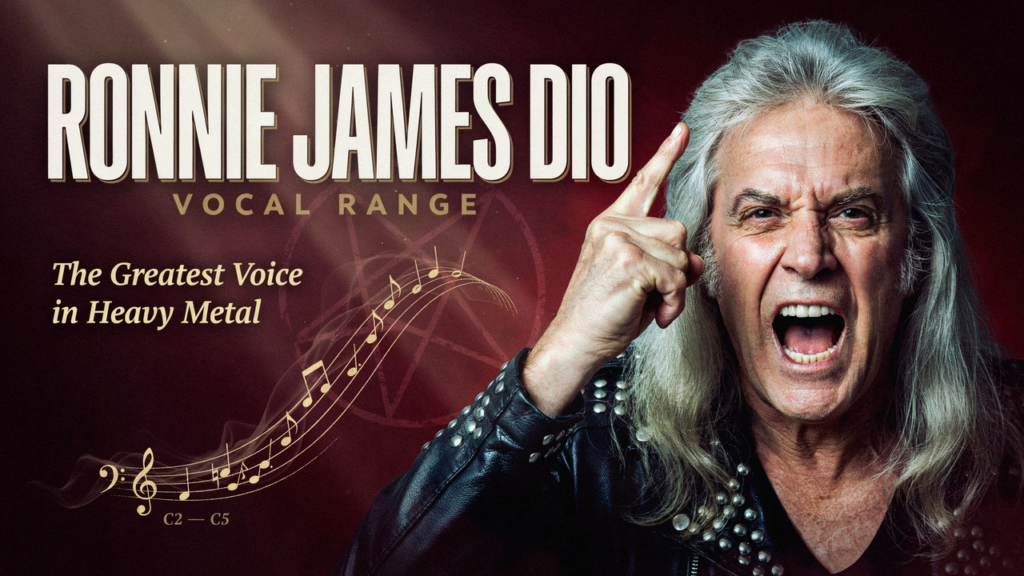
Ronnie James Dio’s Vocal Range at a Glance
Vocal range: approximately three octaves (operatic tenor classification) Primary working range: D4 – D5 (confirmed by isolated vocal analysis) Upper register: anything above E5 was exceptional and memorable Voice type: Low/dramatic tenor with operatic training context Key influence: Mario Lanza (American operatic tenor) Active career: 1958–2010
What Voice Type Was Ronnie James Dio?
Dio was a tenor — specifically, a powerful low-dramatic tenor with operatic characteristics absorbed through his lifelong love of opera. Wikipedia notes that “Dio listened to a great deal of opera while growing up, and was influenced vocally by American tenor Mario Lanza.” Lanza was one of the most powerful and emotionally direct operatic tenors of the mid-20th century, and Dio’s vocal approach reflects that influence: the emphasis on power and emotional directness over agility or extreme upper-register extension.
The “operatic tenor” description appearing in multiple analyses refers not to formal classical training (Dio’s only formal musical training was trumpet from age 5) but to the specific qualities absorbed from operatic listening: sustained notes over large orchestral textures, the ability to project with presence rather than just volume, and the operatic tradition of using the lower part of the tenor range as the primary emotional register.
The tenor vocal range page covers the voice type classification; the vocal range and singing techniques page covers how opera-influenced technique applies in rock and metal contexts.
His Primary Working Range: D4 to D5
The Vintage Heavy Metal isolated vocal analysis of “Heaven and Hell” — one of the most technically scrutinised vocal performances in metal history — identifies D4 to D5 as his comfortable working tessitura. This is the most useful single piece of technical data about his voice because it explains both what made it work and what made it exceptional.
D4 to D5 is the heart of the dramatic tenor range — the register where a powerful tenor voice produces maximum resonance and projection without requiring the extreme effort of the upper fifth octave. Dio’s voice in this zone had what Know Your Instrument describes as “clarity: the vocals cut through dense guitars without sounding thin.” That quality — the ability to project through a dense heavy metal arrangement without losing tonal presence — is the specific technical achievement that made him irreplaceable.
His tonal quality in this range is not a function of volume but of placement: the forward resonance, open vowel production, and breath support of an operatically-influenced singer, applied to music with much higher volume and distortion levels than opera ever encounters.
The Upper Register: E5 and Above
“Anything above E5 etched itself into your soul” is one of the more evocative and technically precise descriptions of a singer’s upper register in rock criticism. What it identifies is exactly right: E5 and above is where Dio’s voice moved from powerful and distinctive into genuinely extraordinary territory.
The passages in “Rainbow in the Dark,” “Holy Diver,” “Heaven and Hell” (the Black Sabbath track), and “Mob Rules” that ascend into the upper fifth octave are the moments most cited by musicians and fans when discussing his voice. The Forum comment that “his opening scream/growl on Mob Rules would make the hair on the back of your neck stand up” references a specific upper-register moment with that quality.
Unlike singers who reach high notes by thinning or pushing, Dio maintained tonal substance in the upper register — the voice remained round and full rather than becoming shrill. This is the operatic tenor heritage: the technique that allows sustained power in the fifth octave without the thinning that untrained rock singers produce at the same heights.
The how to sing high notes without straining page covers the technical principles behind exactly this kind of sustained upper-register power.
Rainbow, Black Sabbath, and Dio: The Three Peaks
His career organises into three major phases, each representing a different aspect of his vocal capabilities:
Rainbow (1975–1979): The Ritchie Blackmore partnership that first demonstrated his voice to a global audience. Albums like Rising (1976) and Long Live Rock ‘n’ Roll (1978) contain his most celebrated pre-Sabbath vocal work. “Stargazer” and “Gates of Babylon” are the specific performances most cited by musicians.
Black Sabbath / Heaven and Hell (1980–1982, 2006–2010): The period that gave him the widest commercial platform. Heaven and Hell (1980) and Mob Rules (1981) placed his dramatic tenor over Tony Iommi’s heavyweight guitar work with results that surprised both the band and the metal world. The Heaven & Hell reunion from 2006 demonstrated — at age 64 and older — that the voice had aged into what Know Your Instrument calls “a heavier kind of authority.”
Dio (1983–2010): His own band, which gave him full creative control across eight studio albums. Holy Diver (1983) remains his most celebrated solo record; “Rainbow in the Dark” is the most widely heard individual track.
Legacy: 47 Million Albums and the Devil Horns
Dio sold over 47 million albums across his career — a figure that reflects sustained commercial presence across five decades rather than a single peak. He is credited with popularizing the devil horns (🤘) hand gesture in heavy metal culture, which he learned from his Italian grandmother as a traditional apotropaic gesture against the evil eye.
Classic Rock Magazine awarded him the Metal Guru Award in 2006. Revolver named him Best Metal Singer in 2010, the year of his death. The Forum comparison to Freddie Mercury — “he did not have the range that Freddie had, no one did, but he was just as an accomplished vocalist” — places him accurately: a different kind of instrument from Mercury’s, but operating at the same level of technical and artistic achievement within its own parameters.
FAQs About Ronnie James Dio’s Vocal Range
What was Ronnie James Dio’s vocal range?
Approximately three octaves, with a primary working range of D4 to D5 confirmed by isolated vocal analysis. The upper register above E5 was exceptional — less frequently visited but enormously impactful when deployed.
What voice type was Ronnie James Dio?
A powerful low-dramatic tenor with operatic characteristics absorbed from his lifelong love of opera and the influence of Mario Lanza. His formal musical training was exclusively trumpet; his vocal approach was self-developed from operatic listening.
Who influenced Ronnie James Dio’s singing?
His primary documented vocal influence was Mario Lanza — the American operatic tenor whose recordings Dio listened to extensively while growing up. Lanza’s emphasis on emotional directness and sustained power in the lower-to-mid tenor register is audible in Dio’s own approach.
When did Ronnie James Dio die?
He died on May 16, 2010 at age 67 from stomach cancer, diagnosed in November 2009. His final performances with Heaven & Hell in 2009 are documented as demonstrating a voice that had retained its authority despite his age.
What is Ronnie James Dio’s best vocal performance?
The most frequently cited are: “Stargazer” and “Gates of Babylon” with Rainbow; “Heaven and Hell” and “Mob Rules” with Black Sabbath; “Holy Diver” and “Rainbow in the Dark” with his own band. The isolated vocal track from the Heaven and Hell album has become particularly discussed in vocal analysis communities for what it reveals about his technical approach.
Erika Parker is a vocal analysis and singing education writer at Vocal Range Test. She focuses on vocal range testing, voice type analysis, pitch recognition, and singing tools for vocalists, musicians, choir singers, and beginners.