
Scott Hoying’s vocal range spans approximately D2 to G#5, with a four-octave lyric baritone instrument that Wikipedia identifies explicitly as “the baritone of the a cappella group Pentatonix.” Born September 17, 1991 in Arlington, Texas, Hoying co-founded Pentatonix with childhood friends Mitch Grassi and Kirstin Maldonado, and later recruited Avi Kaplan and Kevin Olusola to form the five-voice ensemble that the group’s Wikipedia page describes as “the first a cappella group to achieve mainstream success in the modern market.” Three Grammy Awards, eleven studio albums (two at number one), and four songs on the Billboard Hot 100 later, Hoying’s baritone remains the harmonic centre of the group’s arrangements.
He is known in vocal analysis communities as “The King of Riffs and Runs” — a designation that points to his specific technical specialty: the ability to “seamlessly transition between notes at an incredibly high speed while also maintaining each individual note’s unique character and tone,” as one Pentatonix academic analysis describes it.
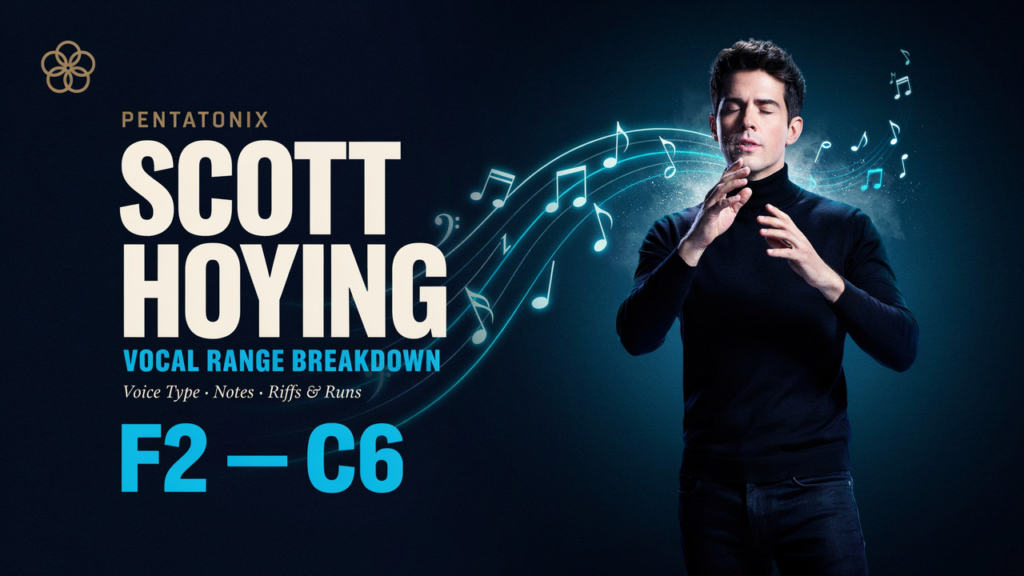
Scott Hoying’s Vocal Range at a Glance
Vocal range: D2 – C#5 (supported range) – G#5 (falsetto extension) Voice type: Lyric baritone Vocal registers in use: Chest voice, mixed voice, falsetto Approximate span: Around 4 octaves Tessitura (comfortable centre): G#2 – F#4 Active career: 2004–present
What Voice Type Is Scott Hoying?
Every independent analysis confirms: Scott Hoying is a lyric baritone. Vocalview: “Lyric Baritone, Range: D2–C#5–G#5.” SingersAvenue: “warm, light and mellow lyric baritone voice.” Wikipedia: “the baritone of the a cappella group Pentatonix.” The Pentatonix Fandom Wiki: “best known as the baritone and co-founder.” The consensus is unusually strong for a pop singer’s voice type classification.
The lyric baritone sits at the lighter, warmer end of the baritone spectrum — not the heavy dramatic baritone of opera villains, but a voice with warmth and brightness that allows both lower register grounding and access into the tenor range with less weight than a full dramatic baritone would carry. Vocalview notes he is “most comfortable in the baritone area” — his tessitura sits in G#2–F#4 — but his four-octave span gives him access to both the low second octave and the upper fifth octave in falsetto.
Within Pentatonix’s five-voice architecture, Hoying occupies the structural middle — above bass/beatbox (Kaplan/Sallee/Olusola), below the high voices (Grassi and Maldonado). He most often sings the melodic lead or the primary harmonic line that connects the bass and the high voices, which requires a voice with both presence and flexibility.
The baritone vocal range page covers the full classification context.
The Lyric Baritone Qualities: Warmth, Brightness, Agility
The “lyric” in lyric baritone describes a specific combination of tonal qualities: the voice is warm but bright, with the agility to move through ornamentation quickly and the presence to carry a melodic line without the weight that a dramatic baritone would impose. Vocalview describes Hoying’s voice as “light, bright and warm” — exactly the lyric characteristics.
His supported range (G#2–F#4) is where the voice is most resonant and most natural — the zone where a baritone produces maximum tonal quality without reaching into either the strained lower bass range or the extended upper mix and falsetto. Vocalview identifies his mixed voice as shining specifically “in the E4–F#4 area.”
The average vocal range page gives context for where Hoying’s four-octave span sits relative to the general population of singers.
Riffs, Runs, and Technical Agility
Being called “The King of Riffs and Runs” in the context of Pentatonix — which contains the six-octave Mitch Grassi — is a meaningful distinction. It means his primary technical standout quality is not range but agility: the ability to move through melodic ornamentation at speed without losing individual note clarity.
This quality — what classical training calls coloratura when it appears in a soprano, and what R&B tradition calls melisma when it appears in a soul singer — is the specific skill that makes Hoying identifiable within Pentatonix’s dense harmonic arrangements. When a run appears in a Pentatonix track, it’s frequently Hoying executing it.
Agility at this level requires not just technical practice but a specific coordination between breath support, cord flexibility, and muscle memory that allows the voice to move rapidly without losing either pitch accuracy or tonal quality. The vocal range and singing techniques page covers how these technical elements interact in practice.
Co-Founding Pentatonix: The Origin Story
Hoying, Grassi, and Maldonado all grew up in Arlington, Texas and attended Martin High School together. They first formed a trio to enter a radio contest for a chance to meet the Glee cast, arranged Lady Gaga’s “Telephone” for three voices, and posted it to YouTube when they didn’t win — getting the attention that suggested a real project was possible.
The Sing-Off requirement of five or more members led to the addition of Avi Kaplan and Kevin Olusola. They won Season 3 of The Sing-Off in 2011, signed with Sony Music, and went on to achieve what the group’s Wikipedia page calls “the first a cappella group to achieve mainstream success in the modern market” — a claim supported by the three Grammy Awards and Billboard top-ten placements.
He attended the University of Southern California briefly, majoring in Pop Music Performance and joining the campus a cappella group SoCal VoCals, before Pentatonix’s trajectory made the degree secondary to the career.
He is also one half of Superfruit with Mitch Grassi — the YouTube pop duo that released the album Future Friends in 2017. He married Mark Manio in 2023.
FAQs About Scott Hoying’s Vocal Range
What is Scott Hoying’s vocal range?
Vocalview documents D2–C#5–G#5, with his supported (most natural and resonant) range sitting at G#2–F#4. SingersAvenue documents G#1–G#5 for his full span. His comfortable working zone centres in the baritone mid-range.
What voice type is Scott Hoying?
A lyric baritone — confirmed by Wikipedia, Vocalview, SingersAvenue, the Pentatonix Fandom Wiki, and SingersAvenue, all converging on the same classification. The lyric designation specifies warmth, brightness, and agility rather than the heaviness of a dramatic baritone.
Why is Scott Hoying called “The King of Riffs and Runs”?
Because his primary technical standout quality in Pentatonix is his ability to execute melodic ornamentation (riffs and runs) at high speed while maintaining individual note character and tonal quality — a skill more associated with R&B and gospel traditions than a cappella, and rare enough in his context to become his defining label.
What is Superfruit?
Superfruit is the pop duo project Scott Hoying and Mitch Grassi started in 2013 as a YouTube channel, which evolved into releasing original music. Their album Future Friends was released in 2017. The project places both voices in a pop production context distinct from Pentatonix’s a cappella aesthetic.
How many Grammys has Pentatonix won?
Three Grammy Awards, as of the most recent count. Pentatonix is described by Wikipedia as “the first a cappella group to achieve mainstream success in the modern market.”
Erika Parker is a vocal analysis and singing education writer at Vocal Range Test. She focuses on vocal range testing, voice type analysis, pitch recognition, and singing tools for vocalists, musicians, choir singers, and beginners.