
Sebastian Bach’s vocal range spans approximately C2 in chest voice to high D5 and above, with a high tenor instrument that vocal coach analysis describes as genuinely unusual: “He has a high tenor voice with extremely thick vocal cords, which not only allow him to sing high C5s and D5s in chest voice, but also to have the ability to mix chest and head voice with his ‘false cords’ to create grit and gravel in the highest notes of his mixed register.” Born Sebastian Philip Bierk, raised in Peterborough, Ontario, Canada, and fronting Skid Row from 1987 to 1996, he has sold over 20 million records worldwide, is cited as “the first heavy metal singer on Broadway,” and has continued performing and releasing solo music while building a parallel career in television and theatre.
When his voice began changing during puberty at boarding school, he locked himself in his dormitory and listened to Rush and The Police to protect the range he had developed — because he had discovered that singing changed how people responded to him, and he didn’t want to lose that. That story, told to NPR in 2016, captures something essential about his relationship to the instrument: it wasn’t incidental to him. It was who he was.
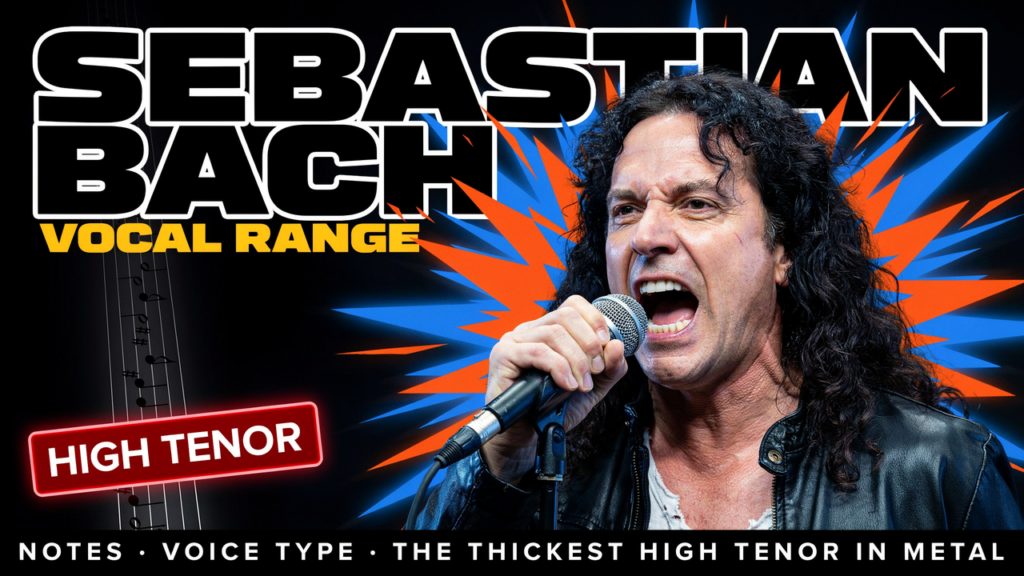
Sebastian Bach’s Vocal Range at a Glance
Vocal range: approximately C2 – D5 (chest voice), with upper extensions in mixed and head voice Voice type: High tenor (with exceptionally thick vocal cords) Key technical quality: C5–D5 chest voice with gritty mixed register above Active career: 1987–present
What Voice Type Is Sebastian Bach?
Unanimous: high tenor. The Rapid Vocal Results vocal coach analysis is the most technically specific: “He has a high tenor voice with extremely thick vocal cords, which not only allow him to sing high C5s and D5s in chest voice, but also to have the ability to mix chest and head voice with his ‘false cords’ to create grit and gravel in the highest notes of his mixed register.”
The thick vocal cords are the key detail — they produce a different kind of high-tenor sound than the typical lighter, thinner cords of a lyric tenor. Thick cords produce more overtones, more weight, and more of the “girth and width” that the vocal coach identifies as his signature quality: “He is famous for having so much girth and width in his high vocals. This creates a gritty, gravelly scream that Sebastian uses to great effect in songs like ’18 and Life’ and ‘I Remember You.'”
This is what makes his voice unusual in metal: most high-tenor metal singers produce their high notes with relative thinness — the cords thin as they ascend, producing the characteristic “screaming” sound of the genre. Bach’s thick cords allow him to maintain tonal weight and grit in the high fifth octave, producing a high note that sounds both powerful and dangerous rather than simply strained.
The tenor vocal range page covers where the high tenor sits relative to other male voice types, and the how to sing high notes without straining page covers the technical principles behind sustained upper-register power.
Church Choir to Metal: The Vocal Foundation
Bach’s vocal foundation came from church choir — he joined All Saints Anglican Church choir at age 8, beginning a formal choral training that preceded his entry into rock and metal. The NPR interview documents this specifically: “I joined the church choir when I was 8 years old, and I describe in detail in my book a Christmas mass where we would sing ‘Gloria in excelsis Deo.'”
That choral foundation — breath support, forward placement, the habit of sustaining tone across extended phrases — is precisely what allows the thick-corded high tenor to function in a heavy metal context without destroying itself. Many metal singers with naturally powerful voices shorten their careers by singing with incorrect technique; Bach’s choral grounding gave him the mechanical foundation to sustain over decades.
He has also discussed his deliberate efforts to protect his range during his voice change — locking himself in his dormitory, using specific reference recordings to monitor where his voice was — which reflects an awareness of the instrument as something to be maintained rather than simply used.
“18 and Life”: The Voice at Its Defining Moment
“18 and Life” (1989, from the Skid Row debut album) is the most widely heard document of Bach’s voice in its prime — and the performance that made the Goodreads reviewer describe it as “pipes of steel that crushed any other voice that sang in that scene.” The song’s emotional arc — from controlled verse verses to the climactic high notes of the chorus — demonstrates precisely the thick-cord high tenor quality: sustained power at height, with grit rather than thinness.
The vocal coach analysis of his voice was specifically motivated by understanding how he achieves this quality: “Speaking as a vocal coach, Sebastian’s voice is extremely special in its characteristics and its tonal nature.” The combination of thick cords with correct technique produces a sound that is both genuinely powerful and sustainably producible — which is why his voice has remained functional across decades of performing.
Broadway: Jekyll & Hyde and Beyond
Penn’s Peak’s promotional copy identifies Bach as “the first heavy metal singer on Broadway” — a designation that refers to his run in Jekyll & Hyde: The Musical. He has also appeared in The Rocky Horror Picture Show and Jesus Christ Superstar in stage productions.
This theatrical dimension is worth examining in the context of his voice. The technique required for Broadway sustained projection — the ability to fill a large theatre acoustically without microphone amplification matching a rock concert’s PA system — requires the same fundamentals his church choir built: forward placement, breath support, and open resonance. His choral foundation made the transition to theatrical singing more natural than it might have been for a singer developed entirely in amplified rock contexts.
He described this in his NPR interview: “From star turns on Broadway to jamming in a garage band on Gilmore Girls, Bach has remained committed to rock ‘n’ roll.” The commitment to both contexts simultaneously reflects a voice type that doesn’t need to choose.
FAQs About Sebastian Bach’s Vocal Range
What is Sebastian Bach’s vocal range?
His high tenor reaches C5 and D5 in chest voice — exceptionally high notes for a male voice to produce with the weight and grit that thick vocal cords allow. His lower range extends into the C2 area. The full span is approximately three-plus octaves in practical singing range.
What makes Sebastian Bach’s voice unusual among high tenors?
His thick vocal cords produce C5 and D5 with weight and grit rather than the thinness typical of high tenor ascent. As one vocal coach analysis states: “He is famous for having so much girth and width in his high vocals” — the quality that gives his high notes their characteristic gravelly power rather than the typical screaming thinness.
Was Sebastian Bach trained formally?
He sang in All Saints Anglican Church choir from age 8 — formal choral training that gave him the breath support and placement technique underlying his sustainable high tenor. He also received coaching from mentors in early bands on mic technique, breathing, and protecting his voice.
What is Sebastian Bach’s Broadway connection?
He is cited as “the first heavy metal singer on Broadway,” with productions including Jekyll & Hyde: The Musical, The Rocky Horror Picture Show, and Jesus Christ Superstar. His choral background made the transition to theatrical performance more natural.
What happened between Sebastian Bach and Skid Row?
He was fired from Skid Row in 1996, when grunge had overtaken the metal genre and internal band tensions had become unmanageable. He has continued as a solo artist since, with albums including Angel Down and Kicking & Screaming, while also pursuing his theatre and television career.
Erika Parker is a vocal analysis and singing education writer at Vocal Range Test. She focuses on vocal range testing, voice type analysis, pitch recognition, and singing tools for vocalists, musicians, choir singers, and beginners.