
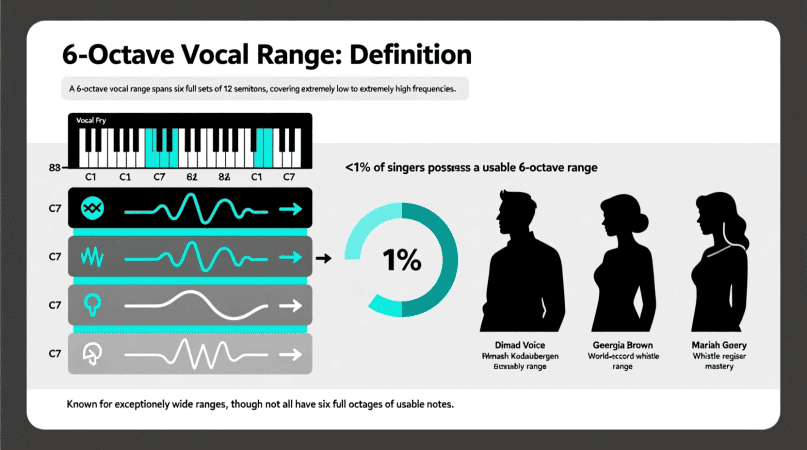
A 6-octave vocal range is one of the rarest and most extraordinary abilities in the world of music. While most trained singers master 3 to 4 octaves, and average individuals manage 1.5 to 2 octaves, a 6-octave range places a vocalist in an elite category shared by only a handful of performers in history.
This guide delivers the most accurate, science-backed, and SEO-optimized authority on what a 6-octave range means, who has it, how it’s verified, and whether it can be developed.
What Is a 6 Octave Vocal Range?
A 6-octave vocal range means that a singer can produce notes spanning six complete octaves — a total of 72 semitones.
This means the singer can vocalize:
- Very low, resonant bass notes
- Mid-range chest/head voice
- Light falsetto
- Extremely high whistle tones
Only a tiny, scientifically rare subset of singers possess the physiological structure and control to consistently use a 6-octave range.
If you want to understand where your voice sits, the Baritone Vocal Range guide describes typical note spans and pairs well with the Vocal Range Test. Baritones can improve stability by practicing the Warm-Up Exercises for Baritone/Bass and checking stamina with the Daily Vocal Warm-Up.
Understanding Six Octaves (Example Range)
A person with a 6-octave range might sing from: C2 → C8
Where:
- C2 = deep bass territory
- C8 = the highest note on a standard piano
Very few singers can control this entire spectrum.
How Rare Is a 6-Octave Vocal Range?
A 6-octave range is virtually unmatched in human vocal ability. To achieve it, a singer must possess:
Unique Physical Traits
- Exceptional vocal fold elasticity
- High control over subharmonics and whistle register
- Naturally strong resonance chambers
Advanced Vocal Technique
- Blending registers seamlessly
- Expanding pitch accuracy at extremes
- Maintaining tone, breath control, and clarity
Why It’s So Rare
Most humans lack the laryngeal flexibility and neuromuscular coordination required to reach six octaves safely and repeatably.
Famous Singers With a 6 Octave Vocal Range
While there are many claims, only a few singers have range measurements approaching or exceeding six octaves. Here are the most credible:
| Singer | Approx. Range | Notability |
|---|---|---|
| Dimash Kudaibergen | ~6 octaves | Considered one of the most technically gifted modern vocalists. |
| Mike Patton (Faith No More) | ~6 octaves | Known for extreme versatility, powerful lows, and experimental highs. |
| Georgia Brown | 8 octaves (Guinness claim) | Famous for whistle-register extremes; range claims often debated. |
| Vitas | 5–6 octaves (varies) | Known for operatic high notes; whistle capabilities. |
| Axl Rose | ~5–6 octaves (controversial) | Studio ranges often exceed live capacity. |
Important: Many online lists exaggerate or rely on non-usable notes.
A true 6-octave range requires proven, controlled, and repeatable vocalization.
Vocal Range Chart (Simplified Overview)
| Octave | Frequency Zone | Typical Voice Presence |
|---|---|---|
| 1st (E1–B1) | Deep bass | Extreme bass singers |
| 2nd (C2–B2) | Low register | Bass, baritone |
| 3rd (C3–B3) | Middle register | Baritone, tenor, alto |
| 4th (C4–B4) | Standard singing range | Most pop & classical |
| 5th (C5–B5) | High register | Powerful tenors, sopranos |
| 6th (C6–B6) | Very high | Coloratura, whistle transition |
| 7th–8th (C7–C8) | Extreme whistle | Very rare |
A 6-octave vocalist may access most or all of these zones.
How Vocal Range Is Measured Accurately
Most incorrect range claims come from sloppy measuring.
Here is the scientific approach used by vocal researchers:
1. Determine Lowest Usable Note
- A note is counted only if sustained and controlled
- Fry register may be included only if pitch-identifiable
2. Move Through Every Register
Chest → mix → head → falsetto → whistle → subharmonics
3. Confirm Using a Spectrogram
Software (like Praat or VoceVista) verifies:
- Frequency (Hz)
- Pitch stability
- Harmonics
- Decibel strength
4. Exclude Unusable Sounds
Random squeaks, inhaled whistles, or unpitched sounds are not valid notes.
Is a 6 Octave Vocal Range Natural or Trainable?
Natural Factors
- Genetics (vocal fold shape & length)
- Lung capacity
- Resonance structures
- Laryngeal mobility
Trainable Factors
- Breath technique
- Register coordination
- Stamina
- Pitch accuracy
- Resonance tuning
Reality Check
Training can expand your range by 1 to 1.5 octaves, but:
Most humans will never achieve six octaves, regardless of training.
It requires physiology that only an estimated 1 in 10 million possess.
Registers Required for a Six-Octave Range
To cover 6 octaves, a singer must master:
1. Chest Voice (Modal Register)
Foundation of power and resonance.
2. Mixed Voice
Bridges chest and head without strain.
3. Head Voice
High, resonant tones; crucial for upper range.
4. Falsetto
Light, airy tones useful in pop and R&B.
5. Whistle Register
The rarest register, supporting C6–C8.
6. Vocal Fry / Subharmonics
Used for extremely low frequencies.
Few singers can use all six registers consistently.
6-Octave Vocal Range vs Other Vocal Ranges
| Range | Difficulty | Seen In |
|---|---|---|
| 2 octaves | Very easy | Most people |
| 3 octaves | Moderate | Amateur singers |
| 4 octaves | Advanced | Many professionals |
| 5 octaves | Very advanced | Exceptional vocalists |
| 6 octaves | Elite | Rare individuals |
| 7–8 octaves | Controversial | Guinness records, debated |
Myths and Misconceptions About 6-Octave Singers
Myth 1: Many celebrities have 6 octaves
Reality: Most famous singers have 3–4 octaves, not six.
Myth 2: Screaming or squeaking counts
No — uncontrolled sounds do NOT count.
Myth 3: Whistle register alone creates huge ranges
Whistle tones add notes, but only if controlled and pitch-accurate.
Myth 4: Studio effects increase vocal range
Digital pitch-shifting does not represent true vocal ability.
Can You Train Yourself to Sing Six Octaves?
You CAN:
- Increase flexibility
- Improve breath support
- Strengthen transitions
- Add whistle notes (advanced)
- Develop deeper fry notes
You CANNOT:
- Change your vocal fold anatomy
- Force-range expansion beyond physiological limits
The average person can realistically achieve 3–4 octaves with dedicated training.
How to Safely Expand Your Vocal Range
(Evidence-backed techniques)
1. SOVT Exercises (Semi-Occluded Vocal Tract)
Straw phonation, lip trills — builds resonance efficiency.
2. Sirens
Smooth transitions across registers.
3. Controlled Whistle Register Drills
For advanced singers only; requires a coach.
4. Fry-Based Low Note Training
Strengthens subharmonic control.
5. Diaphragmatic Breathing
Supports long, stable pitches.
Never attempt whistle or extreme lows without guidance — improper technique can cause vocal fold injury.
Why a 6 Octave Vocal Range Is So Impressive
A singer with six octaves can:
- Perform multiple voice types (bass → soprano)
- Hit notes spanning most of the piano keyboard
- Shift between registers with precision
- Use their voice like a multi-instrument
This kind of versatility is unmatched in modern music.
FAQs: 6-Octave Vocal Range
1. Is a 6-octave vocal range real?
Yes — but extremely rare and often misreported.
2. Who has the widest vocal range?
Tim Storms holds the Guinness Record (~10 octaves including subharmonics).
Georgia Brown claims up to 8 octaves.
Dimash & Mike Patton are among the most credible at ~6 octaves.
3. Can beginners expand their vocal range?
Yes, typically by 1–2 octaves with proper training.
4. Do extreme high notes always come from whistle register?
Often, but not always — some singers use reinforced head tones.
5. How do you verify vocal range?
With spectrogram analysis and sustained pitch accuracy.
6. What is the rarest singing ability?
Extreme whistle register combined with powerful subharmonics — necessary for 6+ octaves.
Final Thoughts
A 6-octave vocal range represents a nearly unmatched level of vocal ability. It requires:
- exceptional physiology
- intense training
- mastery across multiple registers
- refined control and vocal intelligence
Only a handful of singers in history have been able to claim or demonstrate such extraordinary vocal flexibility.
- True six-octave voices are best understood by studying extremes like Tim Storms’ vocal range.
- Legendary sopranos such as Yma Sumac’s vocal range show how rare ultra-wide ranges really are.
- Modern virtuosos including Dimash’s vocal range demonstrate how training can stretch human limits.
- To grasp the mechanics behind these feats, learning how the vocal cords work is essential.
- Singers attempting extreme highs often study how to do whistle voice as a specialized technique.
- Building toward multi-octave control starts with disciplined vocal exercises to increase range.
- A structured foundation from beginner singing lessons helps prevent injury when exploring extreme registers.
Erika Parker is a vocal analysis and singing education writer at Vocal Range Test. She focuses on vocal range testing, voice type analysis, pitch recognition, and singing tools for vocalists, musicians, choir singers, and beginners.