
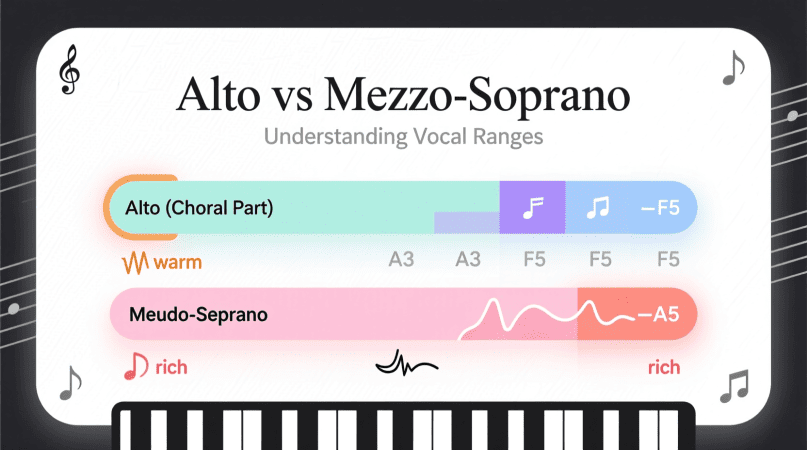
The primary difference between an alto and a mezzo-soprano lies in their tessitura—the range where the voice naturally feels most comfortable.
- Altos (contraltos) are the lowest female voice type, known for a dark, rich, warm tone and a comfortable singing zone around F3–D5.
- Mezzo-sopranos sit one tier higher, with a warm but brighter timbre and a comfortable range between A3–A5.
Range overlap is common, but comfort—not extremes—defines the true voice type.
What Is an Alto? (Contralto Explained)
Definition
An alto is the lowest standard female voice type in classical music. True contraltos are rare and recognized by their naturally weighted lower register and darker resonance.
Alto Vocal Range
- Typical: F3 – F5
- Extended (trained): E3 – E♭5
- Best tessitura: G3 – D5
- Key feature: Depth and darkness of tone
Alto Sound Characteristics
- Rich, chest-dominant tone
- A natural “shadow” or darkness to the sound
- Strong low notes, moderate high-note flexibility
- Wider, heavier vibrato tendency
Common Genres & Roles for Altos
- Choral music (alto line / harmony foundation)
- Jazz, gospel, soul
- Lower female pop vocals
- Classical contralto roles (rare but powerful)
What Is a Mezzo-Soprano?
Definition
A mezzo-soprano (“middle soprano”) is between alto and soprano. It is the most common female voice type and known for its blend of warmth, brightness, and flexibility.
Mezzo-Soprano Vocal Range
- Typical: A3 – A5
- Extended (trained): G3 – C6
- Best tessitura: B3 – G5
- Key feature: Strength in the mid-high range
Mezzo Sound Characteristics
- Warm and rounded tone
- Brighter than alto, darker than soprano
- Flexible mid-range with strong resonance
- Smooth transitions between registers
Common Mezzo Roles & Genres
- Opera roles: Cherubino, Carmen, Dorabella
- Pop, R&B, musical theatre
- Lead vocal lines in modern music
Developing a strong musical ear becomes easier when you practice with the Ear Training Game and follow it up with real-time vocal measurement using the Vocal Range Test. You can improve pitch recognition further with the Voice Type Test and apply these skills while identifying song scales using the Song Key Finder.
Alto vs Mezzo-Soprano: Complete Comparison Chart
| Feature | Alto (Contralto) | Mezzo-Soprano |
|---|---|---|
| Tessitura | Lower | Middle |
| Core Range | F3–F5 | A3–A5 |
| Tone Color | Dark, rich, warm | Warm, bright, resonant |
| High Note Ability | Limited | Strong |
| Low Note Strength | Very strong | Moderate |
| Voice Type Rarity | Very rare | Common |
| Vocal Fold Traits | Longer, thicker | Moderate length, balanced |
| Typical Placement | Choral harmony | Lead roles, lyrical parts |
The Real Difference: Tessitura Explained
Most singers misidentify their voice type by focusing on extremes:
- highest note
- lowest note
- total range
These do not determine voice type.
Correct Method
Your voice type depends on:
- the range where your voice feels relaxed
- the notes you can sustain comfortably
- your natural resonance pattern
Tessitura Comparison
- Altos thrive in the lower middle register
- Mezzos thrive in the upper middle register
Even if a mezzo can hit a low F3, it might sound weaker compared to a true alto.
How Physiology Influences Voice Type
Altos Tend to Have
- Thicker vocal folds
- Lower formant frequencies
- Darker resonance shape
- Stronger chest-dominant production
Mezzo-Sopranos Tend to Have
- Balanced chest–head coordination
- Medium vocal fold length
- More upper harmonic brightness
- Easier access to head voice
Voice type is primarily anatomical.
Training expands range, not your fundamental classification.
How Altos and Mezzos Function in Music
In Choirs
Choral placement considers tone color and blend:
- Mezzos with darker timbre may get placed in alto
- True altos are valuable for deep harmony
- Sopranos may occasionally be shifted down if tone fits
In Pop & Modern Music
Voice types are flexible.
Common mezzo-sopranos in pop:
- Adele
- Lady Gaga
- Beyoncé
- Ariana Grande (light lyric mezzo)
Lower-leaning voices commonly associated with alto color:
- Tracy Chapman
- Annie Lennox
- Amy Winehouse (mezzo-contralto qualities)
How to Know If You’re an Alto or Mezzo-Soprano
Likely an Alto If:
- Your best notes sit below C5
- Notes above E5 feel heavy or strained
- Your timbre is naturally dark
- Your low notes feel powerful and resonant
- You are often placed on alto lines in choir
Likely a Mezzo-Soprano If:
- You comfortably sing A3–A5
- You can reach G5–C6 with training
- Your tone blends warmth and brightness
- You feel strongest in the mid-high register
- Low notes exist but are not your strongest feature
The Only Accurate Method to Determine Voice Type
Step 1: Test Your Full Vocal Range
Use a calibrated tool like Vocal Range Test to map your lowest and highest notes.
Step 2: Identify Your Tessitura
Find the notes you can sing comfortably for extended periods.
Step 3: Analyze Tone Color
Darker voices lean alto; balanced warmth leans mezzo.
Step 4: Compare Traits
Match your vocal behavior to the typical characteristics of each type.
Voice type = natural comfort + tonal identity, not the notes you can force.
Expert-Level FAQ
Is alto lower than mezzo-soprano?
Yes. Alto is the lowest female voice type; mezzo-soprano sits above it.
Can a mezzo-soprano sing alto?
Often yes, especially in choirs, though sustained low passages may be harder.
Can training turn an alto into a mezzo?
Unlikely. Training can extend range but rarely changes the core type.
Why do altos sound darker?
Their resonance emphasizes lower harmonics.
Are there true altos in pop music?
Very few. Many singers only sound alto-like due to stylistic choices.
Why do some altos struggle with high notes?
Their vocal anatomy naturally supports lower frequencies.
Can a mezzo-soprano sing contralto lows?
Yes, but often without the depth, color, or ease of a true alto.
Is mezzo-soprano best for pop?
Yes, it is the most versatile and common female voice type in contemporary genres.
Can someone fall between alto and mezzo?
Yes, hybrid types like mezzo-contralto are common.
Final Thoughts
Your voice type is determined by:
- where you sing most comfortably
- how your tone naturally resonates
- the vocal range where your sound is strongest
You are likely an alto if you excel in the lower range with a darker timbre.
You are likely a mezzo-soprano if you shine in the mid-high range with warmth and brightness.
To identify your voice type accurately:
- Test your full vocal range.
- Observe your comfortable singing zone.
- Evaluate your natural tone color.
This combination gives the most reliable classification.