
Anna Kendrick’s vocal range sits at approximately F3 to E5, covering just over two octaves, with some analysts noting extensions up to B5 in her upper head voice. She’s classified as a soprano — specifically the lighter, lyric end of the spectrum — and her technique leans heavily on a well-integrated mixed register rather than sheer power.
That distinction matters. If you’ve heard her in Pitch Perfect or Into the Woods and wondered why her voice sounds so effortless even on higher passages, the mixed voice is the answer. She’s not grinding through notes with full chest voice or flipping into obvious falsetto — she’s blending the two, which keeps her upper range sounding controlled and natural rather than forced.
It’s also worth noting that Kendrick has been singing since she was a child. By age six she was performing in community theater, and at twelve she made her Broadway debut in the Cole Porter musical High Society, earning a Tony Award nomination — making her one of the youngest nominees in the award’s history. That kind of early classical and musical theater training shapes how a singer manages their instrument for decades afterward.
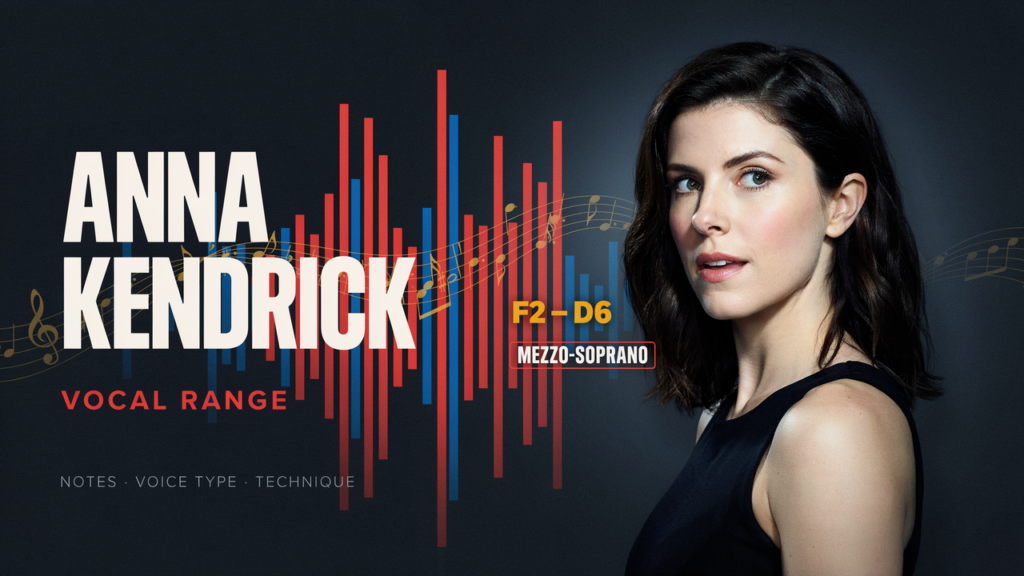
Anna Kendrick’s Vocal Range at a Glance
Vocal range: F3 – E5 (with reported extensions to B5) Voice type: Soprano (lyric) Vocal registers in use: Chest voice, mixed voice, head voice Approximate span: Just over two octaves in chest/mix, wider with head voice extensions Tessitura (comfortable center): Roughly D4 to C5
What Kind of Soprano Is She?
The soprano category covers a lot of ground — from the agile coloratura soprano who runs scales at C6 and above, to the dramatic soprano built for Wagner. Kendrick sits closer to the lyric soprano end: a lighter, more flexible instrument focused on clarity, emotional nuance, and blend rather than volume or extreme high notes.
Lyric sopranos tend to sit comfortably in the E4–B4 range during a song, and that tracks with how Kendrick performs. Her tessitura — the part of the range that sounds easiest and most natural — lives in that middle-to-upper zone, where her tone is bright but never brittle.
If you want to understand how soprano ranges compare to other voice types, the vocal range chart covers the full picture across all six classical categories.
Her Lower Register: F3 and Below
F3 is roughly two Fs below middle C, and getting there in full voice requires genuine chest resonance. Kendrick can access this territory, but it’s not where her voice lives. In quieter, more intimate vocal moments she dips into the low third octave, but the tone thins out as she descends — which is normal for a lyric soprano. Chest voice power in the low register just isn’t where this voice type is built to operate.
That’s not a weakness. It’s physics. Trying to force a lyric soprano voice into deep chest resonance below E3 consistently risks the kind of tension that can lead to vocal fatigue over time. Kendrick wisely doesn’t push there.
Her Upper Register: Mixed Voice and the Fifth Octave
This is where things get more interesting. Kendrick’s E5 ceiling in mixed voice sits comfortably within soprano territory — for reference, E5 is the note a trained soprano would typically approach near the top of their comfortable working range in musical theater.
But she’s also been documented accessing notes into the B5 range in head voice, which is a genuine upper-fifth-octave extension. These notes are light and breathy rather than full and resonant, but they’re there. Whether that counts as part of her “usable” range depends on how strictly you define the term — if you’re curious about where that line falls, the piece on whether head voice counts in vocal range breaks it down in detail.
What’s more notable than the ceiling is the smoothness of her passaggio — the break point between registers. For most sopranos, the area around E4–G4 is where chest voice starts losing steam and head voice or mix needs to take over. A rough passaggio sounds like a crack or a sudden thinning of tone. Kendrick navigates this transition cleanly, which is a direct product of her musical theater training.
The Mixed Register: Kendrick’s Core Technique
If you were to pick one technical hallmark of Anna Kendrick’s voice, it’s her use of mixed voice. Mixed voice — sometimes called mix or middle voice — blends chest resonance with head resonance to produce a sound that’s simultaneously full enough to carry and light enough to reach higher notes without strain. It’s central to vocal range and singing technique at the professional level.
It’s the workhorse register of musical theater. Performers who eight shows a week can’t afford to belt everything in full chest voice and hope for the best — the voice would be gone within days. Mix gives you projection, range, and longevity.
You can hear Kendrick’s mix at work in “Cups (When I’m Gone)” from Pitch Perfect. The melody sits mostly in the D4–A4 range, which is right in her sweet spot. Her tone stays consistent across the phrase — it doesn’t thicken when she goes lower or thin out noticeably when she steps up. That’s mix working correctly.
Into the Woods shows another dimension. Sondheim’s “Cinderella” material requires a singer who can handle complex melodic intervals with precision, and Kendrick’s training in pitch accuracy and breath control is audible in that performance. The character doesn’t demand extreme high notes, but it does demand clarity and emotional specificity at every pitch, which is its own kind of technical challenge.
Breath and Tone: The Breathy Quality
One sonic trademark worth naming directly: Kendrick’s voice carries a consistent, light breathiness. It’s not a flaw — it’s partly a stylistic choice and partly the natural acoustic character of a lighter lyric soprano instrument.
Some listeners hear that quality and assume the voice is fragile. But a controlled breathy tone requires solid breath management. You’re maintaining a specific balance of air flow and vocal cord adduction — the degree to which the cords close — and keeping it consistent across pitch changes takes real technique. A voice that’s actually underpowered just sounds thin and unstable; Kendrick’s sounds intentional and even.
This quality is part of why her voice sits well in film. A bigger, more operatically placed sound can feel overwhelming when recorded close-mic’d. The lighter, breathy soprano tone translates naturally to an intimate context, which is exactly what film scoring and soundtrack recording calls for.
Notable Vocal Performances
Cups (When I’m Gone) — Pitch Perfect (2012): The defining performance in terms of public recognition. Stripped back, rhythmic, and focused entirely on tone and control. It reached number six on the Billboard Hot 100 in 2013 and spent 44 weeks on the chart — rare for a song that relies so heavily on a single unamplified vocal.
Into the Woods (2014): Playing Cinderella gave Kendrick a chance to demonstrate her classical and musical theater roots in a Stephen Sondheim score, which is notoriously unforgiving of pitch imprecision.
The Last Five Years (2014): Probably the most vocally demanding full project she’s taken on. The Jason Robert Brown score requires a soprano who can deliver emotionally complex material across a wide dynamic range. This one shows how far her training actually goes.
How Her Broadway Training Shaped Her Voice
Kendrick’s path to film singing ran through the stage, and that matters technically. Broadway training — especially young, as she experienced — builds habits that most pop singers never develop: breath support, vowel placement, legato phrasing, and the ability to produce consistent tone at soft dynamics without the voice disappearing.
It also trains singers to navigate register transitions smoothly, because in live theater there’s no Auto-Tune and no second take. You either hit the note cleanly or the audience hears it.
That foundational work is audible in the steadiness of her pitch and the consistency of her tone quality across her range. She doesn’t have the extended ceiling of a classical soprano, but she has the reliability and precision that comes from years of performing live.
If you want to test your own voice against soprano territory, the vocal range finder will tell you your lowest and highest notes and place them in context. You can also use the singer comparison tool to see how your range lines up with Kendrick’s — or anyone else’s in the database.
Is Anna Kendrick Actually a Good Singer?
She’d probably be the first person to complicate that question. Kendrick has said publicly that she considers herself primarily an actress who sings, not a singer who acts — and there’s something refreshingly honest in that self-assessment.
From a purely technical standpoint: her pitch accuracy is solid, her mixed register is well-developed, her breath management supports a consistent tone, and her musical theater background gives her real interpretive depth. She’s not trying to deliver five-octave runs or hold notes for forty-five seconds. What she does is sing with precision and emotional clarity within a well-defined range, and she does that reliably.
That’s a different skill set than the virtuosic end of vocal performance, but it’s a real one. The voice type test can help you figure out what category your own voice falls into — knowing whether you’re a lyric soprano, mezzo, or something else entirely shapes which repertoire will work best for you.
FAQs About Anna Kendrick’s Vocal Range
What is Anna Kendrick’s vocal range?
Her documented range runs from approximately F3 to E5, with extensions into the upper fifth octave (around B5) in head voice. That puts her total span at roughly two octaves in chest/mix and wider with head voice included.
What voice type is Anna Kendrick?
She’s a soprano — most accurately described as a lyric soprano. Her voice is lighter and more flexible than a dramatic soprano, with a natural brightness suited to musical theater and film.
Does Anna Kendrick actually sing in her movies?
Yes. Her vocals in Pitch Perfect, Into the Woods, and The Last Five Years are her own. She has a background in live musical theater, which means live vocal performance was part of her training long before the films.
How does Anna Kendrick’s range compare to other sopranos?
Her working range is typical for a lyric soprano. Singers like Kristin Chenoweth sit higher and with more classical placement, while someone like Kelly Clarkson accesses similar soprano territory but with a heavier, more belted approach. Kendrick’s distinguishing quality is the lightness and blend of her mix rather than extreme range.
Erika Parker is a vocal analysis and singing education writer at Vocal Range Test. She focuses on vocal range testing, voice type analysis, pitch recognition, and singing tools for vocalists, musicians, choir singers, and beginners.