
M Shadows’ vocal range spans approximately D2 to A5 — nearly four octaves — per Wikipedia’s documentation from the Rangepedia source. Born Matthew Charles Sanders on July 31, 1981 in Huntington Beach, California, the lead vocalist and co-founder of Avenged Sevenfold became a singer entirely by circumstance: “I didn’t want to be a singer, man. I got forced into it.” He had co-founded the band in 1999 as a necessity and sang because no one else would.
What followed was four decades of deliberate development that took a reluctant metalcore screamer and turned him into one of the more technically versatile vocalists in modern metal. The Avenged Sevenfold Wikipedia article states directly: “Shadows possesses a baritone voice but is able to sing comfortably in the tenor range, hitting high C on a regular basis.”
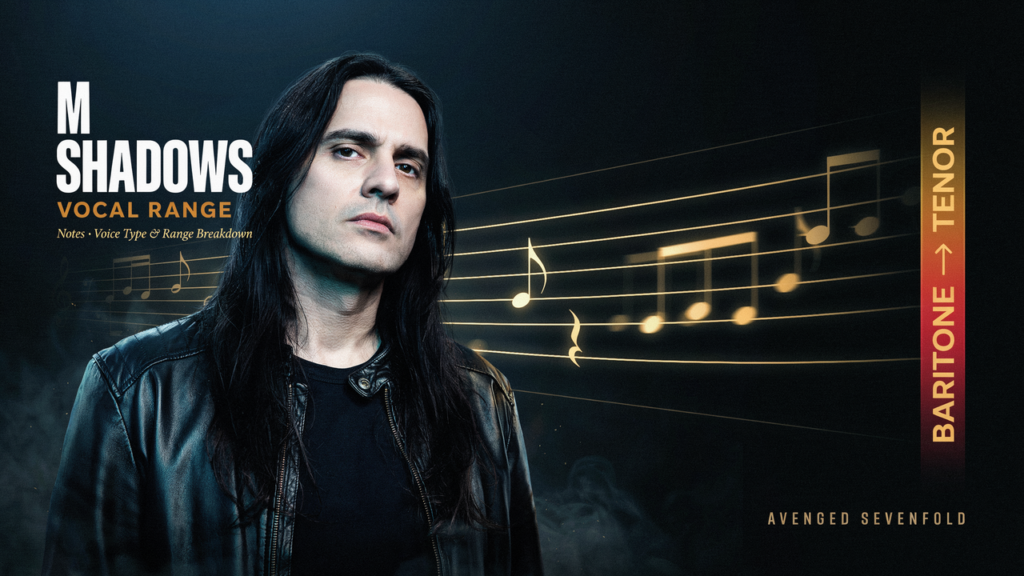
M Shadows’ Vocal Range at a Glance
Vocal range: D2 – A5 (nearly four octaves, Wikipedia/Rangepedia) Voice type: High baritone (with developed tenor upper register) Vocal registers in use: Chest voice, mixed voice, head voice, distortion/screaming Approximate span: Just under 4 octaves Tessitura (comfortable centre): Roughly E3 to G4 Active career: 1999–present
What Voice Type Is M Shadows?
Every credible source — SingersAvenue, the Avenged Sevenfold Wiki, the Rock Riff analysis, and Wikipedia — converges on the same classification: high baritone. The key qualification each adds is that his baritone foundation is developed enough to access the tenor range convincingly. The Avenged Sevenfold Fandom Wiki phrases it precisely: “Though Shadows possesses a baritone voice, he has been able to perfect his technique to a degree that allows him to sing convincingly and comfortably in the tenor range often called for by his genre of music.”
This combination — baritone warmth and depth in the lower register, trained tenor access in the upper — is what allows the Avenged Sevenfold catalogue to work. Heavy metal arrangements frequently demand upper register power from male vocalists; a pure baritone who can’t access that territory comfortably struggles in the genre. Shadows’ developed upper register solves the problem while keeping the dark, weighty mid-range quality that gives his voice its character.
The baritone vocal range page covers the voice type in full. The tenor vs baritone comparison explains the specific boundary his voice sits at.
His Lower Register: D2 and Baritone Depth
D2 — documented as his lowest recorded note — sits at the low end of the baritone range and well into bass territory. His chest voice in the lower second and third octave carries the dark, weighty quality that characterises the high baritone: substantial resonance without the extreme depth of a dramatic bass.
This lower register is most evident in the slower, more atmospheric passages of Avenged Sevenfold’s catalogue. Songs like “So Far Away” (written in memory of drummer The Rev, who died in 2009) demonstrate the lower mid-range chest voice at its most emotionally exposed — a baritone warmth that serves the song’s vulnerability without reaching for upper register power.
His Upper Register: Tenor Access and High C
A5 is the documented upper ceiling — high into the fifth octave, well above what most baritones can access even with full development. Wikipedia specifically notes he hits “high C on a regular basis,” which refers to the C in the fifth octave (C5) — the note that serves as a benchmark for classical tenor facility.
The evolution toward this upper range was deliberate and coached. Before the self-titled 2007 album, Shadows worked with vocal coach Ron Anderson — who had previously worked with Axl Rose and Chris Cornell — specifically to develop a gritty, resonant sound that could carry melodic metal lines without screaming. The result was the cleaner, more tonally consistent voice that characterises his mature work on City of Evil (2005), Nightmare (2010), and subsequent albums.
Singing Carrots describes his range as “spanning from mid-baritone to high tenor” — the practical working span that doesn’t include the extreme extensions at either end.
The Evolution: From Screaming to Singing
Shadows’ vocal evolution is one of the more documented in modern metal. The band’s first album Sounding the Seventh Trumpet (2001) featured primarily harsh metalcore growls; Waking the Fallen (2003) showed increasing melodic development; City of Evil (2005) committed fully to clean singing.
The transition wasn’t welcomed by all fans. When the harsh vocals disappeared, some assumed Shadows had damaged his voice. Producer Andrew Murdock was explicit in response: the change was planned, not forced. Shadows himself said: “We don’t listen to bands that scream… I’d rather listen to the Iron Maidens and Metallicas of the world.” The vocal development was the pursuit of a deliberate aesthetic rather than an accident of physical limitation.
For singers working in similar heavy styles, the vocal health for singers page covers the principles of sustainable technique that Shadows learned to apply through his transition.
M Shadows and Matt Shadows: A Note
Both the URLs vocalrangetest.com/m-shadows-vocal-range and vocalrangetest.com/matt-shadows-vocal-range refer to the same person: Matthew Charles Sanders, who performs under the stage name M. Shadows. He chose the name because he saw himself as “the darker character in the group,” using M instead of Matthew because of how it sounded. There is no separate “Matt Shadows” — only M. Shadows, whose full name is Matthew Sanders.
FAQs About M Shadows’ Vocal Range
What is M Shadows’ vocal range?
Wikipedia documents his range as D2 to A5 — nearly four octaves — citing the Rangepedia source. His comfortable working range in most Avenged Sevenfold material sits in the E3–G4 zone, with upper register passages reaching into C5 and A5.
What voice type is M Shadows?
He’s a high baritone with a developed tenor upper register. Wikipedia states he “possesses a baritone voice but is able to sing comfortably in the tenor range, hitting high C on a regular basis.”
Who was M Shadows’ vocal coach?
He worked with Ron Anderson, who has also coached Axl Rose and Chris Cornell. The coaching relationship was particularly important for the transition from harsh/screaming technique to the cleaner melodic style that characterises the band’s mature sound from City of Evil (2005) onward.
Why did M Shadows stop screaming?
It was a deliberate artistic choice, not a physical limitation. Shadows explained the band’s aesthetic direction toward the Iron Maiden and Metallica tradition of melodic metal rather than metalcore screaming. Producer Andrew Murdock confirmed the change was planned from the outset of the self-titled album sessions.
What is the best showcase of M Shadows’ vocal range?
“Nightmare” and “Afterlife” demonstrate the upper register and melodic capability. “So Far Away” shows the lower baritone in an emotionally exposed context. The self-titled album’s “A Little Piece of Heaven” is frequently cited for demonstrating the widest tonal range within a single track.
Erika Parker is a vocal analysis and singing education writer at Vocal Range Test. She focuses on vocal range testing, voice type analysis, pitch recognition, and singing tools for vocalists, musicians, choir singers, and beginners.