
Patrick Stump’s vocal range spans approximately E2 to C6 — three octaves and a minor sixth — with a high lyric tenor instrument that the Diva Devotee vocal profile describes as carrying “a piercing, ringing quality, most noticeable in the upper fourth and lower fifth octaves.” Born Patrick Martin Stumph on April 27, 1984 in Evanston, Illinois, he is the lead vocalist, guitarist, and primary composer for Fall Out Boy, the pop-punk band he co-founded in 2001. Billboard has described him as having “one of the best voices in pop-punk” — a genre not historically known for technical vocal precision.
What makes Stump’s instrument unusual in the context of pop-punk is precisely that technical quality: a voice with genuine three-octave range, controlled belting through the upper fourth and fifth octaves, melismatic capability that goes well beyond what the genre typically demands, and a tenor high note ceiling that extends into C6 — soprano-adjacent territory for a male voice.
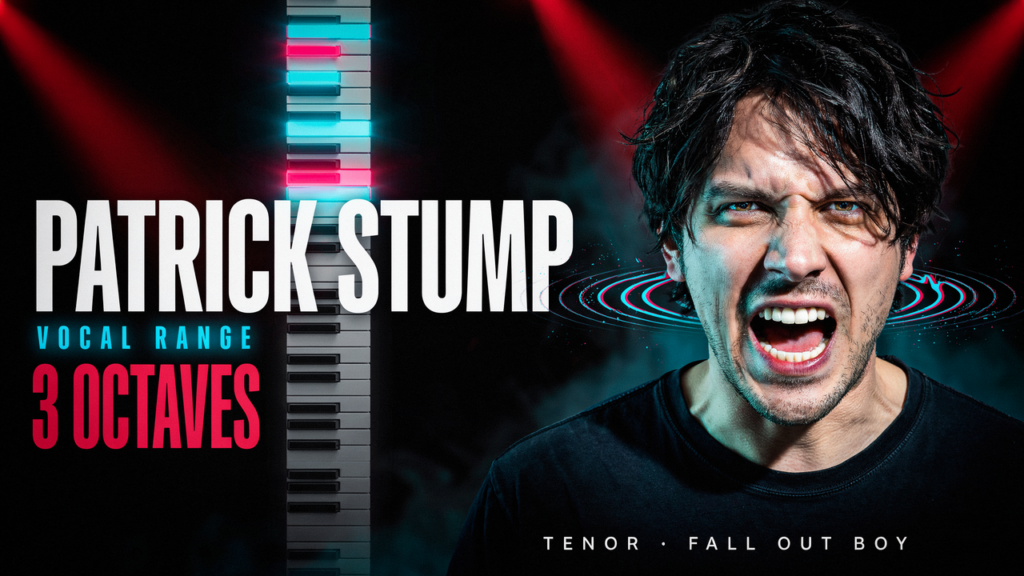
Patrick Stump’s Vocal Range at a Glance
Vocal range: E2 – C6 (Diva Devotee), C#2 – A5 / G#5 (Range Place) Voice type: High lyric tenor Vocal registers in use: Chest voice, mixed voice, falsetto Approximate span: Three octaves and a minor sixth Tessitura (comfortable centre): Roughly B3 to G4 Active career: 2001–present
What Voice Type Is Patrick Stump?
Multiple independent analyses converge on tenor — specifically at the lighter, higher end of the tenor spectrum. The Diva Devotee classifies him as a “high lyric tenor”; The Range Place as an “American Beauty/American Tenor” with C#2–A5 range; SingersAvenue as a spinto tenor; the Tumblr analysis as a “low tenor, maybe spinto.”
The most consistent observation across all these analyses is that his voice sits at the lighter end of the tenor spectrum — not the powerful dramatic tenor of opera, but a bright, forward-placed instrument that carries through dense production rather than over it. Diva Devotee notes “his belting range carries a lot of sound and surprising ease, given the genre he sings in usually calls for more strain and tension than traditional pop music.”
This is the key comparative observation: pop-punk vocal technique typically involves pushed, strained upper register production. Stump produces his upper notes with an ease that reflects genuine tenoric facility rather than forced chest voice — which is why his high notes sound controlled where many pop-punk contemporaries’ sound laboured.
The tenor vocal range page covers where his voice type sits within the male voice classification system.
His Lower Register: E2 and the Darker Depths
E2 — the documented lower limit — sits at the low end of the baritone range and below the standard tenor floor. The Diva Devotee analysis notes “his low range is the least-used area of his voice, and has a dark, distended quality” with the example of “Headfirst Slide Into Cooperstown on a Bad Bet.” He “very infrequently descends lower than C3, but when he does, approaches the notes with solid support, and doesn’t have the breathy quality that so many tenors do when singing low.”
This observation — that his low notes are supported rather than breathy — is a technical marker of a voice with genuine chest voice development across the full range. Many light tenors lose quality quickly when they descend into the low third octave; Stump’s voice remains grounded there, which extends the emotional palette available below the comfort zone.
His Upper Register: Belt, Mix, and the C6 Ceiling
The C6 upper ceiling — documented by the Diva Devotee analysis — puts Stump’s head voice in soprano range. For context: C6 is a note that classically trained sopranos approach as a significant high note achievement. Accessing it in head voice with “typical breathiness, though this can be controlled” places his upper register in genuinely exceptional territory for a male voice in a rock context.
His belt ceiling — the upper limit of his chest/mix register — sits in the B4–D5 range per the Diva Devotee analysis. “The highest belts (B4-D5) are interesting for the fact that his tone does not become heady, indicating an unusually controlled mix, as well as a rather high voice type.” This controlled mix — where the upper belt maintains chest quality rather than thinning into head voice — is a specific technical achievement.
The practical consequence for Fall Out Boy’s music: songs like “Dance, Dance,” “Sugar, We’re Goin Down,” and “Centuries” place him in the upper fourth and fifth octave for their melodic peaks, and he sustains those peaks with the “piercing, ringing quality” the analysis identifies — the specific acoustic character of a forward-placed high lyric tenor in its most natural register.
The how to belt page covers the mix technique that allows Stump’s upper belt to maintain chest quality at B4–D5.
The Melisma: Unexpected Technical Sophistication
One of the most frequently noted features of Stump’s voice in technical analysis is his capacity for melisma — the rapid ornamentation of a single syllable across multiple pitches associated with gospel and R&B rather than pop-punk. The Diva Devotee analysis notes “an interesting knack for melisma – unusual given his chosen genre” and specifically cites the Fall Out Boy album Folie à Deux as demonstrating “great capability for fast-moving, melismatic lines in the middle voice.”
This melismatic facility is consistent with the R&B and soul influences that appear most clearly in his solo work. His 2011 solo album Soul Punk — the name itself signals the synthesis — demonstrated the voice in an R&B context where the melisma and the soul phrasing that appear as unusual grace notes in Fall Out Boy become the primary sonic mode.
Solo Work and Versatility
Soul Punk (2011) is the clearest document of Stump’s voice outside the pop-punk context. The album was described by Billboard as “funky and R&B infused” — which tracks with the melismatic capability and the light tenor’s natural affinity for mid-range soul phrasing. The transition from Fall Out Boy’s dense, produced pop-punk to bare-bones R&B material requires a voice that can function in both contexts, and Stump’s three-octave instrument handles the switch without audible strain.
Fall Out Boy’s own catalogue spans from the early pop-punk of From Under the Cork Tree (2005) through the more arena-pop Mania (2018), requiring the voice to function across a significant range of production contexts while maintaining the “piercing, ringing quality” that makes it identifiable in all of them.
FAQs About Patrick Stump’s Vocal Range
What is Patrick Stump’s vocal range?
The Diva Devotee documents E2 to C6 — three octaves and a minor sixth. The Range Place documents C#2 to A5 as his recorded range, with A5 being his highest documented live note. His practical working belt range sits primarily in the C3–D5 zone.
What voice type is Patrick Stump?
He’s a high lyric tenor — all major vocal analysis sources converge on tenor, with qualifications ranging from “high lyric” (Diva Devotee) to “spinto” (SingersAvenue) to “American tenor” (Range Place). His voice sits at the lighter, brighter end of the tenor spectrum.
What did Billboard say about Patrick Stump’s voice?
Billboard described him as having “one of the best voices in pop-punk” — a genre where clean technical vocal production is the exception rather than the rule, making the assessment particularly meaningful.
Does Patrick Stump sing melisma?
Yes — the Diva Devotee analysis specifically notes “an interesting knack for melisma – unusual given his chosen genre” and cites Folie à Deux as demonstrating this capability. His solo album Soul Punk places the melismatic technique in an R&B context where it’s stylistically more expected.
What instruments does Patrick Stump play?
Guitar, piano, keyboards, bass, and drums — he is the primary composer for Fall Out Boy’s music, writing the melodies and arrangements from Wentz’s lyrics. His multi-instrumentalism shapes how he conceives vocal lines in relation to instrumental parts.
Erika Parker is a vocal analysis and singing education writer at Vocal Range Test. She focuses on vocal range testing, voice type analysis, pitch recognition, and singing tools for vocalists, musicians, choir singers, and beginners.