
Randy Meisner’s vocal range spanned approximately D3 in chest voice through D5 in full voice, with a falsetto documented to G#5 on “Take It to the Limit” — the very note that, paradoxically, defined both the peak of his vocal legacy and the cause of his departure from the Eagles. Born Randy Herman Meisner on March 8, 1946 in Scottsbluff, Nebraska, and dying on July 27, 2023 at age 77 from chronic obstructive pulmonary disease, he co-founded the Eagles in 1971 alongside Glenn Frey, Don Henley, and Bernie Leadon, and his high tenor voice provided the harmonic ceiling that made the group’s vocal arrangements unique in 1970s rock.
The Eagles themselves said it directly in their tribute statement: “Randy was an integral part of the Eagles and instrumental in the early success of the band. His vocal range was astonishing, as is evident on his signature ballad, ‘Take It to the Limit.'” Glenn Frey, at a 1976 concert, told the audience after Meisner’s performance: “The highest voice in the business — and he can sing higher, too.” Joe Walsh immediately added: “He can sing higher than that if he needs to.”
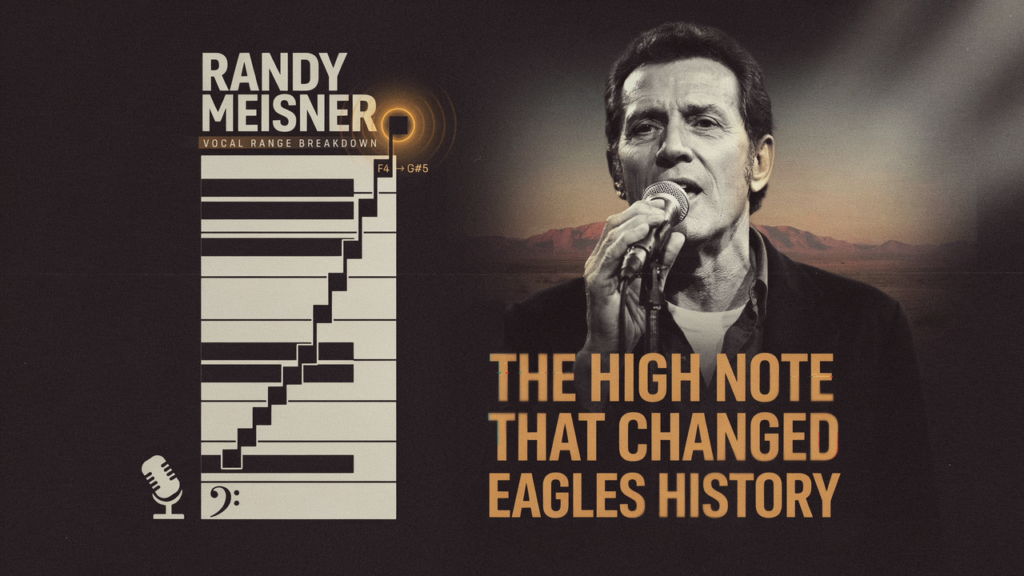
Randy Meisner’s Vocal Range at a Glance
Vocal range: D3 (low notes) – D5 (chest/full voice) – G#5 (falsetto) Voice type: High tenor Vocal registers in use: Chest voice, mixed voice, falsetto Active career: 1964–2001 Notable high note: G#5 falsetto on “Take It to the Limit” — the note that defined his career and his departure
What Voice Type Was Randy Meisner?
Meisner was a high tenor — consistently described across reviews, tributes, and vocal analyses as having a “high tenor voice” and “bright tenor” quality that sat above the rest of the Eagles’ harmonic architecture. The Ken Tamplin forum vocal analysis places him explicitly as “a high tenor” with D3 as his low note, D5 as his chest/full high note, and G#5 in falsetto.
In the Eagles’ harmonic system, Meisner occupied the top register — his falsetto peaks provided the strato-spheric elements that made arrangements like “Take It to the Limit,” “One of These Nights,” and “Take It Easy” distinctive. Don Henley and Glenn Frey provided the mid-range tenor and upper baritone foundation; Meisner floated above them in the passages that required the highest notes.
His voice, as Far Out Magazine described it, “soared above everything else, providing a high harmony on ‘Witchy Woman’ and ‘Take It Easy.'” That “soaring” quality — the ability of a falsetto to sit brilliantly above a dense harmonic texture without becoming thin or shrill — is the specific characteristic of a well-supported high tenor upper register.
For the full context of his voice type classification, the tenor vocal range page covers where high tenors sit in the male voice spectrum.
“Take It to the Limit” and the G#5 Note
“Take It to the Limit” (1975) is the most analysed vocal document in Meisner’s catalogue — and the most consequential. The song, co-written by Meisner with Frey and Henley, peaked at number four on the Billboard Hot 100 and became one of the Eagles’ most beloved recordings. The climactic falsetto in the song’s final section sits at G#5 — well into the soprano register for a male voice.
The problem was that hitting G#5 consistently and repeatably over a touring schedule is a different proposition from nailing it in a studio recording. The note requires the falsetto mechanism to be perfectly calibrated — a function of physical state, vocal warm-up, and the psychological pressure of knowing the audience is waiting for that specific moment. Meisner began to struggle with it live, and as the song became a crowd expectation, the pressure mounted.
The friction this created within the band is well documented. The song was removed from the set list for periods. The continued reluctance to perform it led to the backstage confrontation that marked Meisner’s last night on stage with the Eagles, and his departure in September 1977.
What’s technically interesting about this story is what it illustrates about the difference between a capable performance and a reliable one. Meisner could sing G#5 — Frey’s testimony and the studio recording both confirm it. The question was whether he could deliver it every night, on demand, with the certainty that a climactic live moment requires. The how to sing high notes without straining page covers the technical principles that distinguish sustainable high note access from intermittent capability.
His Harmonic Role: More Than a Bass Player Who Could Sing High
Meisner’s role in the Eagles is sometimes reduced to “the high notes guy” — the member whose falsetto provided the ceiling. This undersells his contribution. As TIDAL Magazine noted, he provided “the sultry bassline on ‘One of These Nights,’ which nodded to his soul chops, or that same hit’s skyscraping background vocal parts.” He was a bassist and a high harmonic voice simultaneously — the two roles that typically belong to different people in a rock band.
His bass playing on “One of These Nights” — the groove-oriented, soul-influenced bassline that gives the song its distinctive feel — is as significant to that track as his falsetto harmony parts. He was a complete musician operating in two different registers of both bass guitar and human voice simultaneously.
His background included Poco (the country-rock band he helped found before the Eagles) and Rick Nelson’s Stone Canyon Band — contexts that developed his musicianship across both instruments before the Eagles gave him his largest platform.
His Early Career: Poco and Before
Before the Eagles, Meisner was a founding member of Poco — one of the seminal country-rock bands of the late 1960s. Though he doesn’t appear in Poco’s official lineup (he left before the debut album was fully released), he plays and sings on their first recordings. From Poco, he moved to Rick Nelson’s Stone Canyon Band, and from there to the Eagles in 1971.
This trajectory — through multiple country-rock outfits where harmony singing and instrumental versatility were prized — gave him the specific musical preparation that the Eagles’ complex harmonic arrangements required. He wasn’t simply a high voice bolted onto a rock band; he was a developed harmony singer with years of ensemble experience before the group’s first album.
Remembering the Voice
The Eagles tribute called his vocal range “astonishing.” Glenn Frey called him “the highest voice in the business.” A 1976 concert review in the Cooper Point Journal described his vocal on “Take It to the Limit” as “incredibly breathtaking.” These assessments were made in real time, not in retrospect — which means the voice was recognised as exceptional by contemporaries as well as by later critics.
He died on July 27, 2023. The Eagles’ statement did not overstate his contribution: the harmonic ceiling he provided across six years and five albums — Desperado, On the Border, One of These Nights, Hotel California, and the compilation Their Greatest Hits — is audible in some of the most enduring recordings in rock history.
FAQs About Randy Meisner’s Vocal Range
What was Randy Meisner’s vocal range?
Forum analysis documents D3 as his low note, D5 as his chest/full high note, and G#5 in falsetto — the famous climactic note in “Take It to the Limit.” The Eagles called his range “astonishing” in their tribute statement.
What voice type was Randy Meisner?
He was a high tenor — described across multiple sources as having the “highest voice in the business” (Glenn Frey’s assessment) and providing the harmonic ceiling of the Eagles’ five-part vocal arrangements.
Why did Randy Meisner leave the Eagles?
His reluctance to perform the high note in “Take It to the Limit” live became a growing source of tension. The note — G#5 in falsetto — was difficult to sustain reliably under touring conditions, and the crowd expectation that built around it created pressure that ultimately led to an irreconcilable backstage confrontation in 1977.
When did Randy Meisner die?
He died on July 27, 2023, at age 77, of complications from chronic obstructive pulmonary disease (COPD) in Los Angeles.
What did Glenn Frey say about Randy Meisner’s voice?
At a 1976 concert, after Meisner hit the high note in “Take It to the Limit,” Frey told the audience: “The highest voice in the business — and he can sing higher, too.” Joe Walsh added: “He can sing higher than that if he needs to.” The exchange is documented in the Randy Meisner Retrospective archive.
Erika Parker is a vocal analysis and singing education writer at Vocal Range Test. She focuses on vocal range testing, voice type analysis, pitch recognition, and singing tools for vocalists, musicians, choir singers, and beginners.