
Tyler Joseph’s vocal range spans Bb2 to A5 — just over three octaves — with a tenor instrument that combines rapping, melodic singing, and falsetto in a way that defies any single-genre classification. Born Tyler Robert Joseph on December 1, 1988 in Columbus, Ohio, he is the lead vocalist, primary songwriter, and multi-instrumentalist for Twenty One Pilots, the duo he formed with Josh Dun. They have received six Grammy Award nominations and won one Grammy (Best Pop Duo/Group Performance for “Stressed Out” in 2017). Blurryface (2015) debuted at number one and produced their first top-10 Billboard Hot 100 hit.
His vocal style is the defining reason Twenty One Pilots exists at the boundary between alternative rock, hip-hop, and pop. The ability to rap technically in the B♭2–F3 zone, sing melodically in the E4–D5 zone, and access falsetto up to A5 gives the voice three distinct registers that serve three distinct musical modes — all within the same song, sometimes within the same verse.
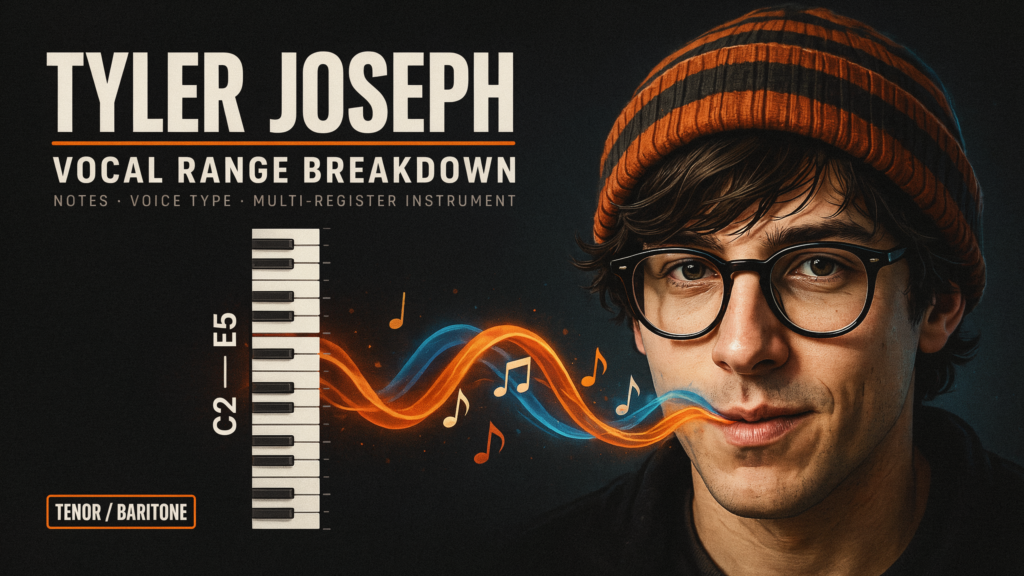
Tyler Joseph’s Vocal Range at a Glance
Vocal range: Bb2 – A5 (Vocal Files documentation) Voice type: Tenor Primary modes: Rapping (lower register), sung melody (mid-register), falsetto (upper register) Active career: 2007–present
What Voice Type Is Tyler Joseph?
SingersAvenue, the Vocal Files, and multiple independent analyses classify him as a tenor. His Vocal Files analysis specifies that “his upper register (E4 – D5) is strong and full of power, regardless of the amount of grit and distortion he applies,” while his lower register “has a soft and light quality to it, if a bit unstable in pitch, lending nicely to their more relaxed songs.”
The upper register power in the E4–D5 belt zone is the primary marker of the tenor classification — this is where tenors are most naturally resonant, and where Joseph’s voice has the “strong and full” quality the analysis identifies. His lower notes (down to Bb2) sit below the standard tenor floor, but with a lighter, less grounded quality there that the analysis correctly notes as used primarily in relaxed contexts rather than as a primary chest voice register.
The tenor vocal range page covers the full classification context.
The Rapping Register: Hip-Hop Meets Alternative Rock
Joseph’s rapping is not decorative — it’s technically accomplished within the hip-hop tradition, with rhythmic precision, articulation at speed, and the breath control required for sustained rapid delivery. The influence of hip-hop and spoken word on his writing is as foundational as his melodic singing.
In the lower register (Bb2–F3), he produces the rapping register: a rhythmic, speech-adjacent delivery that functions differently from conventional singing. The Vocal Files notes this range “has a soft and light quality to it” when sung — but in rapping contexts, the quality is percussive and rhythmically precise rather than tonally focused.
The combination of rapping and singing within single songs is what Singing Carrots calls the “unique style” combining “pop, rock and rap into a sound uniquely his own.” This isn’t a novelty — it’s the structural foundation of Twenty One Pilots’ identity, from the debut album through Scaled and Icy.
The Sung Register and Belt: E4–D5
The primary melodic zone — E4 through D5 — is where his voice is most powerful. The Vocal Files notes: “His belts can range from quite operatic in nature, to harshly distorted screams and sung notes that can be quite terrifying to hear.” This description captures the range of production approaches he applies to the same pitch territory: operatic openness in quieter passages, distortion and grit in heavier ones.
“Stressed Out,” “Heathens,” “Ride,” and “Car Radio” all demonstrate this belt zone in different emotional registers — the singing voice at the core of the band’s melodic identity, with the specific tenor quality that carries through dense production.
Falsetto: “Wobbly but Occasionally Stable”
The Vocal Files is honest about his falsetto: “usually on the weaker end and possesses a wobbly quality, but he has demonstrated it to occasionally sound quite stable.” This is a characteristic of many self-taught or genre-developed tenors — the falsetto develops later and less consistently than the chest voice and mix, because the genre demands are focused elsewhere.
His falsetto reaches A5, placing it well into soprano territory. In the context of Twenty One Pilots’ production — which uses synthesisers, electronics, and layered arrangements — the falsetto functions more as an atmospheric element than a primary melodic vehicle.
The does head voice count in vocal range page addresses the question of how falsetto and head voice fit within total vocal range documentation.
“Stressed Out” and the Grammy
“Stressed Out” won the Grammy for Best Pop Duo/Group Performance in 2017 — the pair’s first Grammy win after multiple nominations. The song’s vocal sits primarily in the E4 area, demonstrating the belt register at its most melodically direct: no extended techniques, no grit, just the tenor at its most commercially accessible.
The song’s success — and the Grammy recognition — confirmed that the multi-register, multi-genre approach Joseph developed was commercially viable at the highest level, not just within the genre-specific emo/alternative community where Twenty One Pilots built their initial following.
FAQs About Tyler Joseph’s Vocal Range
What is Tyler Joseph’s vocal range?
The Vocal Files documents Bb2 to A5 — just over three octaves. His practical singing range sits primarily in the E4–D5 belt zone; his rapping register uses the lower Bb2–F3 area; his falsetto extends to A5.
What voice type is Tyler Joseph?
A tenor — confirmed by SingersAvenue, the Vocal Files, and multiple independent analyses. His upper register is his strongest zone, in the E4–D5 area, with characteristic tenor power and quality there.
How many Grammys has Twenty One Pilots won?
One Grammy win (Best Pop Duo/Group Performance for “Stressed Out,” 2017) out of six nominations.
Can Tyler Joseph rap?
Yes — rapping is a core element of his vocal style and Twenty One Pilots’ musical identity. His rapping operates in the lower register (Bb2–F3) and is technically accomplished within the hip-hop tradition rather than being a theatrical imitation of the style.
What instruments does Tyler Joseph play?
Keyboards, piano, synthesizer, ukulele, bass, guitar, sampler, and accordion — he is the primary songwriter and a genuine multi-instrumentalist who writes across all of these in addition to his vocal work.
Erika Parker is a vocal analysis and singing education writer at Vocal Range Test. She focuses on vocal range testing, voice type analysis, pitch recognition, and singing tools for vocalists, musicians, choir singers, and beginners.