
If you’ve ever tried singing like Pavarotti, even as a joke, you already know how it usually goes:
Either your voice cracks in a way that makes you question your life choices, or your dog gets up and quietly leaves the room.
That was my experience the first time I attempted a Pavarotti-style High C. My voice gave out so dramatically that I checked if I pulled something in my throat.
But that moment taught me something important:
Understanding Pavarotti’s vocal range isn’t really about copying him. It’s about appreciating the insane control and musical intelligence behind what he did.
So let’s break down Pavarotti’s real vocal range, the myths, the surprises, and even a few problems I ran into while trying to understand his technique.
Think of this as a conversation between friends, not a dry opera lecture.
What Was Pavarotti’s Vocal Range?
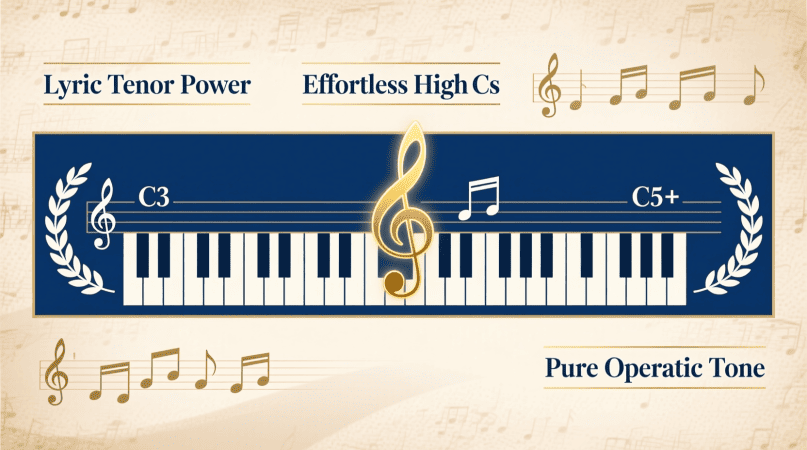
Luciano Pavarotti’s vocal range was approximately from C3 to C5.
That’s about two octaves, but what made him extraordinary wasn’t the size of his range. It was the quality of it.
Here’s the breakdown:
| Range Type | Pitch | Notes |
|---|---|---|
| Lowest reliable note | C3 | Warm and steady |
| Comfortable singing zone | D3–Bb4 | His strongest area |
| Highest note | C5 | The famous High C |
| Voice type | Lyric Tenor | Bright, ringing tone |
Many tenors can hit these notes.
Very few can make them sound the way Pavarotti did.
The Famous High C (C5): Why Everyone Talks About It
The operatic High C is legendary. It’s the note that can bring an audience to its feet or send a tenor into instant retirement.
Pavarotti didn’t just hit the High C.
He delivered it with clarity, confidence, and this shimmering resonance that felt like the note was glowing.
When I attempted that same note, what came out was a strained, confused squeal that nearly made me apologize to my vocal cords.
People often ask if Pavarotti sang higher than C5.
There is no verified recording of him hitting D5 or above.
Most “D5” clips online are mislabeled or digitally altered.
C5 was his top, and he mastered it.
Pavarotti’s Lowest Notes (C3)
Pavarotti is famous for his highs, but his lows deserve some credit too.
He could comfortably hit C3, which is fairly standard for a lyric tenor, but the tone he produced was unusually warm and controlled.
When I tried singing C3 the way Pavarotti does, my voice either went breathy or flat. He had a balance in his lower register that most lyric tenors have to fight for.
His low notes were never forced or swallowed. They were shaped with intention.
Why Pavarotti Was a Pure Lyric Tenor
Pavarotti is considered the perfect example of a lyric tenor. This type of tenor typically has:
- a bright, ringing sound
- emotional expression
- agility
- a youthful tone
He didn’t push like a dramatic tenor or float like a leggiero tenor. He stayed in his lane, and he perfected it.
Try singing the middle section of “Nessun Dorma” and you’ll understand instantly why lyric tenors admire him so much. The control it requires is brutal.
I’ve tried it many times, and my voice still rebels in the passaggio.
What Made Pavarotti’s Range Sound So Special
It wasn’t the number of notes he could sing.
It was how he sang them.
Here were his superpowers:
1. Exceptional Breath Support
He could carry a phrase with such steadiness that sometimes I replayed recordings to check if he actually took a breath.
When I tried imitating his breath technique, I almost got lightheaded. It takes incredible discipline.
2. Seamless Passaggio
Every tenor knows the passaggio, the transition between registers, is the danger zone.
Pavarotti made it disappear.
Some days I can manage mine. Other days it refuses to cooperate.
3. Focused Resonance
He didn’t just sing loudly; he sang with a laser-like focus.
That’s why his High C sounded powerful without sounding strained.
How Pavarotti Compares to Other Tenors
Not all tenors operate in the same vocal category. Here is how he compares:
| Singer | Voice Type | Highest Note | Strength |
|---|---|---|---|
| Pavarotti | Lyric Tenor | C5 | Iconic clarity and brilliance |
| Domingo | Dramatic/Bari-tenor | Bb4 | Power, depth, emotional weight |
| Carreras | Lyric Tenor | Bb4 | Smooth, passionate phrasing |
| Bocelli | Lyric/Pop Tenor | C5 (rare) | Soft, modern tone |
Pavarotti wasn’t the tenor with the widest range.
He was the tenor with the most memorable one.
My Personal Experience Testing My Own Range
The first time I used a vocal range test, my results came back as:
- Low note: E2
- High note: G4
I felt bold and decided to attempt Pavarotti’s High C, just to see how close I was.
I breathed in, positioned myself like an opera singer, lifted my chest, and went for it.
What emerged sounded like someone stepping on a rubber toy.
That moment taught me what technique truly means.
Pavarotti didn’t just hit C5.
He made it beautiful, consistent, and emotionally powerful.
If you haven’t tried it yet, test your own range. It’s eye-opening.
Why Pavarotti’s Range Doesn’t Tell the Whole Story
A lot of tenors have similar ranges.
What they don’t have is Pavarotti’s unique combination of:
- breath control
- resonance
- phrasing
- tone quality
- emotional power
Two singers can hit the same note.
One sounds like music.
One sounds like noise.
Pavarotti always sounded like music.
FAQ
Did Pavarotti have a big range?
Not unusually big, but extraordinarily well-developed.
What was his highest note?
C5.
Did he ever hit D5?
No confirmed example exists.
What was his lowest note?
Around C3.
Why was his High C legendary?
Because he hit it with full resonance, clarity, and confidence.
Can beginners learn to sing C5?
Yes, but only with proper technique and patient practice.
How can I find my own vocal range?
Use a vocal range test tool to identify your lowest and highest notes.
- Pavarotti’s operatic range can be better appreciated through types of vocal ranges that classify voices by pitch and timbre.
- His soaring tenor highs are closely related to techniques outlined in how to sing high notes without straining.
- Many of his dramatic mid-to-upper notes align with the tenor vocal range profile.
- To see how his legendary range compares with other performers, the vocal range of famous singers provides clear charts.
- His comfortable tessitura in operatic pieces fits the concept explained in what is tessitura in singing.
- If you want to choose songs that suit similar operatic style, how to find songs that fit your vocal range provides practical guidance.
- To understand how he produced such powerful and precise pitches, how vocal cords produce different pitches explains the science behind singing.