
The first time I tried singing a Robert Smith song, I made a mistake that every Cure fan eventually makes:
I sang along to “Pictures of You” and thought, “His voice sounds soft, breathy, almost whispery — this will be easy.”
It was not easy.
Somewhere around the first airy high phrase, my voice cracked, my breath disappeared, and the emotional fragility that sounds effortless when Robert Smith does it turned into me sounding like someone half-sobbing while trying to read karaoke lyrics.
And that’s when I realized something important: Robert Smith’s voice isn’t simple. It’s subtle. And subtle is harder.
This article breaks down Robert Smith’s true vocal range, what makes his tone so haunting, how his voice evolved over the years, and the surprising challenges I faced trying to imitate him.
Robert Smith’s Vocal Range
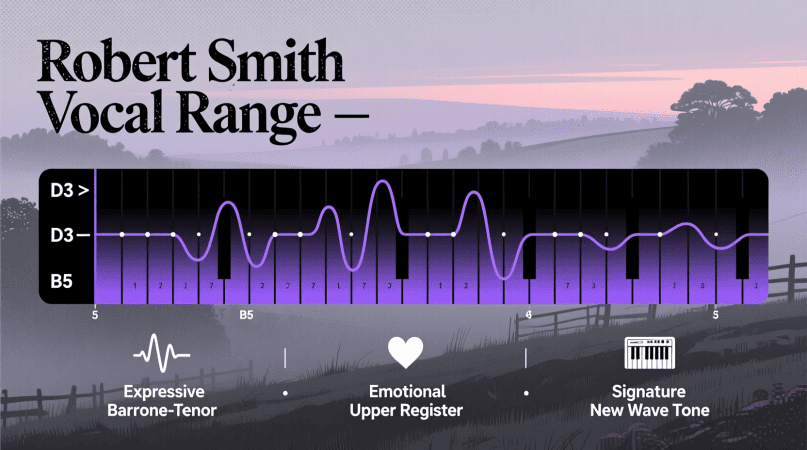
Across his long career, Robert Smith’s documented vocal range spans: G2 – B4
with falsetto frequently reaching: C5–D5
About two octaves + a falsetto extension — but the magic lies in how he uses it, not how wide it is.
Robert Smith Range Summary
| Range Area | Notes | Description |
|---|---|---|
| Low notes | G2 – A2 | Smoky, intimate, perfect for dark atmospheres |
| Middle range | B2 – G4 | His main expressive zone: warm, dreamy, melancholic |
| Upper range | A4 – B4 | Occasionally bright, lightly strained for emotion |
| Falsetto | C5 – D5 | Airy, ghostly, floating (signature Cure energy) |
His voice doesn’t dominate a room — it occupies your mind.
What Makes Robert Smith’s Voice Sound So Emotional and Haunting
Most vocalists rely on power or range to stand out.
Robert Smith relies on texture. Emotion. Atmosphere. Vulnerability.
Here’s the real breakdown of why his voice hits the way it does:
1. He has a natural baritone darkness — but uses it lightly
A typical baritone sings with weight.
Smith sings with air.
This creates a paradox:
- low, dark timbre
- delivered with soft, fragile breathiness
Trying to imitate this softness made my voice wobble like a leaf in the wind.
Smith makes it feel like floating.
2. His breathy tone is controlled — not sloppy
People assume breathiness = lack of technique.
But Smith’s breathiness is very intentional:
- he leaks air by choice
- maintains pitch through minimal effort
- keeps tension low
- uses breath as an emotional tool
When I tried matching it, I either used too much breath (sounded weak) or too little (sounded too clean).
Smith walks a razor-thin line perfectly.
3. His phrasing is cinematic
Robert Smith sings like someone telling a story in the middle of a dream:
- phrases feel stretched
- time feels loose
- melodies drift rather than march
It’s not rigid. It’s not classical. It’s not technically “proper.”
It’s atmospheric — the way fog rolls in slowly.
4. Smith uses falsetto like a painter uses white space
He doesn’t leap into falsetto to show off range.
He uses it to add fragility, nostalgia, distance, like an emotional echo inside the song.
Think “Pictures of You,” “The Last Day of Summer,” or “A Night Like This.”
When I attempted his falsetto, I cracked in the least magical way possible.
Smith cracks intentionally — like emotional glass fracturing.
5. Minimal vibrato = maximum vulnerability
Most singers use vibrato to stabilize pitch.
Smith often sings without vibrato — intentionally.
This creates:
- tension
- longing
- rawness
- an “unfinished sentence” feeling
It feels human, like he’s searching for the words as he sings them.
Try our singing range checker to map your high and low notes.
Robert Smith’s Highest Notes (With Song Examples and Explanation)
Robert Smith’s highs aren’t loud — they’re delicately emotional.
Here are some standout examples:
B4 — “Just Like Heaven” (chorus)
Bright but not shouted. A lift of energy.
C5–D5 (falsetto) — “Pictures of You”
The airy, ghost-like falsetto floats above the mix like mist.
A4–B4 — “Friday I’m In Love”
More cheerful and forward, showing his lighter upper placement.
B4 — Live performances of “Lovesong”
Occasionally he pushes into a slightly strained but emotionally charged upper tone.
When I tried these, I discovered something surprising:
High notes aren’t hard because they’re high — they’re hard because Smith sings them softly but never weakly.
That balance is far more challenging than belting.
Robert Smith’s Lowest Notes
His lows often define the mood of The Cure.
Examples:
- G2–A2 in “The Drowning Man”
- A2 in “A Forest”
- Low baritone phrases in “One Hundred Years”
- The deep, resonant storytelling tone in “Cold”
Trying to sing these lows taught me that his darkness doesn’t come from pushing down — it comes from relaxation.
He lets the note settle like sediment in deep water.
How Robert Smith Actually Sings
Smith doesn’t rely on classical technique or rock power.
He has his own rules — but they’re surprisingly consistent.
1. Light chest resonance + airy breath flow
This is why his mid-range sounds melancholic and floating.
2. Nasal-forward placement
Not nasally blocked — just slightly forward to create that dreamy tone.
3. Soft articulation
Consonants soften.
Vowels stretch.
Syllables melt into each other.
Perfect for creating an otherworldly mood.
4. Easy, unforced falsetto transitions
He slips in and out of falsetto calmly — like he’s drifting between emotional states.
5. Emotional shaping > technical shaping
He cares more about tone color than textbook technique, and that’s his secret weapon.
When I tried singing with soft articulation, I accidentally swallowed half the words.
Smith manages to be soft without becoming unintelligible — a rare skill.
How Robert Smith’s Voice Changed Across His Career
Late 1970s — Young, bright, slightly raw
“Boys Don’t Cry” shows a surprisingly energetic upper-mid tone.
1980s — The Cure’s atmospheric peak
This is Disintegration, Pornography, The Top era:
- breathier
- darker
- emotionally heavy
- longer phrasing
His voice matched the band’s sonic evolution.
1990s — Fuller, warmer, more polished
Songs like “Mint Car” show more chest resonance and brightness.
2000s–2020s — Mature baritone tone
Deeper, rounder, slightly slower, very expressive.
Unlike many rock singers, Smith didn’t “lose” anything — he grew into a different emotional palette.
Robert Smith Compared to Other Alternative/Goth Vocalists
| Singer | Range | Style | What Makes Smith Unique |
|---|---|---|---|
| Robert Smith | G2–B4 + falsetto | Breath-heavy, emotional | Dream-like vulnerability |
| Ian Curtis | A1–E4 | Monotone bass-baritone | Lower, darker, more rigid |
| Morrissey | A2–A4 | Crooning, bright | More operatic and dramatic |
| Peter Murphy | F2–C5 | Gothic baritone | More theatrical and imposing |
| Dave Gahan | F2–B4 | Dark, powerful | Stronger chest dominance |
Smith stands out because he embodies sadness, nostalgia, longing, and romance with vocal choices that feel deeply personal.
My Experience Trying to Sing Like Robert Smith
I assumed Robert Smith’s style would be easier than rock screamers or metal tenors.
I was wrong.
Here’s what really happened:
1. The breathiness destroyed my control
I ran out of air long before he ever would.
2. Falsetto cracked in the most un-magical way
Smith’s falsetto is fragile on purpose.
Mine was fragile by accident.
3. His vowel shapes are unbelievably tricky
He stretches vowels just enough to add emotion — but not enough to lose pitch.
4. My mids sounded too “clean”
Smith’s tone carries emotional weight that technique alone can’t reproduce.
5. His emotional sincerity is the hardest part to imitate
Smith doesn’t “perform” sadness.
He feels it.
His voice carries decades of vulnerability, longing, and introspection.
Trying to copy him made me realize his superpower isn’t range or technique —
it’s honesty.
FAQ
What is Robert Smith’s vocal range?
Approximately G2 to B4, with falsetto reaching C5–D5.
Is Robert Smith a baritone?
Yes — a baritone with a uniquely airy, emotional upper range.
Does Robert Smith use falsetto?
Frequently, especially for expressive highs.
Why does Robert Smith sound breathy?
It’s intentional — controlled airflow for atmosphere.
Has his voice changed?
Yes — it has deepened and warmed but kept the emotional core.
- Robert Smith’s unique falsetto and tone can be better understood through difference between falsetto and head voice.
- Many of his mid-range melodies align with the baritone vocal range profile.
- To see how his style compares with other alternative and rock singers, check vocal range of famous singers.
- His comfortable pitch placement fits the concept explained in what is tessitura in singing.
- If you want to find songs suited for his vocal type, how to find songs that fit your vocal range provides practical guidance.
- Understanding how his voice produces unique tone is aided by how vocal cords produce different pitches.
- For expanding vocal control safely, see expand vocal range safely.