
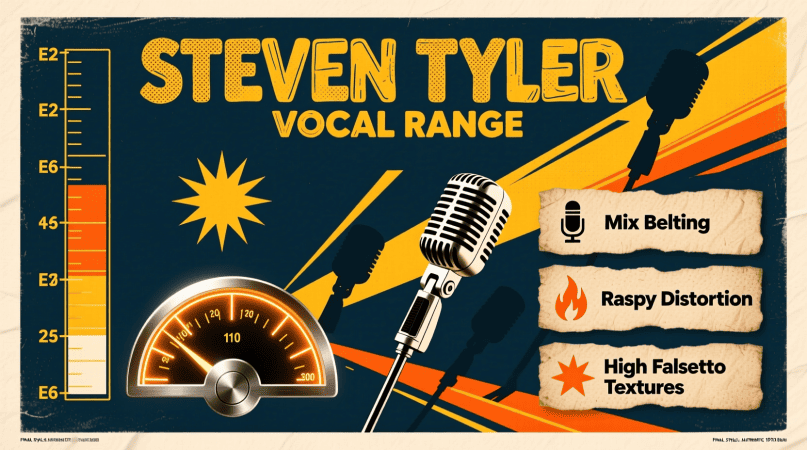
Steven Tyler isn’t just a rock singer—he’s a vocal phenomenon.
From the soaring, spine-tingling screams in “Dream On” to the bluesy swagger of “Sweet Emotion,” he has one of the most extreme, instantly recognizable voices in rock history.
His range isn’t just big—it’s wild, unpredictable, and brutally expressive.
And as someone who has tried (and failed… multiple times) to sing like Steven Tyler, I can tell you firsthand: the man’s voice is no joke.
Let’s break down Steven Tyler’s vocal range, explore what makes his sound so insane, and talk honestly about what happens when a normal singer tries to imitate him.
Steven Tyler’s Vocal Range: C3 – E6 (Around 3.5 Octaves)
Steven Tyler’s recorded vocal range spans roughly:
- Lowest note: C3
- Highest note: E6
This gives him a range of more than 3.5 octaves, but range alone doesn’t capture his magic.
What truly defines Steven Tyler’s voice is how explosively, aggressively, and emotionally he uses his upper register.
His top notes feel like a primal yell and a perfectly pitched musical instrument rolled into one.
What Voice Type Is Steven Tyler? (High Rock Tenor With Freakish Upper Range)
Steven Tyler is typically classified as a high tenor, but he stretches far beyond the normal boundaries of rock tenor singing.
His vocals combine:
- Chest-dominant belts in the G4–B4 range
- Falsetto/head voice around C5–E5
- Distorted “false cord” screams reaching E6
- Occasional whistle-like shrieks (not true whistle register, but close in pitch)
It’s the blend of technique, distortion, and attitude that makes his voice so iconic.
He doesn’t just sing high notes—he attacks them.
Want to see how your voice stacks up against professionals? The Singer Comparison Tool lets you compare your results from the Vocal Range Test. You can also explore registers through Chest Voice vs Head Voice and check pitch accuracy using the AI Voice Analysis.
My Attempt at Singing Steven Tyler
The first time I tried to sing the iconic “Dream On” scream”, I thought:
“How bad can it be? He’s basically screaming, right?”
Huge mistake.
Here’s what happened:
1. My scream didn’t land on any actual pitch.
Steven Tyler’s screams are pitched—they sit right on notes like E5, G5, or higher.
My attempt sounded… chaotic.
The kind of sound you’d make if you stubbed your toe in the dark.
2. My throat tightened instantly.
I wasn’t using support—I was pushing from the throat.
Tyler doesn’t do that.
He uses false cord distortion layered on top of a supported note.
3. I underestimated how much breath control he actually uses.
Even when he sounds wild, there’s structure behind it.
Meanwhile, I ran out of breath after one phrase of “Dream On,” and had to pretend it was a stylistic choice.
4. The blues influence is harder than it sounds.
Trying to match his raspy slides and gritty growls is like trying to wrestle a wild animal—chaotic and totally unpredictable.
That experience taught me that Steven Tyler isn’t just screaming—he’s mixing screaming with technique, control, breath, and musicality.
Steven Tyler Vocal Range Chart
| Register | Notes | Song Examples | Tone Description |
|---|---|---|---|
| Low Register | C3 – G3 | “Dream On” (verses) | Dark, gritty, bluesy warmth |
| Middle Register | A3 – E4 | “Sweet Emotion,” “Cryin’” | Raspy, expressive, punchy |
| Upper Mix/High Belting | F4 – C5 | “Walk This Way,” “Love in an Elevator” | Bright, aggressive, high-energy |
| Head Voice / Falsetto | C5 – E5 | “Crazy,” “Jaded” | Thin but flexible, emotional |
| Distorted Screams | E5 – E6 | “Dream On,” live ad-libs | Wild, powerful, iconic |
This chart explains why his voice feels so epic—his upper mix and scream range are far beyond what most singers can even attempt.
Steven Tyler’s Highest Notes (Including the “Dream On” Scream)
The signature moment everyone asks about is the climax of “Dream On.”
This is where Steven Tyler fires off a prolonged, distorted scream around E5–F5, and sometimes even higher in live versions.
Other high-note highlights:
- D5–E5 – common in nearly every Aerosmith chorus
- E6 – rare high screams in live performances
- C5 – standard upper mix notes in his prime
That famous scream in Dream On is NOT random—it’s controlled, supported, and pitched.
Steven Tyler’s Lowest Notes
Tyler’s lower range doesn’t get much attention, but it’s bluesy and gritty:
- C3 – low growls in “Dream On” (verse)
- E3–G3 – common in Aerosmith ballads
His low notes aren’t operatic, but they set the emotional mood of songs beautifully.
Why Steven Tyler’s Voice Sounds So Raw, Powerful, and Unique
Here’s what makes him unlike any other rock tenor:
1. Controlled Distortion
His rasp comes from false cord distortion, not damaging strain.
This adds grit without losing pitch.
2. Huge Breath Compression
Tyler pushes a ton of air through a focused vocal setup, which makes his screams punch through guitars and drums.
3. Amazing Mixed Voice
He blends chest and head resonance so smoothly that even notes around B4–C5 sound full and powerful.
4. Blues Influence
He adds slides, bends, growls, and soulful ornaments that give his singing emotional weight.
5. Natural Vocal Elasticity
Some singers are simply born with extraordinary flexibility in their vocal folds—Tyler is one of them.
How Steven Tyler’s Voice Evolved Over the Years
Early Aerosmith (1970s)
- Youthful, cleaner tone
- Insanely flexible upper register
- Sharp, bright screams
Peak Era (1980s–1990s)
- Most iconic high notes
- Strongest belting years
- Perfect combination of rasp + power
Modern Era
- More rasp from age
- Lower stamina
- But still shockingly capable of iconic screams
Even now, Tyler’s voice holds that unmistakable fire—even if he uses it more selectively.
Steven Tyler vs Other Rock Tenors
| Singer | Range | Strength | Notes |
|---|---|---|---|
| Steven Tyler | C3–E6 | Screams + rasp | Extreme upper extension |
| Axl Rose | F1–B♭6 | Versatility | Wild multi-octave range |
| Robert Plant | G2–G5 | Purity + rock edge | Iconic early rock high belts |
| Freddie Mercury | F2–F6 | Power + agility | Operatic elements |
Steven Tyler isn’t the highest, but he may be the most ferocious rock singer in history.
Want to Compare Your Voice to Steven Tyler’s?
When I tested my range against his, I realized quickly:
**1. I could hit some of the same notes…
but NOT with his confidence or grit.**
Pitch is just one piece.
Attitude and technique are everything.
2. His screams rely on technique I didn’t have yet.
Without support and distortion control, attempting his screams felt dangerous.
3. His breath control is unreal.
You don’t notice it until you try to sing a full chorus in his style.
Doing a vocal range test helped me understand my own limits and why Steven Tyler sits in a different league.
- To find out how wide your own voice really is, you can try the vocal range calculator for an instant result.
- His high-energy tenor placement can be confirmed with the voice type test.
- Many of his signature screams and high notes sit near the top of the highest vocal range spectrum.
- You can also see how many octaves you personally cover by using this tool.
- To view the pitch accuracy behind his vocals, the voice frequency test breaks down the data.
- If his raw vocal power inspires you to improve, learn more about a structured way to build range and control.