
If you’ve ever listened to Tate McRae and thought, “How does she make those soft high notes sound so clean?” you’re definitely not alone. I’ve spent years analyzing vocal ranges, and Tate’s voice caught me off guard in the best way. She doesn’t rely on powerhouse diva belts or extreme whistle notes. Instead, she does something trickier: she makes modern pop vocals smooth, emotional, and deceptively challenging.
When I first tried singing along to her songs, I assumed it would be easy. Her tone is relaxed, almost whispery at times. But within seconds of attempting her style, I realized something important: Tate McRae makes subtle sound effortless, and that requires serious control.
In this article, I’ll break down Tate McRae’s vocal range, voice type, signature techniques, and why so many singers struggle to imitate her sound. I’ll even share a few personal mistakes I made while trying to match her vocals.
What Is Tate McRae’s Vocal Range?
Tate McRae’s vocal range spans roughly G3 to C6, depending on the performance. This includes:
- Chest voice: G3–E4
- Mixed voice: F4–A4
- Head voice and falsetto: Bb4–C6
Her classification aligns most closely with a light lyric mezzo-soprano, though her airy head voice sometimes gives off a soprano-like feel in pop settings.
Sopranos and tenors can prepare their voices using the Warm-Up Exercises for Soprano/Tenor and complement it with quick routines like the Quick Warm-Up Routine. Measuring your results with the Vocal Range Test and improving breath support through Breathing Techniques for Singing ensures safer and more consistent progress.
Why Tate McRae’s Voice Sounds So Unique
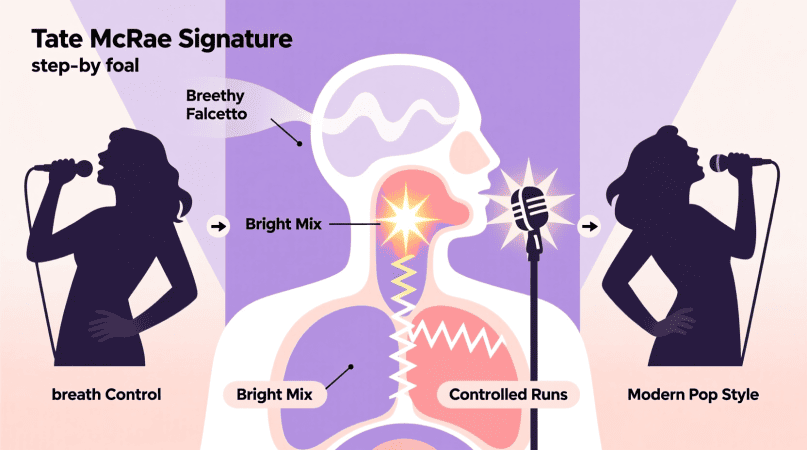
Tate’s vocal uniqueness comes down to three things: control, tone, and emotional delivery. Her sound is intimate and polished. She rarely over-sings, and she doesn’t rely on dramatic belting. Instead, she uses a lighter, breathier tone that blends well with modern pop production.
When I first tried singing “You Broke Me First,” I completely underestimated how hard it would be. I thought, “She’s not belting, this should be simple.” But within a few lines, I was either running out of breath or slipping off pitch. Her soft tone requires an amount of breath control I simply did not have at the time.
Tate’s style depends heavily on:
Breath control – sustaining airy notes without losing pitch
Smooth transitions – flipping between chest, mix, and head voice seamlessly
Subtle dynamics – emotionally expressive singing without volume
This combination creates a clean, modern sound that’s hard to replicate unless you understand the technique behind it.
Her High Notes: Where Things Start Getting Tricky
Tate doesn’t chase whistle notes or extreme belting. Her high register shines because of its clarity and control, not its range.
Some of her strongest high-register moments include:
- Bb5–C6 in acoustic and stripped performances
- Clean head voice notes in “Greedy” live sessions
- Soft floaty lines in ballad-style versions of her songs
When I attempted these sections, I quickly learned it’s not about singing louder or higher. Her technique is precise, not forceful. I cracked more times than I’d like to admit while trying to imitate the lighter quality of her head voice.
Her Lower Notes: Surprisingly Strong for Her Tone
People sometimes assume Tate is a natural soprano because of her airy style, but her lower register is actually more stable than many expect. She comfortably sings down to G3, especially in song verses.
Examples include:
- Lower phrases in “that way”
- Verses in “feel like shit”
- Soothing low lines in “she’s all i wanna be”
Personally, this part of her range was easier for me to match. But even here, maintaining a breathy tone while staying perfectly on pitch was much harder than I expected. Tate keeps her low notes controlled, relaxed, and connected, which requires solid technique rather than just “singing quietly.”
What Voice Type Is Tate McRae?
Most vocal coaches classify Tate as a light lyric mezzo-soprano.
Here’s why:
- Her natural comfort zone sits between A3 and A4.
- Her head voice is light, flexible, and clean.
- Her belting is controlled, using a forward and lean mix rather than heavy power.
Even though she often uses a soft soprano-like delivery, her tessitura and vocal weight align more closely with a mezzo.
Tate McRae Vocal Range Chart
| Vocal Register | Notes | Characteristics |
|---|---|---|
| Chest Voice | G3–E4 | Warm, conversational, breathy |
| Mixed Voice | F4–A4 | Light, clean, modern pop mix |
| Head Voice | Bb4–C6 | Airy, controlled, stable |
| Falsetto | Up to C6 | Soft, stylistic, expressive |
Why Tate McRae’s Songs Are Harder to Sing Than They Seem
Even though Tate doesn’t rely on explosive power, her music is challenging for a few reasons:
1. Breathiness Requires Technique
A breathy tone is not simply “using less volume.” It requires managing airflow, keeping the vocal cords relaxed yet stable.
2. Clean Register Transitions
She shifts between chest, mix, and head voice quickly, and smoothly. Many singers either crack or tense up when attempting this.
3. Quiet High Notes Reveal Pitch Issues
Soft singing exposes every small mistake. It’s like singing under a microscope.
4. Emotional Delivery Is Essential
Her songs don’t work without vulnerability. If you sing them too flat or too loud, you lose the emotional tone.
When I tried singing her catalog, I found her soft high notes far more demanding than expected. It took practice to stabilize my airflow and maintain her signature delicate tone.
Notable Vocal Moments in Her Songs
Here are a few standout examples across different registers:
- G3: Verses in “that way”
- E5: Mixed note peaks in “Greedy”
- A5–C6: Light head voice riffs in stripped-down performances
- Bb5: Higher mix placements in certain live versions
These moments highlight her control rather than sheer power.
Can You Sing Like Tate McRae? My Honest Take
After trying and failing multiple times, here’s what actually helped me:
- Light warm-ups to relax tension
- Practicing soft high notes without pushing
- Recording myself to catch inconsistencies
- Using pitch tools to check accuracy
Over time, I was able to imitate her style much better. The key wasn’t singing louder or higher; it was learning to control breath and maintain gentleness without losing pitch.