
Most people hear about Tim Storms for the first time through a random viral clip, and the reaction is almost always the same:
“Is that real?”
I had the same reaction.
I remember listening to one of his “lowest note demonstrations” and genuinely thinking my audio was broken. I turned the volume up, switched headphones, replayed it multiple times… still nothing.
It wasn’t until I used a proper speaker system with real sub-bass capability that I finally understood what was going on. I didn’t hear a tone — I felt a soft vibration in the room, almost like distant thunder.
That was my introduction to Tim Storms, the man with the deepest voice ever measured.
Who Is Tim Storms?
Tim Storms is an American singer known across the world for his exceptionally deep voice. He has spent decades performing, recording, and training, but what sets him apart is something even experts struggle to explain:
his voice operates in a frequency range almost no other human can access.
He holds two official Guinness World Records:
- The lowest vocal note ever recorded
- The widest vocal range for a male singer
Those two achievements alone would make anyone notable, but Tim Storms’ voice goes far beyond records — it expands what we believe is physically possible.
Tim Storms’ Vocal Range Explained
Lowest Note Ever Recorded
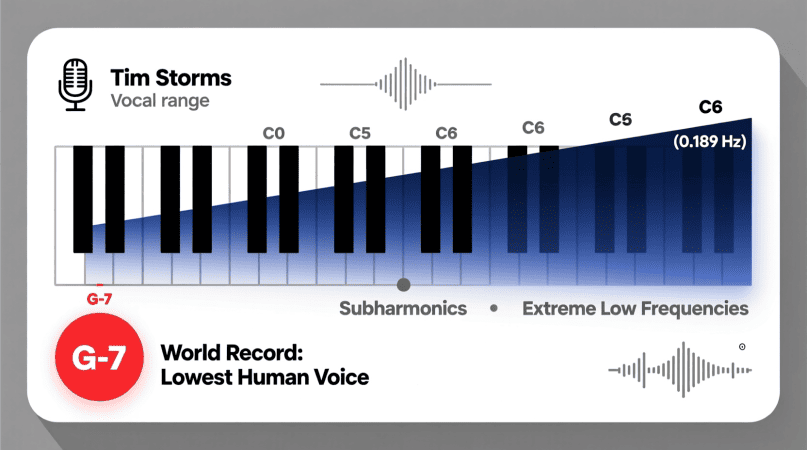
His lowest note was measured at G-7, which is just 0.189 Hz.
For reference, human hearing generally starts at about 20 Hz.
That means this note is not something you “hear” at all.
It’s a physical vibration below the threshold of sound perception.
Total Vocal Range
Tim Storms has a confirmed range of 10 octaves — more than double what most trained singers can achieve.
For comparison:
- Average singers use 1.5 to 2.5 octaves
- Great singers use 3–4 octaves
- Exceptional singers reach 5–6
Tim’s voice covers ten.
No other recognized singer reaches this span.
Want to understand your voice better? Try our voice type test to see if you’re a soprano, tenor, or baritone. Then measure your pitch range with the octave range test and see how low you can go with the deep voice test. You can even compare your voice with famous singers using the singer comparison tool to see where you stand.
What It Actually Sounds Like
One of the most surprising things about Tim Storms’ low notes is that they don’t sound like what you expect when you think of “deep voice.” There’s no rumbling baritone line or dramatic movie-trailer tone.
When I first tried to listen to his recordings, I made the classic mistake of assuming my headphones were malfunctioning. I literally replayed the audio three times thinking something was wrong.
But the truth is simpler:
speakers — especially small ones like phone or laptop speakers — cannot reproduce frequencies that low.
When I finally listened with a proper subwoofer, the experience was strange and fascinating. Still no “note” in the musical sense, but a gentle vibration filled the space. It felt more like standing near a large machine than listening to a singer.
It made me realize how different Tim’s voice is from anything else in music.
How Tim Storms Can Sing This Low
Scientists and vocal specialists have analyzed his voice for years.
Several factors contribute:
Natural Physiology
Tim has unusually long and flexible vocal folds. This allows them to vibrate much slower than average, creating extremely low frequencies.
Subharmonic Control
Most singers use the normal vibration pattern of the vocal folds. Tim can access vibration modes that generate frequencies far below typical human capability.
Resonance and Breath Technique
His vocal tract resonates low frequencies efficiently, and decades of practice have given him exceptional control.
Gift + Training
This combination is extremely rare.
Many people have a natural gift; very few train it to this level.
Can Tim Storms Actually Sing Songs at Those Frequencies?
No. The record-breaking notes are demonstrations, not musical notes. They fall far below the range of musical instruments and human hearing.
However, his usable singing voice is still far lower than almost all other bass singers. In the traditional bass range, his tone is smooth, rich, and surprisingly warm—not just “deep for the sake of being deep.”
His singing voice is less about shock value and more about musicality.
How He Compares to Other Deep-Voice Singers
Even the deepest professional basses—like Russian Oktavists or modern bass singers such as Geoff Castellucci—typically bottom out around the low C1–E1 range.
Tim’s lowest official note is several octaves below that.
It isn’t a comparison.
It’s an entirely different category.
Why Tim Storms Matters in Vocal Science
Tim’s voice isn’t just impressive—it’s scientifically important.
He has contributed to research in:
- Human vocal limits
- Subharmonic resonance
- Psychoacoustics
- Acoustic measurement techniques
His ability challenges long-standing assumptions about the lower boundaries of human vocal production.
Even for people who never plan to sing professionally, his voice is a reminder that human physiology still contains surprises.
Common Misconceptions About Tim Storms
“He talks like this in real life.”
He doesn’t. Everyday speech is within a normal range.
“Anyone can train to sing this low.”
This level of range requires rare anatomy, not just training.
“Record-breaking low notes are used in songs.”
They are not; they are scientific measurements.
“Videos online must be edited.”
If someone can’t hear the note, it’s usually because their speakers can’t reproduce sub-20 Hz frequencies.
Frequently Asked Questions
Does Tim Storms have the deepest voice in the world?
Yes. He holds the official Guinness record.
Can humans hear his lowest notes?
No. They are below the hearing threshold.
Is his ultra-low singing harmful?
No. His physiology supports it naturally.
How many octaves can he sing?
Ten octaves total.
Does he perform live?
Yes, though the very lowest notes require specialized sound equipment.