
The first time I heard Yma Sumac’s voice, I genuinely thought someone had layered three different singers into one track.
How could one person jump from deep, resonant lows to piercing, almost supernatural highs in the same breath?
I replayed “Chuncho” — then replayed it again — trying to understand what I was hearing.
Eventually, I tried copying one of her bird-like trills… and my throat immediately told me to sit down and drink some water.
That’s the effect Yma Sumac has on people.
Her voice doesn’t just impress you — it shocks you.
If you’re here to understand Yma Sumac’s vocal range, her real octave span, highest notes, lowest notes, voice type, and what makes her so rare, this is the most complete breakdown you’ll find.
Let’s dive in.
Quick Summary: Yma Sumac’s Vocal Range
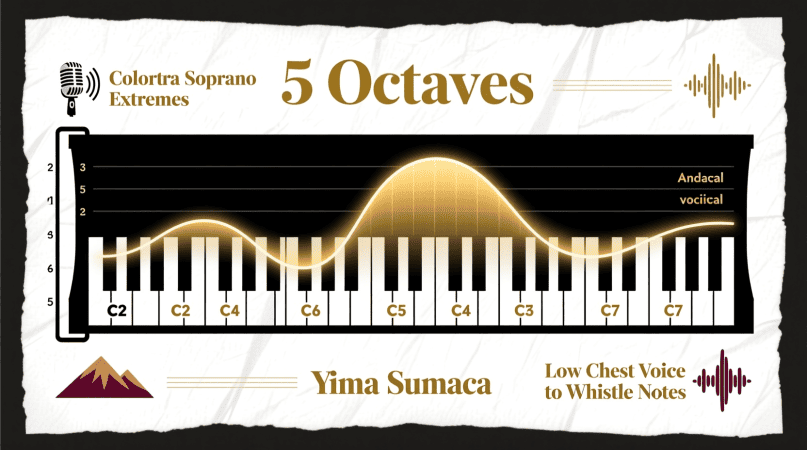
- Approximate Vocal Range: E2 – C#7
- Range Width: About five octaves (one of the widest in history)
- Voice Type: A hybrid of coloratura soprano, mezzo, and contralto
- Famous For: Bird-like whistle notes, volcanic chest voice, lightning-fast agility
- Signature Performances: “Chuncho,” “Malambo No.1,” “Tumpa,” “Voice of the Xtabay”
Her voice spanned nearly the entire piano — something extremely rare even among elite opera singers.
Why Yma Sumac’s Vocal Range Still Feels Unreal
Many singers have wide ranges.
But how Yma used her range is what made her unforgettable.
She didn’t just sing high notes or low notes — she combined them with:
- unbelievable agility
- non-Western vocal technique
- emotional precision
- theatrical control
- and a tone that sounded like no one else on Earth
Even today, vocal coaches debate how to classify her.
Here’s what made her sound “impossible”:
1. She could leap multiple octaves instantly
Most singers need transitions or vowel shifts.
She jumped effortlessly between registers like it was nothing.
2. Her whistle-like notes were unusually full
Most whistle tones are breathy or thin.
Yma’s sounded like a bright, ringing instrument.
3. Her contralto notes were legitimately deep
She comfortably reached E2, a note below many men’s ranges.
4. She combined classical technique with Andean folk tradition
Her Peruvian upbringing shaped her tone, phrasing, and agility.
I once tried imitating one of her rapid shifts from low chest voice into whistle tone — it sounded more like a coughing fit than a musical moment. Yma made it feel weightless.
Yma Sumac’s Highest Notes: The Legendary Top End
Most analyses place her highest controlled pitch around:
- C#7 (in recordings)
- Possibly higher in live variations
Her highest notes appear in:
“Chuncho”
The most jaw-dropping display of her full range.
Her voice moves so quickly between “human” and “bird” that it feels like watching a magic trick.
“Tumpa”
Features piercing soprano bursts that almost seem unreal.
“Voice of the Xtabay”
Her voice floats, glides, and blooms across the top of her range — gracefully, not forcefully.
One thing you notice in these performances:
Her high notes never sound tense.
No strain, no pushing — just pure resonance.
Hitting higher notes becomes more manageable when you follow the High Notes Singing guide and combine it with breath support techniques from the Breathing Techniques for Singing page. You can warm up using the Daily Vocal Warm-Up and measure improvements with the Vocal Range Test as your upper register grows.
Yma Sumac’s Lowest Notes: The Forgotten Power of Her Voice
Her low register is just as astonishing.
She produced controlled, powerful notes down to:
- E2 (verified in recordings)
That’s lower than many male baritones can comfortably sing.
Her low notes appear in:
- “Tumpa” – smoky and warm
- “Kuyaway” – deep, chesty resonance
- “Suray Surita” – surprisingly rich phrases
It’s the contrast between E2 and C#7 — nearly a full five octaves — that makes her voice so historically significant.
I tried hitting E2 once. My voice didn’t just crack — it gave up.
Hearing Yma do it with ease is unreal.
What Voice Type Was Yma Sumac?
No single voice type fits her.
She was the definition of a vocal outlier.
She exhibited:
- Contralto depth
- Mezzo warmth
- Coloratura soprano agility
- Whistle-like upper extension
Most singers spend their lives mastering one category.
Yma moved between all three like they belonged to her.
The best description?
A dramatic coloratura soprano with a contralto extension and whistle capability.
In other words: A once-in-a-century instrument.
Yma Sumac’s Vocal Range in Her Most Iconic Songs
1. Chuncho (The Forest Creatures)
If you want the full Yma experience, start here.
She uses:
- chest voice
- head voice
- whistle register
- trills
- yodel-style leaps
It’s a masterclass in vocal athleticism.
2. Malambo No. 1
Fast, rhythmic, energetic — and full of precise agility.
Her staccatos are razor-sharp.
Try singing along: you’ll discover very quickly how coordinated her technique was.
3. Voice of the Xtabay
This shows off her atmospheric soprano tone.
She glides across notes with an elegance that’s impossible to fake.
4. Tumpa
Here she blends:
- dark lower tones
- operatic midrange
- explosive soprano peaks
It’s dramatic, powerful, and unmistakably Yma.
How Yma Sumac Produced Her Extraordinary Range
Musicians, scientists, and vocal pedagogues have studied her voice for decades.
Here’s the simplest explanation:
1. Highly flexible vocal folds
They vibrated at unusually fast speeds, enabling extreme highs.
2. Strong chest-dominant lower register
Most sopranos can’t access lows like hers.
3. Peruvian folk vocal training
Her upbringing included natural use of rapid register switching — similar to yodeling but more melodic.
4. Precise breath support
Without this, her range would collapse instantly.
5. Incredible resonance placement
She shifted resonance between:
- chest
- mask
- hard palate
- and whistle space
This made every register sound intentional — not forced.
I once recorded myself trying to imitate her sudden jump from E3 to G6.
The playback sounded like my voice was arguing with itself.
It made me appreciate her mastery even more.
Yma Sumac vs Other Extreme-Range Singers
| Singer | Vocal Range | Notes |
|---|---|---|
| Yma Sumac | E2–C#7 | 5 octaves; legendary agility |
| Dimash | C2–D8 | Classical technique + whistle |
| Mariah Carey | G2–G7 | Whistle queen, agile soprano |
| Vitas | F2–D8 | Extreme whistle & brightness |
| Georgia Brown | G2–G10 | Guinness record holder |
Yma stands out not just for range —
but for style.
Her voice had ancient Andean color, operatic discipline, and cinematic drama.
No one else sounds like her.
Can You Learn to Sing Like Yma Sumac?
Short answer: Not exactly.
Longer answer:
You can train elements of her technique — agility, breath control, and resonance — but her full range is extremely rare.
Most singers can safely expand their range by:
- practicing controlled falsetto
- strengthening chest voice
- developing head voice resonance
- learning vowel modifications
But trying to copy her raw?
You’ll quickly learn why she’s one of a kind.
How Your Vocal Range Compares to Yma Sumac’s
If you want to see where you stand next to her, you can use the vocal range test on my site.
You’ll learn:
- Your highest note
- Your lowest note
- Your voice type
- Whether you have whistle potential
Don’t be discouraged if your range doesn’t resemble E2–C#7.
Almost no one in history can do what Yma did.
Frequently Asked Questions
What was Yma Sumac’s actual vocal range?
Approximately five octaves, from E2 to C#7.
Could she really mimic birds and animals?
Yes — this was part of her Andean vocal heritage.
Did she use whistle register?
Absolutely — you can hear it clearly in “Chuncho.”
Was her voice natural or trained?
Both. She was born with unusual flexibility and refined it with cultural and musical training.
Was she classically trained?
Not formally, but she mastered techniques comparable to highly trained coloratura sopranos.
Can modern singers match her range?
Some come close, but none replicate her exact tone, agility, or style.