
Laufey has one of the most recognizable voices of this generation — warm, velvety, intimate, and nostalgic in a way that feels decades older than she is.
She doesn’t belt. She doesn’t scream. She doesn’t rely on flashy tricks.
Instead, she pulls you in with softness.
But here’s the secret most people miss: Soft singing is much harder than loud singing.
The first time I tried covering “Let You Break My Heart Again,” I thought the vocal line looked simple on paper.
A few soft phrases, some low notes, a touch of jazz phrasing… easy, right?
Not even close.
My low notes wobbled, my breath support fell apart, and my pitch drifted the moment I relaxed too much. The exact thing that makes Laufey’s voice beautiful — that gentle, warm control — is unbelievably difficult to replicate.
So let’s break down everything that makes her voice so special, starting with the question everyone searches for:
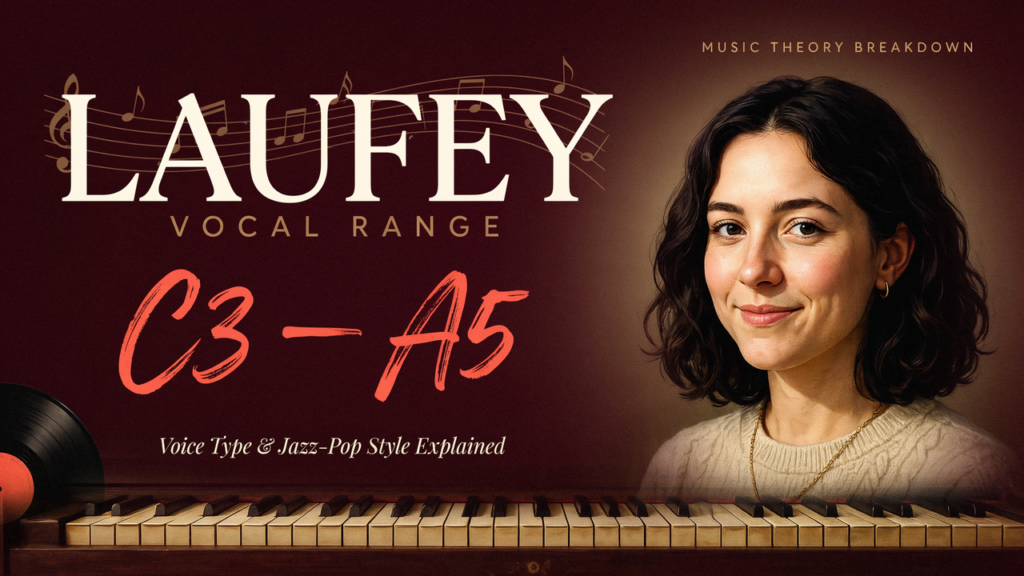
Laufey’s Vocal Range (Exact Notes)
Across live performances, studio recordings, interviews, and fan-verified analyses, Laufey’s vocal range sits around:
C3 – A5 (approximately 2.5 octaves)
Some performances slide slightly below or above this, but C3–A5 represents her comfortable, musical range.
What makes Laufey’s range unique?
It’s not the size — it’s the tone, the warmth, the control, and the jazzy phrasing she brings to it.
Laufey Vocal Range Chart
| Register | Notes | Description |
|---|---|---|
| Low Register | C3 – E3 | Warm, intimate, child-of-jazz depth |
| Middle Register | F3 – C5 | Smooth, controlled, creamy and conversational |
| Upper Register | C5 – A5 | Airy, soft, falsetto-driven, delicate |
| Signature Traits | Fry, breathy tone, jazz phrasing | Defines her vintage-modern fusion |
Even her highest notes are intentionally soft — a stylistic choice that enhances her timeless sound.
Laufey’s Lowest Notes (C3 Range)
Laufey is admired for her unusually rich lower register.
She comfortably dips to C3, which is low even for many mezzo-sopranos.
Examples:
- “Promise” – deep, warm low phrases
- “Let You Break My Heart Again” – clean E3–D3 moments
- “From the Start” (live) – beautifully placed C3–D3
Her lows don’t sound forced — they sound lived-in, like the voice of someone who grew up listening to vintage jazz on old vinyl.
When I tried singing her lower lines, the struggle was real:
Soft + Low = Surprisingly Hard
Maintaining pitch while singing quietly in the lower register requires:
- high breath support
- open throat
- steady airflow
Laufey does this effortlessly.
Laufey’s Highest Notes (Up to A5)
While Laufey rarely belts, she does sing high notes — just not in the traditional pop “power” style.
Her highs typically come from:
- falsetto
- head voice
- airy lifts
- controlled lightness
Examples:
- “Valentine” – floaty A5 flourishes
- “Let You Break My Heart Again” – elegant upper harmonies
- “Beautiful Stranger” – breathy head-voice transitions
Her upper register feels like morning light — soft, golden, gentle.
What Voice Type Is Laufey? (Low Mezzo-Soprano — Not Contralto)
There’s a popular debate online about whether Laufey is a contralto, but let’s clear this up with vocal science.
Laufey is a low mezzo-soprano with contralto-like coloration.
Why she sounds like a contralto:
- rich low register
- rounded warm timbre
- slow vibrato
- chest resonance
- jazz-inspired vowel shapes
Why she is actually a mezzo:
- her tessitura sits higher than a true contralto
- her mid-range is where she shines most
- contraltos rarely use as much head voice as she does
- her upper register is too light and airy
Her voice is like a soft jazz cello — warm on the bottom, silky in the middle, whispery at the top.
Why Laufey Sounds So Warm, Deep, and Vintage (The Real Technique Behind It)
It’s not an accident. Laufey uses several advanced vocal techniques:
1. Chest-dominant resonance
She keeps sound grounded in the chest cavity, giving it depth.
2. Dark vowel shaping
She rounds vowels to create a lush, vintage timbre (“u,” “o,” “ah”).
3. Soft phonation
She uses low breath pressure, resulting in that intimate whisper-singing aesthetic.
4. Vocal fry accents
Used at the start or end of phrases for old-Hollywood texture.
5. Jazz phrasing
She bends lines behind the beat — a signature of jazz greats.
6. Minimal vibrato
Her vibrato is subtle, letting the lyrics feel conversational.
Trying this myself, the hardest part was:
Staying quiet without losing resonance.
If you relax too much, your sound collapses.
If you over-support, you lose the softness.
Laufey balances both like it’s second nature.
How Laufey’s Classical and Jazz Training Shape Her Voice
Laufey trained in:
- classical voice
- jazz performance
- orchestral phrasing (she plays cello)
This creates a unique blend:
- classical clarity
- jazz looseness
- pop emotionality
Her voice isn’t just singing — it’s storytelling with texture.
How Laufey’s Voice Compares to Other Artists
| Singer | Vocal Range | Voice Type |
|---|---|---|
| Laufey | C3 – A5 | Low Mezzo-Soprano |
| Billie Eilish | D3 – E6 | Mezzo with whispery style |
| Norah Jones | F3 – C6 | Mezzo with jazz tone |
| Adele | C3 – C6 | Powerful Mezzo |
| Olivia Rodrigo | G3 – B5 | Light Mezzo-Soprano |
Laufey stands out because she blends:
- low mezzo depth
- jazz warmth
- classical technique
- Gen-Z storytelling
She’s simultaneously retro and modern
My Personal Experience Singing Laufey Songs
Laufey seems easy… until you try singing like her.
Here are the struggles I ran into:
1. Her low notes demand rock-solid breath support
Quiet + low = recipe for pitch drops.
2. Singing behind the beat is shockingly difficult
Her jazz phrasing requires relaxation — but controlled relaxation.
3. Her vowel shapes are subtle but essential
The warm tone disappears instantly if you brighten the vowels.
4. Emotional transparency
Her songs feel exposed, delicate.
You can’t hide behind big belting — everything is intimate.
But learning her technique made me:
- improve my breath control
- learn to soften my tone
- understand jazz phrasing better
- appreciate the art of subtle singing
Laufey is a master of softness — and softness requires strength.
Test Your Vocal Range Compared to Laufey
If you’re curious how your voice compares to Laufey’s:
Use the Vocal Range Test — your audio stays on your device.
It shows:
- your lowest note
- your highest note
- your voice type
- a complete range map
Great for singers exploring their own tone and style.
Frequently Asked Questions
What is Laufey’s vocal range?
Approximately C3 – A5.
Is Laufey a contralto?
No — she is a low mezzo-soprano with contralto-like warmth.
What is her lowest note?
Around C3.
What is her highest note?
Around A5 in falsetto/head voice.
Why does Laufey sound so deep?
Chest resonance, dark vowels, soft phonation, and jazz phrasing.
Is Laufey classically trained?
Yes — she studied classical voice and jazz at Berklee.
What makes her voice sound “vintage”?
Her tone, mic technique, phrasing, and warm vowel shapes.
- If you want to see how her voice compares to other singers, check the average vocal range of pop vs classical singers.
- Beginners can develop foundational skills with adult singing lessons for proper technique.
- To safely extend your high notes, try the breathing techniques to improve vocal range.
- Maintain your instrument with essential vocal health tips for singers.
- Discover how to choose songs that fit your voice in how to find songs that fit your vocal range.
- For examples of other artists’ ranges, see the what singer has the best vocal range page.
Erika Parker is a vocal analysis and singing education writer at Vocal Range Test. She focuses on vocal range testing, voice type analysis, pitch recognition, and singing tools for vocalists, musicians, choir singers, and beginners.