
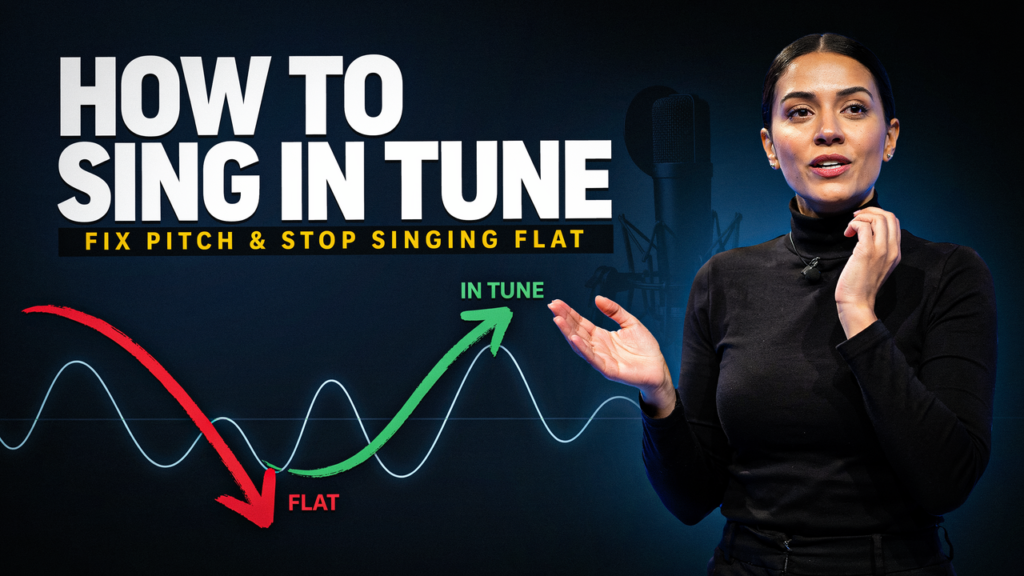
To sing in tune, you need to hear the target pitch, produce it with your voice, and adjust quickly when you are flat or sharp. Most pitch problems are trainable: start with simple pitch matching, record yourself, slow the melody down, sing in a comfortable range, and build steady breath support so notes do not sag at the end of phrases.
Being “off-key” does not automatically mean you have a bad voice. Many singers can hear music well but have not yet connected the ear, breath, and vocal muscles accurately. The goal is not to guess notes; it is to build a feedback loop where you hear the note, sing it, check it, and make small corrections.
Why You Sing Out of Tune
Singing out of tune usually comes from one of five issues:
- You cannot hear the target clearly yet. If the note is vague in your ear, your voice has nothing precise to match.
- Your voice overshoots or undershoots the note. You may hear the pitch but land slightly above or below it.
- Your breath is unstable. Notes often go flat when airflow drops at the end of a phrase.
- You are singing outside your practical range. A note may be technically possible but not reliable yet.
- The song key is wrong for your voice. Even good singers sound strained when the key sits badly.
Before you blame your voice, check your range with a vocal range finder. If the song is too high or too low for your current voice, tuning becomes much harder than it needs to be.
Flat vs Sharp: Know Which Problem You Have
Singing flat means your pitch is below the target note. This often happens when the voice is tired, the breath drops, the vowel gets heavy, or a high note is approached with too little energy.
Singing sharp means your pitch is above the target note. This often comes from pushing, jaw or tongue tension, over-bright vowels, or trying to “reach” instead of settling into the note.
A real-time pitch test can help you see the direction of your error. Do not stare at the tuner the whole time while singing songs; use it during exercises so your ear learns what correct pitch feels and sounds like.
Step 1: Match One Note at a Time
Play one comfortable note on a piano, keyboard app, or pitch tool. Listen first. Then hum the note softly. If your pitch is low, slide upward slowly. If it is high, slide downward. Stop when your voice feels locked into the note.
Keep this exercise simple:
- Play one note.
- Hum it back softly.
- Check whether you are flat, sharp, or centered.
- Repeat the same note three times before moving on.
- Practice only five to ten minutes so your ear stays focused.
A note detector can confirm what pitch you are producing, but the real goal is to make your ear more accurate without depending on the screen forever.
Step 2: Record and Compare
Your voice sounds different inside your head because you hear it partly through bone vibration. Recording removes that illusion. Sing a short phrase, play it back, and ask one question: did the pitch stay centered, or did it drift?
Use very short clips at first. A full song gives too much information. Four bars are enough. Mark the exact word or note where the pitch changes, then practice only that spot slowly.
Step 3: Slow the Melody Down
Speed hides pitch errors. When a melody moves quickly, you may slide past the correct note without noticing. Slow it down until every note has a clear target.
Try this method:
- Speak the lyric in rhythm first.
- Sing the melody on “mm” or “oo.”
- Add the words back only after the notes are stable.
- Practice difficult jumps separately before singing the whole line.
This is especially useful for riffs, runs, and pop melodies with quick turns. Accuracy comes before speed.
Step 4: Support the Pitch With Breath
Pitch is not only an ear-training problem. If the breath collapses, the note often drops. If the throat tightens, the note may go sharp or sound squeezed. A steady, comfortable stream of air makes tuning easier.
Start with basic breathing exercises for singers. Then sing a five-note scale on a gentle “oo” or “ng,” keeping the airflow even from the first note to the last. If the final note falls flat, reduce volume and reset the breath.
Step 5: Warm Up Before Checking Pitch
Do not judge your pitch from a cold voice. Many singers start slightly unstable before the voice is coordinated. A gentle warm-up helps the folds respond more evenly and makes tuning practice more reliable.
Use light humming, lip trills, sirens, and easy scales before harder songs. This guide on how to warm up your voice can help you build a short routine before pitch work.
Step 6: Choose the Right Key
If a song sits too high, you may go flat from strain. If it sits too low, you may lose clarity and slide under the pitch. Good tuning often begins with a better key, not more force.
You can find your comfortable notes on an instrument with this guide to finding your vocal range on piano. Then use a song key finder to understand the song’s key and transpose it if needed.
For practice, choose songs that sit mostly in your comfortable middle range. This list of best songs to sing by vocal range can help you avoid songs that are too demanding too soon.
A 10-Minute Daily Routine to Sing More in Tune
| Time | Exercise | Purpose |
|---|---|---|
| 2 minutes | Gentle humming or lip trills | Wake up the voice without pressure |
| 3 minutes | One-note pitch matching | Connect ear and voice |
| 2 minutes | Five-note scales | Stabilize pitch movement |
| 2 minutes | One difficult song phrase | Apply tuning to real music |
| 1 minute | Record and listen | Check whether you improved |
Repeat this routine for a few weeks and track one small thing: are you correcting faster? Progress often shows up first as better awareness, then better accuracy.
Common Mistakes That Keep Singers Off Pitch
- Practicing only full songs: isolate the exact phrase that goes out of tune.
- Singing too loudly: loud practice can hide tension and make pitch harder to control.
- Using a tuner as a crutch: check pitch, then close your eyes and listen.
- Skipping warm-ups: a cold voice can make tuning seem worse than it really is.
- Ignoring the key: some songs need transposition before they fit your voice.
How to Sing in Tune FAQs
Can anyone learn to sing in tune?
Most people can improve pitch accuracy with focused practice. Some singers need more ear training than others, but many tuning problems are coordination issues rather than permanent limitations.
Why do I sing flat?
You may be singing flat because of low breath energy, vocal fatigue, heavy vowels, unsupported high notes, or a song key that sits too high for your current voice.
Why do I sing sharp?
You may be singing sharp because of tension, pushing, over-bright vowels, jaw tightness, or trying to reach notes instead of letting the pitch settle.
Should I use a tuner to sing better in tune?
Yes, but use it as a training tool, not a permanent crutch. A tuner can show whether you are flat or sharp, while recording and listening build the ear skills you need for real singing.
How long does it take to sing in tune?
Simple pitch matching can improve within days or weeks, but reliable tuning in songs takes longer because you must coordinate pitch, breath, vowels, rhythm, and emotion at the same time.
Final Takeaway
To sing in tune, make pitch practice smaller and more specific. Match one note, record short phrases, slow difficult melodies down, support the breath, warm up first, and choose songs in a key that fits your voice. Better tuning is not about forcing notes harder; it is about hearing clearly, adjusting calmly, and practicing with feedback.
Erika Parker is a vocal analysis and singing education writer at Vocal Range Test. She focuses on vocal range testing, voice type analysis, pitch recognition, and singing tools for vocalists, musicians, choir singers, and beginners.