
Anthony Green’s vocal range sits at approximately C3 to C6, covering around three octaves — but the numbers alone don’t explain why his voice is so distinctive. The Circa Survive and former Saosin frontman has one of the most immediately recognizable voices in post-hardcore: a high, light tenor timbre that carries an almost boyish quality even in its upper registers, layered with controlled distortion and a falsetto that feels less like a separate register and more like a seamless extension of his chest voice.
That combination is genuinely unusual. Most rock vocalists work in one of two modes — either they belt in chest voice and use falsetto as a stylistic decoration, or they flip into head voice and sacrifice power for range. Green doesn’t cleanly fit either template.
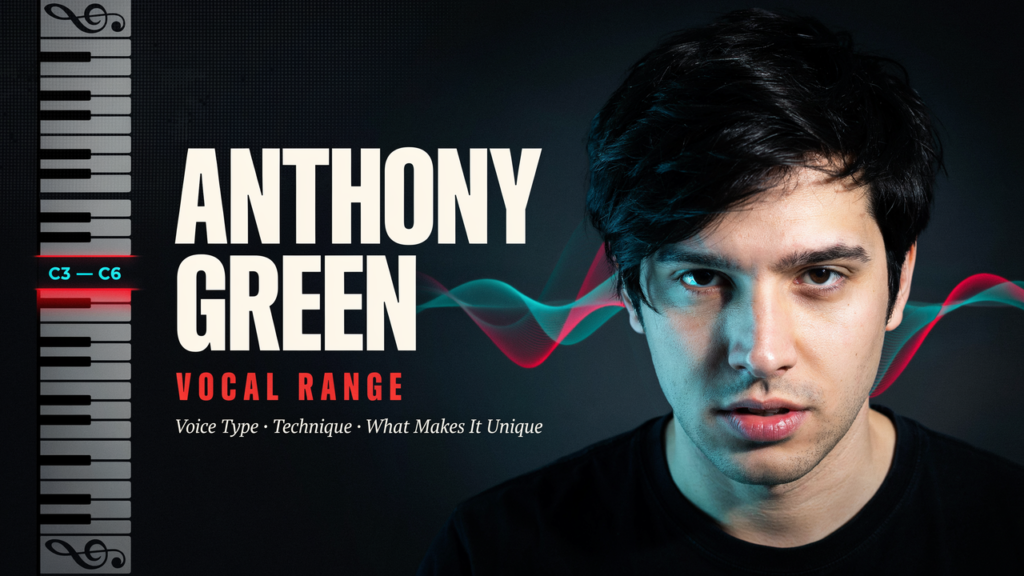
Anthony Green’s Vocal Range at a Glance
Vocal range: approximately C3 – C6 Voice type: High tenor (light lyric tenor) Vocal registers in use: Chest voice, mixed voice, falsetto, vocal distortion/fry Approximate span: Around 3 octaves Tessitura (comfortable center): Roughly A3 to B4
What Voice Type Is Anthony Green?
Green is a tenor — more specifically, what some vocal analysts and forum discussions have described as a “light high tenor” or spinto-lyric tenor, meaning he sits at the higher, lighter end of the tenor spectrum rather than the heavy, powerful end you’d associate with classical dramatic tenors.
His natural timbre has a bright, almost treble-heavy quality that some listeners initially mistake for falsetto even when he’s in full voice. That’s partly a function of cord thickness — lighter tenor cords vibrate differently than those of a heavier baritone instrument, producing less fundamental resonance and more upper harmonic content. The result is a voice that sounds high and bright at relatively low effort, which is part of why he can sustain long, soaring phrases without apparent strain even at the top of his chest range.
For reference on how tenor ranges sit relative to other voice types, the vocal range chart lays out the full picture across all six classical categories.
His Lower Register: C3 and the Chest Voice Floor
C3 — two Cs below middle C — is a reasonable lower limit for a light tenor. It’s not a deep note, and Green doesn’t spend much time in that territory. His songs with Circa Survive and in his solo work tend to avoid extended passages in the low third octave, because that’s simply not where this voice type generates its best tone.
When he does dip lower, the voice thins slightly — again, normal for a high tenor instrument. The chest resonance that gives a baritone warmth and weight in the low third octave just isn’t part of Green’s acoustic profile. If you’re trying to understand your own low notes by comparison, the deep voice test can help you map where your floor actually sits.
His Upper Register: The Fifth Octave and Above
This is where Green’s voice earns its reputation. His ability to access the fifth octave — notes above C5 — in what sounds like a supported, resonant tone (rather than a thin, strained falsetto) is what sets him apart from most rock singers.
Vocal analysts who have tracked his performances note extensions into the C6 range in full falsetto, which puts him in the same upper territory as singers with documented whistle-adjacent head voice extensions. Whether those extreme upper notes count as part of his practical working range is debatable — they’re present but rare — but his consistent fifth-octave access in normal performance is well established.
The question of whether head voice and falsetto extensions count toward vocal range is worth understanding if you’re trying to place Green’s voice accurately. The answer depends on how you define “range,” and the breakdown of whether head voice counts in vocal range explains the distinction in detail.
The Falsetto Question: Where Does Chest End and Falsetto Begin?
With Green, this question is harder to answer than it sounds — and that’s a compliment to his technique.
Most singers have a passaggio, the transition point between registers, that’s audible if you know what to listen for. The tone shifts, the resonance changes, and a well-trained ear picks it up. Green’s passaggio is remarkably smooth. When he ascends through the upper fourth octave into the fifth, the tonal quality stays consistent enough that casual listeners often can’t tell when he’s left chest voice.
Part of this is physiology — lighter tenor cords transition into head resonance more gradually than heavier instruments. Part of it is technique. His approach blends chest and head resonance in a way that functions like what vocal coaches call mixed voice, even if the sound reads as more falsetto-forward than a typical musical theater mix. For a deeper look at how these registers compare and interact, the piece on chest voice vs head voice is a useful reference.
Vocal Distortion: Green’s Third Dimension
Separate from his clean range, Green incorporates controlled vocal distortion throughout his work — what sounds like a raw, slightly gravelly overlay on top of otherwise clear singing. This is most audible in his Circa Survive catalog, particularly on heavier passages in tracks like “In Fear and Faith” and “Get Out.”
Healthy vocal distortion — when executed correctly — works by creating turbulence at the level of the false vocal folds or through glottal compression, rather than by actually abrading the true cords. The effect sounds rougher than it is, physiologically speaking. Vocal coaches analyzing Green’s technique have noted he appears to use relatively little excess airflow when distorting, which is generally a marker of safer execution. Singers who push excess air through distortion are the ones who tend to develop nodules; those who control airflow and rely on cord compression sustain the technique longer.
That said, any sustained vocal distortion carries risk over years of heavy touring. It’s worth hedging the “safe” label — what sounds controlled in studio recordings may be harder to replicate consistently night after night on a touring schedule.
Notable Vocal Performances
Juturna (2005) — the debut Circa Survive album remains the clearest early document of Green’s high tenor range in full flight. Tracks like “Act Appalled” and “The Greatest Lie” show the falsetto-chest blend in its most undisguised form.
On Letting Go (2007) — often cited by fans as the peak of Green’s range and control. The album sits in the upper fourth and lower fifth octave for extended passages, which is demanding territory for any rock vocalist to sustain across a full record.
Translating the Name EP (2003, Saosin) — Green’s recorded work with Saosin is brief but striking. The EP captures a rawer, slightly less polished version of the same voice, making it a useful reference point for how his technique evolved.
Avalon (2008, solo) — the solo debut strips away some of the post-hardcore density and puts the voice in a more acoustic context, where the clarity and breath control of his tone are easier to evaluate without a wall of guitar behind them.
How His Voice Has Changed Over Time
Green has been performing since the late 1990s, and a few decades of heavy touring, distortion use, and the general wear of rock singing leave marks on any voice. Recordings from the Saosin and early Circa Survive era versus his more recent work with L.S. Dunes and later solo material show some expected evolution: a slight decrease in the very highest extensions, a little more character and grit in the mid-range, and arguably more expressive control in the lower-to-mid fourth octave.
This is a normal trajectory for a voice like his. If you’re curious about how vocal range shifts across a career, the piece on how age affects your vocal range over time covers the physiology in detail.
What Makes Green’s Voice Rare in Rock
The combination of three things is what makes him genuinely unusual in the post-hardcore and alternative rock space:
First, the natural high tenor timbre. Most rock singers, even those who access high notes regularly, have a heavier, darker instrument underneath. Green’s voice is bright and light all the way down to its chest voice foundation.
Second, the integrated falsetto. Rather than using falsetto as a special effect, Green treats it as a continuous part of his voice — accessible throughout a song without an obvious gear change.
Third, the coexistence of distortion with that light, high tone. Most singers who incorporate distortion work from a heavier chest voice platform. Layering distortion onto a bright, light tenor timbre produces a different, more distinctive sonic result.
If you want to know where your own voice sits in relation to Green’s — or whether you share his high tenor profile — the vocal range finder will map your range, and the singer comparison tool will place it alongside documented artists in the database.
FAQs About Anthony Green’s Vocal Range
What is Anthony Green’s vocal range?
His range spans approximately C3 to C6, covering around three octaves. His practical working range in chest voice and mix sits in the upper third to lower fifth octave, with documented falsetto extensions into the sixth octave.
What voice type is Anthony Green?
He’s a high tenor — often described as a light or lyric tenor. His natural timbre sits at the bright, high end of the tenor spectrum, which contributes to the falsetto-like quality some listeners hear even in his full chest voice.
Is Anthony Green actually using falsetto, or is that his real voice?
Both, often simultaneously. His chest voice sits naturally high and bright, which means the transition into falsetto is less dramatic than it would be for a heavier voice. The result is a blend that functions like mixed voice — he’s not purely in falsetto when he’s singing in the upper fourth octave, even if it sounds that way.
How does Anthony Green’s range compare to other post-hardcore singers?
Green’s upper range and light timbre put him in relatively rare company in the genre. Singers like Kellin Quinn of Sleeping with Sirens share a similar high-tenor profile, though Green’s distortion technique and his particular falsetto blend are his own. Most post-hardcore vocalists work from a heavier mid-tenor base and use high notes as accent points rather than as a sustained operating zone.
Erika Parker is a vocal analysis and singing education writer at Vocal Range Test. She focuses on vocal range testing, voice type analysis, pitch recognition, and singing tools for vocalists, musicians, choir singers, and beginners.