
Geoff Tate’s vocal range spans approximately A2 to A5 — four octaves, by his own account — making him one of the most technically accomplished vocalists in the history of progressive metal. Born Jeffrey Wayne Tate on January 14, 1959 in Stuttgart, West Germany, he joined Queensrÿche (then called The Mob) in 1981 and led the band through its commercial and artistic peak: Operation: Mindcrime (1988), widely considered one of the greatest concept albums in rock history, and Empire (1990), which went triple platinum, reached #7 on the Billboard album chart, and produced the Grammy-nominated ballad “Silent Lucidity.”
He has described his own range in a Smashing Interviews Magazine interview: “Tate has a four-octave range, which goes from the A below C up to the A above high C.” He added, on the subject of his early training: “I studied voice. I thought maybe when I grew up I’d be an opera singer and I’m kind of still waiting for that.” Hit Parader ranked him 14th on their list of the 100 Greatest Metal Vocalists of All Time, and he was voted No. 2 on That Metal Show’s top five hard rock vocalists of the 1980s.
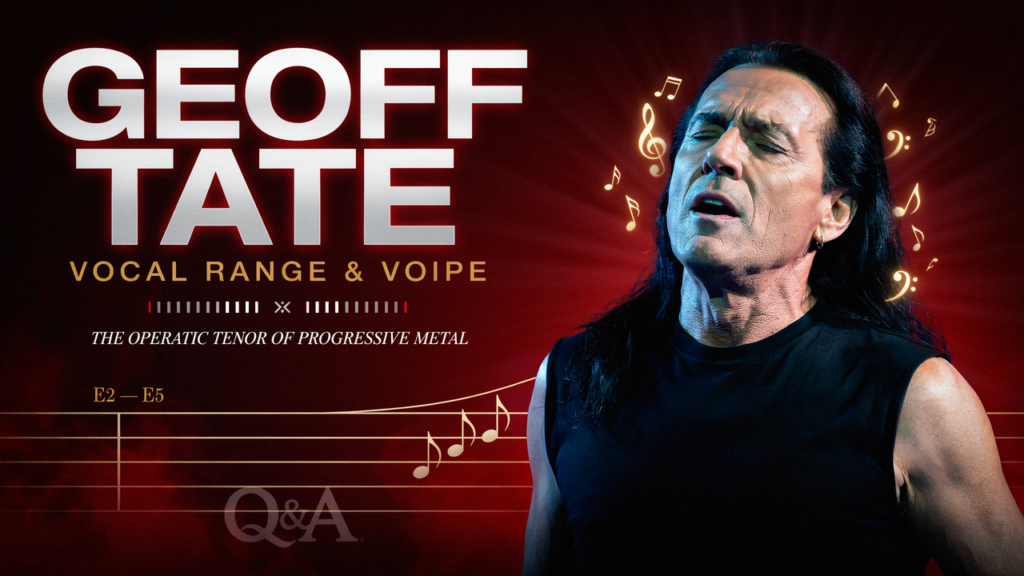
Geoff Tate’s Vocal Range at a Glance
Vocal range: approximately A2 – A5 (four octaves, self-documented) Voice type: Tenor (operatically-trained, dramatic in rock context) Vocal registers in use: Chest voice, mixed voice, head voice/falsetto Approximate span: Four octaves Tessitura (comfortable centre): Roughly D3 to G4 Active career: 1981–present
What Voice Type Is Geoff Tate?
Tate is a tenor — and specifically a tenor whose instrument was shaped by operatic training before it entered the metal context. He studied classical voice formally with opera as a career possibility, and the bel canto technique he absorbed — forward placement, open vowels, breath management, long legato lines — is audible in how his voice projects through dense metal arrangements without the strain that destroys most rock vocalists’ upper range over decades of touring.
The comparison point isn’t arbitrary: one dedicated analysis describes him as capable of delivering “the range of Rob Halford of Judas Priest and Bruce Dickinson of Iron Maiden and Ronnie James Dio” — three of the most documented high tenors in metal history — while adding that “Geoff’s power and expression were unexpected and unsurpassed.” This is the specific combination that makes the operatically-trained tenor in a metal context rare: technical precision in the upper register, with the weight and emotional power that metal performance demands.
His range sits within the tenor vocal range classification, but the operatic training context gives his placement and production a different character from most rock tenors.
His Lower Register: A2 and the Chest Voice Foundation
A2 — the lower limit he himself documented — sits at the low end of tenor range, approaching baritone territory. His chest voice in the lower third octave carries a warmth and weight that grounds even the most dramatic Queensrÿche arrangements: the mid-range passages of “Silent Lucidity,” the verse lines of “I Don’t Believe in Love,” and the intimate moments of Operation: Mindcrime all demonstrate a voice comfortable and resonant in its lower range rather than simply tolerating those notes on the way to the upper register.
Classical voice training cultivates this lower register quality in tenors specifically — bel canto technique doesn’t allow singers to thin out the lower range in favour of the upper; the instrument needs consistent tonal quality across the full span. The result in Tate’s case is a lower chest register that supports dramatic delivery without sacrificing the resonance needed for the material.
The Upper Register: High A and the Metal Ceiling
A5 — the A above soprano high C — is the documented upper limit. This is remarkable territory for any singer in any context; in metal performance, where the instrument is subjected to sustained high-volume output rather than the calibrated projection of operatic performance, sustaining access to the fifth octave across decades of touring is genuinely exceptional.
Songs like “Take Hold of the Flame” from The Warning (1984) and “Eyes of a Stranger” from Operation: Mindcrime demonstrate the upper register in its most demanding forms — high notes sustained in power metal arrangements, with the specific quality one analyst described as sounding “so easy for him.” The apparent ease is the product of the operatic training: a well-supported high note from a trained voice produces less physiological stress than a pushed, unsupported one, and the longevity of his upper range reflects this.
The combination of operatic chest support and classical forward placement means his high notes carry projection rather than shrillness — the upper register sounds like an extension of his natural voice rather than a strained departure from it. The how to increase vocal range page covers the technical principles that underlie the kind of systematic upper-register development Tate’s training produced.
The Operatic Influence on Progressive Metal
Queensrÿche’s progressive metal identity was inseparable from Tate’s operatic foundation. Where most early metal vocalists worked from blues and rock vocal traditions — chest-voice heavy, maximally powerful, sometimes technically raw — Tate brought a classically-trained approach that prioritised tonal precision, melodic phrasing, and register integration.
This gave Operation: Mindcrime — a concept album following a narrative arc across 14 tracks — a vocal coherence that few rock albums achieve. The voice wasn’t simply performing individual songs; it was sustaining a character across a 50-minute dramatic arc. That’s an operatic demand in a metal context, and Tate met it with the specific technical vocabulary his early training provided.
Empire (1990) translated this approach to more commercially accessible material without sacrificing the technical quality. “Silent Lucidity” — the acoustic ballad that earned two Grammy nominations and reached #9 on the Billboard singles chart — demonstrated that the operatic tenor could also deliver intimate, emotionally direct material at soft dynamics with the same tonal quality.
His maintenance of vocal quality into his sixties has been noted by multiple reviewers — a 2024 Toronto concert review observed that at 65, “he literally sounds 35 years younger.” When asked how he maintains his voice after four decades of performing, Tate attributed it simply to “practice” and “keeping up with it” — a response that reflects the internalised discipline of classical training rather than a series of special regimens.
Notable Vocal Performances
Take Hold of the Flame (1984): The early showcase of his upper register in power metal context. Widely cited as a first demonstration of what separated his voice from contemporaries.
Eyes of a Stranger (1988, Operation: Mindcrime): The song his dedicated fan site describes as sounding “so easy for him” — the upper register in full flight on a progressive metal arrangement.
Silent Lucidity (1990, Empire): The Grammy-nominated ballad demonstrating the softer, more intimate dimension of the voice at low dynamics. Reached #9 on the Billboard Hot 100.
I Am I (1994, Promised Land): From the period after the commercial peak, showing the voice continuing to develop rather than merely sustaining.
Queensrÿche Career and Departure
Queensrÿche sold over 20 million albums worldwide with Tate as frontman. His departure — announced June 20, 2012, when the band fired him and replaced him with Todd La Torre — was followed by legal proceedings and a protracted dispute over the band’s name and legacy. He subsequently performed under his own name and with a group called Operation: Mindcrime, named after the Queensrÿche album.
The departure is a complex part of his story that doesn’t reduce to a simple narrative. What’s clear from the recordings and the continued touring is that a four-octave operatically-trained tenor, whatever the circumstances of his departure, left behind a body of work that defined a genre.
FAQs About Geoff Tate’s Vocal Range
What is Geoff Tate’s vocal range?
In his own words: “a four-octave range, which goes from the A below C up to the A above high C” — approximately A2 to A5. This self-documented range is corroborated by fan analyses and critical assessments of his recordings.
What voice type is Geoff Tate?
He’s a tenor — operatically trained, with classical bel canto technique applied to progressive metal. His formal voice study with opera as an intended career shaped the forward placement, breath support, and register integration that have sustained his upper range across more than four decades of performing.
Did Geoff Tate really study opera?
Yes — in his own words from a Smashing Interviews Magazine interview: “I studied voice. I thought maybe when I grew up I’d be an opera singer.” The classical training is audible in his placement and production, and his longevity is consistent with the outcomes of properly supported classical technique.
What are Queensrÿche’s biggest albums?
Operation: Mindcrime (1988) — widely considered one of the greatest rock concept albums ever recorded — and Empire (1990), which went triple platinum and reached #7 on the Billboard album chart. Together they define Tate’s commercial and artistic peak with the band.
How does Geoff Tate’s range compare to other metal vocalists?
Hit Parader placed him 14th on their 100 Greatest Metal Vocalists list. The comparison cluster — Rob Halford, Bruce Dickinson, Ronnie James Dio — places him among the most technically accomplished tenors in the genre. His four-octave self-documented range exceeds most metal vocal ceilings, and his operatic training gives his high notes a clarity and precision that distinguishes them from the more commonly heard pushed or distorted upper register approach.
Erika Parker is a vocal analysis and singing education writer at Vocal Range Test. She focuses on vocal range testing, voice type analysis, pitch recognition, and singing tools for vocalists, musicians, choir singers, and beginners.