
George Harrison’s vocal range spanned approximately E2 to A4 — just under two and a half octaves — with a lyric tenor instrument that sat at the quieter, more understated end of the Beatles’ vocal spectrum. Born on February 25, 1943 in Speke, Liverpool, and died November 29, 2001, Harrison was the third-most frequent lead vocalist in the Beatles after Paul McCartney and John Lennon, but consistently the most underappreciated — despite the fact that Frank Sinatra called “Something” the greatest love song written in fifty years, and despite the fact that Harrison himself wrote some of the most vocally sophisticated material in the band’s catalogue.
The voice, like the man, tended to reveal itself gradually rather than announcing itself. It wasn’t the most powerful in the room. But it had emotional honesty and a tonal warmth that made the songs it carried — “Something,” “Here Comes the Sun,” “My Sweet Lord” — feel like confidences rather than performances.
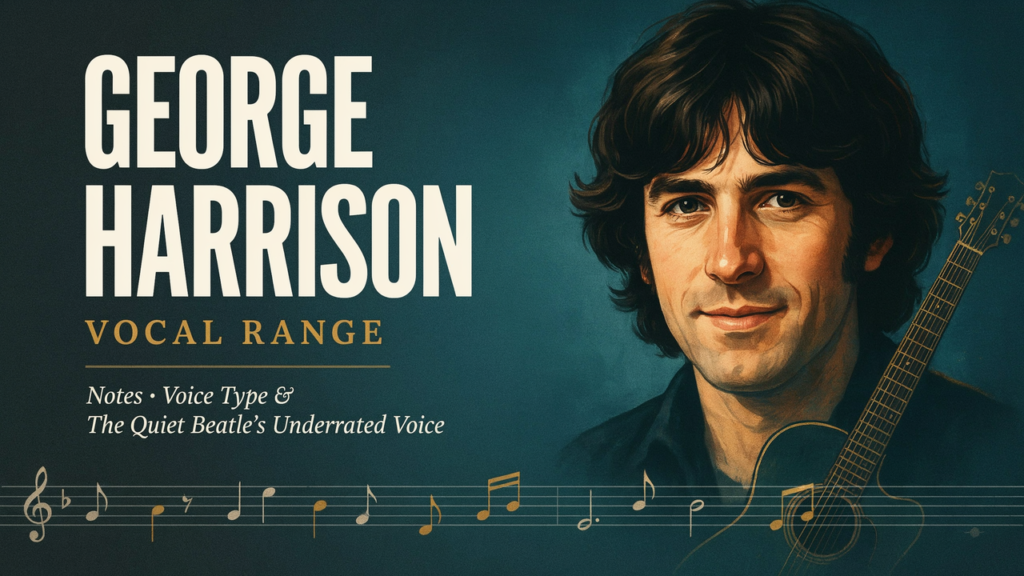
George Harrison’s Vocal Range at a Glance
Vocal range: approximately E2 – A4 Voice type: Lyric tenor (low tenor / high baritone boundary) Vocal registers in use: Chest voice, mixed voice, falsetto Approximate span: Just under 2.5 octaves Tessitura (comfortable centre): Roughly E3 to F4 Active career: 1958–2001
What Voice Type Was George Harrison?
The voice type question generates genuine debate among Beatles vocal analysts. SingersAvenue classifies him as a lyric tenor; multiple Quora and Beatles forum analyses describe him as a “low tenor” or a voice that “sang within the high baritone range in the early 60s” before settling more fully into tenor territory from the mid-to-late 1960s onward.
The most accurate framing is low tenor — or, put differently, a voice that sits at the border between high baritone and lyric tenor, classified as tenor primarily because of timbre rather than extreme upper range. His timbre is brighter and more forward-placed than a true baritone, but his natural tessitura sits lower than most lyric tenors and his lower register has genuine resonance that a purely light tenor wouldn’t produce.
One Beatles forum analysis summarises it well: “He seems to have a very complete tenor range, with John and Paul either side” — meaning Harrison sat between Lennon’s lower placement and McCartney’s higher placement within the group’s harmonic architecture.
The tenor vocal range page covers where the lyric tenor classification sits relative to the full male voice type spectrum.
His Lower Register: The Surprisingly Deep Foundation
Multiple sources note that Harrison’s speaking voice was “surprisingly low” — several forum discussions at Beatles Bible note he “has a low speaking voice, very close to John’s at times.” His documented Eb2 and C2 appear in interview speech rather than singing, but they establish a natural voice that sits lower than the light lyric tenor classification might suggest.
In his earliest Beatles recordings — “Do You Want to Know a Secret?” (1963), “Chains” (1963), “Don’t Bother Me” (1963) — the voice operated primarily in the upper baritone zone (E3–D4), which is why some analysts initially classified him as a high baritone. The songs written for him by Lennon and McCartney in this period tended to sit in that comfortable mid-range territory.
His chest voice in the lower third octave carried more warmth than a purely light tenor would produce there, which is part of what gives his early Beatles lead vocals their characteristic grounded quality rather than the floating brightness of McCartney’s instrument.
His Upper Register: The Tender Tenor Peak
A4 — just above middle C’s octave — sits at the comfortable upper limit of his practical chest/mix range. His falsetto extended above this, used selectively for harmony passages and occasional lead moments.
“Something” (1969) is the clearest document of his upper register working at its best. The song sits primarily in the E3–F4 range for the verse and rises to the A4 area in the chorus — exactly in his most natural and expressive tessitura. The tone in that zone is warm, slightly breathy, and emotionally transparent in a way that more powerful tenor voices often struggle to achieve.
“Here Comes the Sun” (1969) has a similar quality — the voice sitting in the mid-to-upper fourth octave with a lightness and expressiveness that serves the song’s emotional content rather than demonstrating what the voice can do at its limits.
“My Sweet Lord” (1970) pushes slightly higher, with the devotional intensity of the gospel influence apparent in how he sustains the upper phrases. This was his first post-Beatles solo number one (UK and US), and the voice is at its most open and emotionally direct.
The Harmony Role: Precision Over Power
Within the Beatles, Harrison’s primary harmonic function was to provide a third voice between Lennon and McCartney — typically singing above Lennon when McCartney was on top, or below McCartney when a different harmonic configuration was needed. This required tonal flexibility rather than a single fixed register: the voice had to blend rather than project.
Multiple analyses note that Harrison “sang quite a few of the high harmonies on Beatles songs” — which seems counterintuitive for a lower tenor, but makes sense when you understand harmonic arrangements. His voice, sitting between Lennon’s lower placement and McCartney’s higher placement, could access both upper harmony parts above Lennon and lower parts below McCartney. The voice’s versatility within a relatively modest range made it the most harmonically flexible of the four.
His approach to harmony — blending rather than projecting, supporting rather than leading — reflects a musical instinct that prioritised the ensemble over individual display. It’s the same instinct that made his lead vocals so effective: he sang toward the song rather than toward the audience.
“Something”: The Greatest Love Song
Frank Sinatra introduced “Something” in concert as “the greatest love song written in the past fifty years.” That this compliment was directed at Harrison rather than Lennon or McCartney is significant — Sinatra, a sophisticated judge of song, identified something specific in both the writing and the original vocal performance.
What Harrison does vocally on “Something” is worth examining technically. The melody is written precisely within his most characterful range — neither reaching for high notes that would require technical effort nor sitting so low that the tone loses its warm tenor brightness. The phrasing is unhurried and emotionally direct, with a quality that the trained ear recognises as the opposite of forced: the voice going where the emotion takes it rather than demonstrating what it can do.
The isolated vocal track of “Something” — circulated and analyzed online — reveals a performance with natural, lightly applied vibrato, consistent intonation, and a warmth in the mid-range that records more intimately than a brighter, more projected voice would.
How His Voice Evolved
Harrison’s voice in the early Beatles years — bright, slightly thin in the lower range, clearly the least powerful of the four — developed significantly across the band’s run. Late-period recordings (White Album, Abbey Road) and his early solo work show a voice that had grown into its lower register and gained emotional weight rather than purely technical extension.
His post-Beatles solo voice in the 1970s and 1980s continued this trajectory. Recordings from the Concert for Bangladesh (1971) show the voice in confident, emotionally direct form; later solo albums like Cloud Nine (1987) demonstrate a voice that had settled into a comfortable, characterful mid-range rather than pushing into ambitious territory.
The does vocal range change with age page covers the physiological process that Harrison’s vocal evolution reflects.
FAQs About George Harrison’s Vocal Range
What was George Harrison’s vocal range?
His practical range spanned approximately E2 to A4 — just under two and a half octaves. His most comfortable and characterful singing zone was in the E3–F4 range, which is where songs like “Something” and “Here Comes the Sun” primarily sit.
What voice type was George Harrison?
He’s most accurately classified as a lyric tenor at the lower end of the tenor spectrum — sometimes described as a low tenor or a voice on the boundary between high baritone and lyric tenor. His timbre is brighter and more forward-placed than a true baritone, but his tessitura sits lower than most lyric tenors.
What did Frank Sinatra say about George Harrison?
Sinatra introduced “Something” in his live performances as “the greatest love song written in the past fifty years” — a significant compliment directed at Harrison as both songwriter and original vocalist.
Why is George Harrison’s voice underrated?
He was the third-most frequent Beatles lead vocalist and consistently compared unfavourably to Lennon and McCartney on the basis of power and range. What his voice lacked in those qualities it compensated for in emotional honesty and tonal warmth — qualities that serve certain repertoire better than sheer power does. “Something” and “Here Comes the Sun” are among the most enduring songs in the Beatles catalogue precisely because they were matched to a voice suited to intimacy rather than spectacle.
What are his best vocal performances?
“Something” (1969) is the consensus answer — the vocal that prompted Sinatra’s famous compliment and that demonstrates his voice in its most characteristic and emotionally direct form. “Here Comes the Sun” (1969) and “My Sweet Lord” (1970) are the other most cited examples.
Erika Parker is a vocal analysis and singing education writer at Vocal Range Test. She focuses on vocal range testing, voice type analysis, pitch recognition, and singing tools for vocalists, musicians, choir singers, and beginners.