
“Golden” by Huntrix spans approximately C3 to A5 — a three-octave range — with an A5 high note that Ars Technica described as “usually reserved for classically trained operatic sopranos.” The song, from Netflix’s animated musical film K-Pop Demon Hunters (released June 20, 2025), became a genuine cultural phenomenon: the first female K-pop song to reach number one on the Billboard Hot 100, where it held the top position for eight consecutive weeks — making Huntrix (the film’s fictional girl group) the longest-running number one girl group of the century on the Hot 100, surpassing Destiny’s Child.
Huntrix is fictional. The voices behind the songs are real. Rumi — the lead vocalist whose singing drives “Golden” — is voiced by EJAE (Ellie Jae Kim), a Korean-American vocal producer, arranger, and singer based in Brooklyn who also co-wrote the soundtrack. Understanding the vocal range of “Golden” means understanding EJAE’s instrument and the compositional choices she made when writing the song for her own voice.
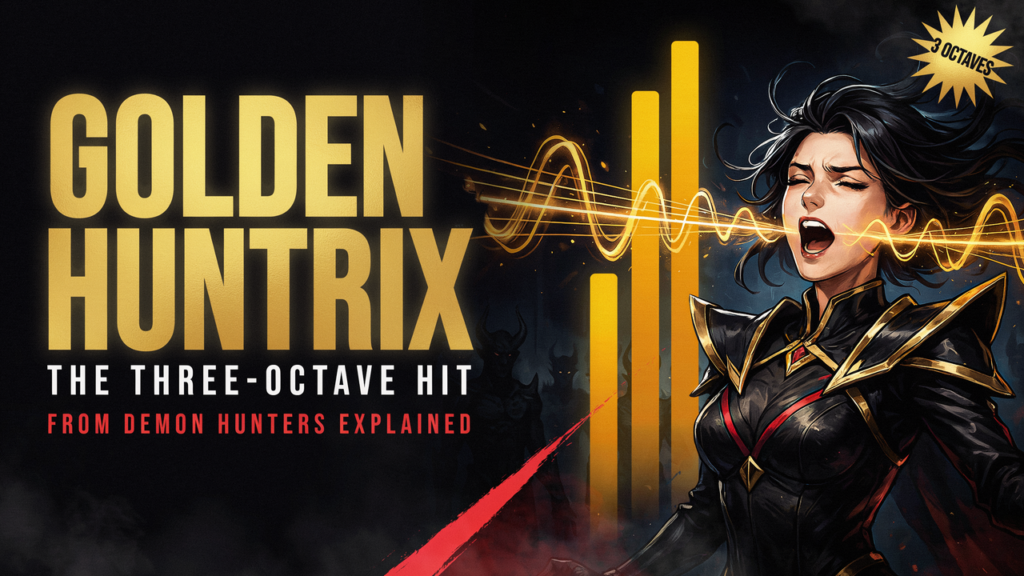
“Golden” Vocal Range at a Glance
Song vocal range: C3 – A5 (three octaves) Character vocalist: Rumi (voiced by EJAE) Voice type: Soprano High note: A5 (chorus climax) Low note: C3 (verse passages) — unusually low for a K-pop song Billboard Hot 100: Number one, eight consecutive weeks (2025)
The Vocal Demands of the Song
Music critic Lim Hee-yoon wrote that “the powerful high note reaching up to a high A in the third octave is rarely used in idol songs,” noting the A5 added “freshness” to the track’s sonic impact. The three-octave span from C3 to A5 is not a typical pop vocal range — most commercial K-pop sits in a much narrower window, prioritising melodic accessibility over technical ambition.
The range in “Golden” was a deliberate compositional choice. EJAE told Korea JoongAng Daily that she “intentionally wrote a challenging vocal line” to “reflect both Rumi’s vocal prowess and her fierce determination to seal the magical barrier of the Honmoon” — the fictional narrative in which the song exists. She added she “just followed where the melody took” her, suggesting the emotional logic of the song’s story drove the register choices as much as any technical calculation.
The result is a song that functions simultaneously as K-pop radio material and as a genuine vocal workout. The lower passages in the C3 range are, as NamuWiki notes, “so low that it is difficult to just take a single shot” for most female vocalists. Vocal trainers who analyzed the song noted it sits in “the low to mid 1 octave range, which is difficult for women.” The lowest note (D3 in the original before a two-key lowering in some versions) places the song’s floor in territory that a typical pop soprano simply can’t access with useful tone.
EJAE: The Voice Behind Rumi
EJAE — born Ellie Jae Kim, Korean-American, based in Brooklyn — is not a conventional pop star. She is primarily a vocal producer and arranger with songwriter credits for major K-pop acts including TWICE and Red Velvet, making her background in music production rather than solo performance. Her selection to voice Rumi was partly based on her ability to write and perform material that exceeded typical commercial pop demands.
Her performance on “Golden” has been widely praised by vocal coaches on TikTok and YouTube, with one coach (Rozette) calling the singers “STACKED” with “wildly skillful” technique, “sky-high notes, big juicy intervals, register switcheroos” and “stamina for days.” The Korea Herald noted that the result is “both technically impressive and emotionally resonant, a combination that has resonated with audiences far beyond the film.”
The range EJAE demonstrates in “Golden” — from C3 through to a sustained A5 — places her in soprano territory with an unusually developed lower register. The soprano vocal range page covers the voice type classifications that “Golden” tests at both ends.
The A5 High Note: Why It’s Remarkable
A5 — the A in the fifth octave — sits two semitones above soprano high C (C6 would be one octave above middle C’s high C, but A5 is below that — clarifying: A5 is the A above C5, which is above soprano middle C). To be precise: A5 is a note that sits in the upper fifth octave, in territory that requires either strong classical training or exceptional natural upper register facility to produce cleanly in performance.
The Washington Post’s Anne Branigin documented the song’s virality: its “popularity can be measured not just in its streaming numbers but also in the scores of covers (dance, vocal and instrumental) and passionate lip-synching videos that it has inspired on TikTok and Instagram.” The A5 specifically became a social media challenge — its difficulty driving both covers and commentary.
The highest vocal range page gives context for where an A5 sits within the documented range of soprano voices.
The Low C3: The Other Remarkable End
Less discussed than the A5 but arguably more unusual for a K-pop song is the low C3 — middle C’s lower neighbour — which sits in the lower part of the third octave. For most female pop singers, C3 territory produces thin, pressured tone rather than the warm resonance needed to carry a melodic phrase.
EJAE’s ability to produce usable, character-bearing tone in this lower register is part of what makes the three-octave span of “Golden” functionally rather than merely theoretically impressive. A note range that starts at C3 and ends at A5 only counts as three usable octaves if both ends of the range contribute meaningfully to the song’s emotional content — and in “Golden,” the lower passages create the intimacy and vulnerability that makes the A5 climax feel earned rather than arbitrary.
Cultural Impact and the Billboard Record
“Golden” became the first female K-pop song to reach #1 on the Billboard Hot 100. As of its eight-week run, Huntrix (as the credited artist) became the longest-running number-one girl group of the century on the chart. The achievement prompted Jimmy Fallon to present the real performers — EJAE, Rei Ami, and Audrey Nuna — with a plaque documenting the record during their Tonight Show appearance.
The trio performed “Golden” at the Snoop Dogg NFL Halftime Show (December 25, 2025) and appeared as surprise guests at Katseye’s Coachella 2026 performance, where they performed the song live. The fictional group’s songs — performed by real artists — had crossed fully into the mainstream of live music culture.
FAQs About Golden Huntrix Vocal Range
What is the vocal range of “Golden” by Huntrix?
The song spans C3 to A5 — three octaves. The low note (C3, or D3 in the original before transposition) sits in unusually low territory for a K-pop song; the high note (A5) is what Ars Technica described as “usually reserved for classically trained operatic sopranos.”
Who actually sings “Golden”?
The song is performed by EJAE (as Rumi), who also co-wrote and produced the soundtrack. Audrey Nuna and Rei Ami voice Mira and Zoey in the film’s fictional group Huntrix. EJAE is a Korean-American vocal producer and arranger based in Brooklyn, with previous songwriter credits for TWICE and Red Velvet.
Is Huntrix a real K-pop group?
No — Huntrix is the fictional K-pop girl group in Netflix’s animated film K-Pop Demon Hunters (released June 20, 2025). The real singers behind the characters are EJAE (Rumi), Audrey Nuna (Mira), and Rei Ami (Zoey).
Why did “Golden” go viral?
Multiple factors: the song’s unusually wide vocal range and technically demanding high note made it a cover challenge; the film’s K-pop cultural context gave it a built-in audience; and its crossover to American radio — with airplay impressions surging over 70% in a single week — brought it to listeners outside the K-pop fanbase. It was the first female K-pop song to hit #1 on the Billboard Hot 100.
How do I find out if my vocal range could handle “Golden”?
The song requires access to C3 at the low end and A5 at the high end — a significant range for any singer. The vocal range finder will map your range, and the singer comparison tool can show you how your range relates to the song’s demands.
Erika Parker is a vocal analysis and singing education writer at Vocal Range Test. She focuses on vocal range testing, voice type analysis, pitch recognition, and singing tools for vocalists, musicians, choir singers, and beginners.