
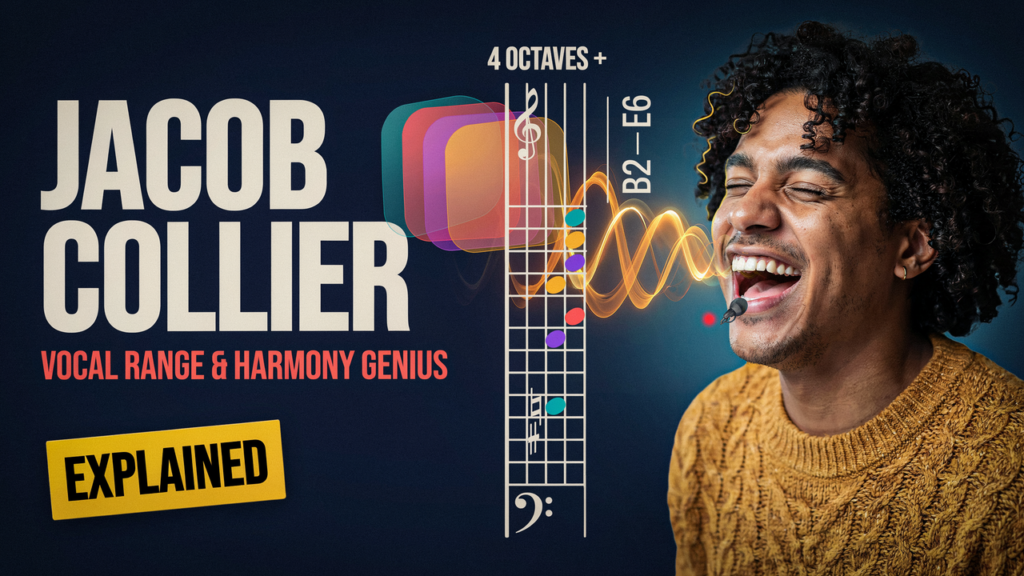
Jacob Collier’s vocal range spans approximately A1 to B5 — just over four octaves — with both extremes documented in his viral arrangement of Henry Mancini’s “Moon River.” Classic FM, drawing on documented recordings, reports “a reported vocal range of just over four octaves, spanning from around A1 (three ‘A’s below middle C) to B5 (two ‘B’s above middle C).” He won his sixth Grammy Award in 2024 at the age of 29, making him one of the youngest artists to reach that milestone.
Born on August 2, 1994 in North London to a multi-generational family of professional musicians — his mother Suzie is a violinist, conductor, and violin professor at the Junior Royal Academy of Music; his maternal grandfather taught at the Royal Academy of Music — Collier began uploading split-screen arrangement videos to YouTube in 2012 and was signed to Quincy Jones’ management by 2014. What Jones heard was a musical intelligence almost impossible to categorise: a singer, arranger, composer, and multi-instrumentalist who had taught himself eight or more instruments and developed a harmonic vocabulary that music academics and pop producers find equally compelling.
Jacob Collier’s Vocal Range at a Glance
Vocal range: approximately A1 – B5 (just over four octaves) Voice type: Countertenor / high lyric tenor (context-dependent) Vocal registers in use: Sub-bass, chest voice, mixed voice, falsetto/countertenor, head voice Approximate span: Just over 4 octaves Active career: 2012–present
What Voice Type Is Jacob Collier?
Voice type classification for Collier is genuinely difficult because he uses his instrument in ways that deliberately cross register boundaries rather than staying within them. In natural conversation and in the lower passages of his songs, his voice has a warm, mid-range quality consistent with a lyric tenor. In his upper register — the countertenor-adjacent falsetto that he uses for the high harmony parts in his arrangements — it sounds entirely different.
The four-octave span isn’t produced by a single, integrated classical voice type. It’s produced by a deliberately trained full-range instrument that accesses sub-bass, chest voice, mixed voice, and falsetto as separate tools in service of harmonic arrangements that require different voices to be stacked by the same person. Classic FM notes that he received vocal lessons from age eight to thirteen but is otherwise self-taught — which means his upper and lower extensions were developed not through classical voice training but through the practical demands of his arrangement work.
The most useful description is countertenor-adjacent high tenor in his primary register, with an unusually developed sub-bass extension at the other end. This isn’t a standard classification because it’s not a standard voice.
His Lower Register: A1 and the Sub-Bass Depth
A1 — three As below middle C — sits in basso profundo territory, below the standard bass range and approaching the floor of human vocal production. In his “Moon River” arrangement, Collier descends to A1 as the lowest documented note, producing the sub-bass resonance that anchors the arrangement’s harmonic foundation.
Like other singers who develop extreme low extensions (Avi Kaplan, Geoff Castellucci), these notes are audible on quality playback equipment and felt as vibration more than perceived as distinct pitch by many listeners. The difference with Collier is that the A1 isn’t the point of the performance — it’s one element of a harmonic architecture that spans four octaves in a single arrangement.
The bass vocal range page covers the low voice classifications that Collier’s lower register touches at its extremes.
His Upper Register: B5 and the Countertenor Flight
B5 — two Bs above middle C — sits in the high soprano zone, where only the most trained or naturally gifted sopranos operate comfortably. For a male voice to access B5 with clarity and control requires either a genuine countertenor instrument (in which the upper register is the natural home) or an exceptionally well-developed falsetto that maintains tonal quality at that height.
Collier’s upper register has a bright, clean quality that in context functions like a countertenor voice — the kind of vocal quality associated with male singers in early music who access soprano register territory. His “Moon River” arrangement and various YouTube covers demonstrate B5 with the same tonal confidence he shows in the mid-range.
Between A1 and B5 — a span of just over four octaves — Collier covers territory that would normally require multiple different singers to fill in a harmonic arrangement. The fact that one voice produces all of it in a single recording, stacked through home recording technology, is what made his early YouTube videos so striking.
The Harmonic Intelligence: More Than Range
Range is the least interesting thing about Jacob Collier’s voice, which is a sentence that needs unpacking.
His four-octave span is genuinely remarkable, but what distinguishes him in the musical world is not how far his voice goes but what he does with it harmonically. He works in “negative harmony” — a reharmonisation technique associated with theorist Ernst Levy, in which the tonal relationships in a chord progression are mirrored around a central axis, producing unusual but emotionally coherent harmonic movements. He uses microtonal intervals (notes between the standard semitones of Western equal temperament). He writes in unusual time signatures and polyrhythms. He stacks four, five, six, seven, or more vocal parts, each with its own harmonic function, into arrangements that music professors and composers describe as the most sophisticated in contemporary popular music.
All of this is vocal technique in the broadest sense — the ability to hear and produce precise intervals at any pitch across a four-octave span, with the intonation accuracy required to make complex chords sound in tune rather than merely approximately close.
Quincy Jones, upon discovering Collier’s YouTube videos, called him “one of the most talented musicians I have ever encountered in my 60 years in the music business” — a significant statement from someone who has worked with Michael Jackson, Frank Sinatra, and Miles Davis.
The Grammy Record
Collier has won six Grammy Awards as of 2024, in the following categories: Best Arrangement, Instruments and Vocals (twice), Best Engineered Album, Non-Classical, Best Traditional Pop Vocal Album, Best R&B Song, and Best Arrangement, Instruments and Vocals again. Winning his sixth at age 29 made him one of the youngest artists to reach that total.
The Grammy categories he has won span arrangement, engineering, production, and performance — reflecting the multi-disciplinary nature of his work rather than a single skill being recognised repeatedly.
Live Performance: The Audience as Choir
One of Collier’s most discussed live performance innovations is his habit of turning concert audiences into real-time choir members, directing them with hand signals to sing specific harmonies that he then harmonises above or below. Video documentation of this practice — audiences of thousands producing complex chords under his direction — has circulated widely and represents a specific vocal pedagogy in action: his ability to hear and direct harmony in real time, applied at scale.
This is a different demonstration of vocal intelligence than range: it requires knowing exactly what harmonic note is needed, hearing what the audience produces, and adjusting the live arrangement accordingly. It works because his ear is precise enough to function in real-time harmonic environments that most musicians couldn’t navigate.
FAQs About Jacob Collier’s Vocal Range
What is Jacob Collier’s vocal range?
Classic FM documents his range as “just over four octaves, spanning from around A1 to B5.” Both extremes are documented in his viral arrangement of Henry Mancini’s “Moon River.”
What voice type is Jacob Collier?
He defies standard classification. In his natural mid-range he functions as a lyric tenor; in his upper register he accesses countertenor-adjacent falsetto up to B5; in his lower register he has documented sub-bass extensions to A1. No single voice type label covers all of this — he is a deliberately full-range instrument.
How many Grammy Awards has Jacob Collier won?
Six, as of 2024. He won his first two in 2017 (age 22) for arrangements from his debut album In My Room, and his sixth in 2024 (age 29) for Best Arrangement, Instruments and Vocals. He has been nominated for ten Grammys in total.
Is Jacob Collier self-taught?
Largely, yes. He received vocal lessons from age eight to thirteen and participated in choral work, but taught himself more than eight instruments and developed his harmonic technique through self-directed study. His arrangement approach, including his use of negative harmony and microtonality, was developed independently rather than through formal instruction.
What did Quincy Jones say about Jacob Collier?
Upon discovering Collier’s YouTube videos, Jones called him “one of the most talented musicians I have ever encountered in my 60 years in the music business” and subsequently signed him to his management company. Collier’s debut album In My Room (2016) was released under Quincy Jones Productions.
Erika Parker is a vocal analysis and singing education writer at Vocal Range Test. She focuses on vocal range testing, voice type analysis, pitch recognition, and singing tools for vocalists, musicians, choir singers, and beginners.